Chinese solar energy equipment manufacturer Suzhou Maxwell Technologies has claimed a power conversion efficiency of 32.38% for a perovskite/silicon tandem heterojunction technology (HJT) solar cell.
The result was certified by China’s National Institute of Metrology (NIM) on a G12H (210mm*105mm) commercial-size cell and was achieved using the company’s in-house developed, mass-producible equipment and processes. The company claimed the milestone validates the readiness of its tandem cell manufacturing technology for large-scale deployment.
Try Premium for just $1
- Full premium access for the first month at only $1
- Converts to an annual rate after 30 days unless cancelled
- Cancel anytime during the trial period
Premium Benefits
- Expert industry analysis and interviews
- Digital access to PV Tech Power journal
- Exclusive event discounts
Or get the full Premium subscription right away
Or continue reading this article for free
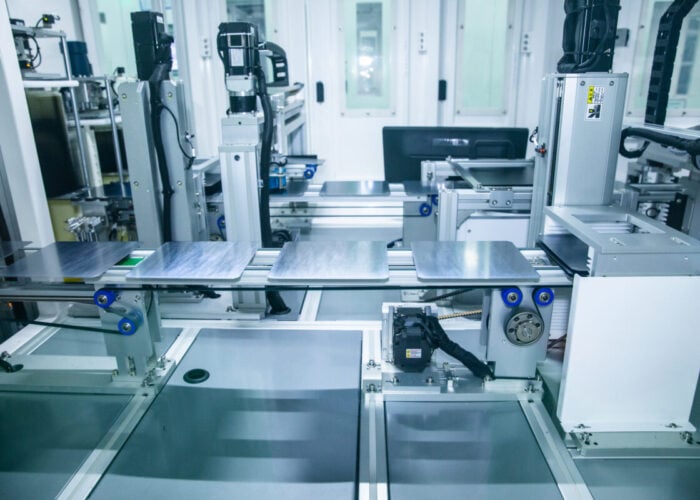
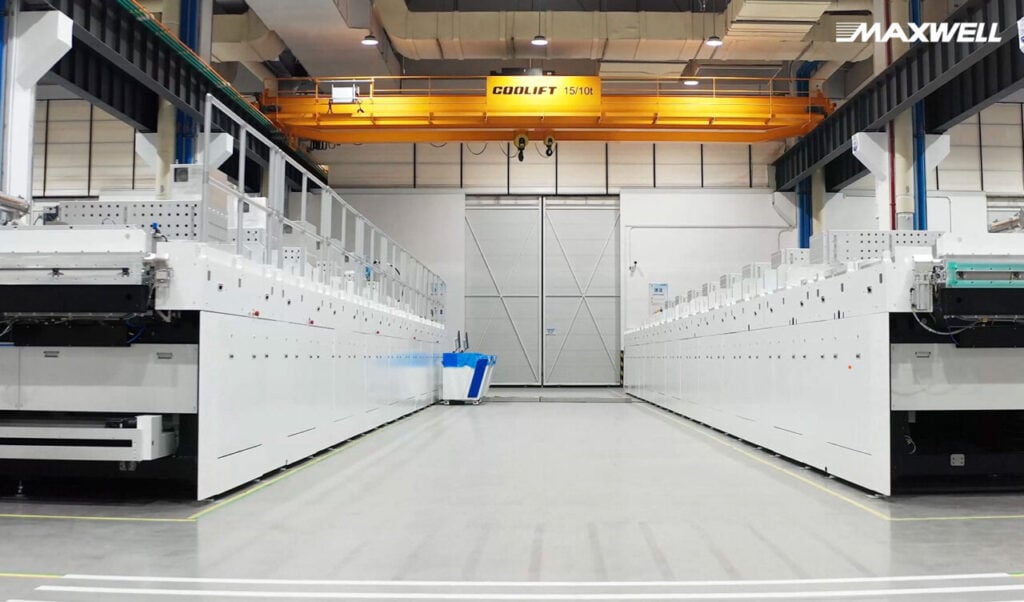
The high-efficiency device is designed for large-area, full-coverage cells with an annual capacity of 200MW. The process integrates high-uniformity plasma-enhanced chemical vapor deposition (PECVD) and physical vapor deposition (PVD) vacuum coating, pre-deposition printing to reduce material costs, high-throughput inkjet printing, and plate-type temporal atomic layer deposition (ALD). According to the company, all tools, materials and processes are compatible with industrial mass production.
Nobody in the solar industry has yet produced perovskite-silicon tandem products at an industrial scale, due chiefly to the volatility of perovskite materials which are highly reactive to moisture, light and air. PV Tech has covered the technology and efforts to commercialise it in depth here.
Additionally, in collaboration with Soochow University and Beijing University of Technology, the company recently published research in Nature demonstrating a flexible perovskite/HJT tandem solar cell with a certified efficiency of 33.6%. The work addresses efficiency and stability challenges in flexible tandem devices, with potential applications in building-integrated photovoltaics and aerospace.
Separately, Maxwell’s joint research with Soochow University and Nanchang University published in Advanced Materials detailed a low-cost solution-processed perovskite approach for fully textured SHJ cells. According to the firm, the combination of certified efficiency records and peer-reviewed research highlights its strategy of advancing both tandem cell industrialisation and next-generation PV innovation.