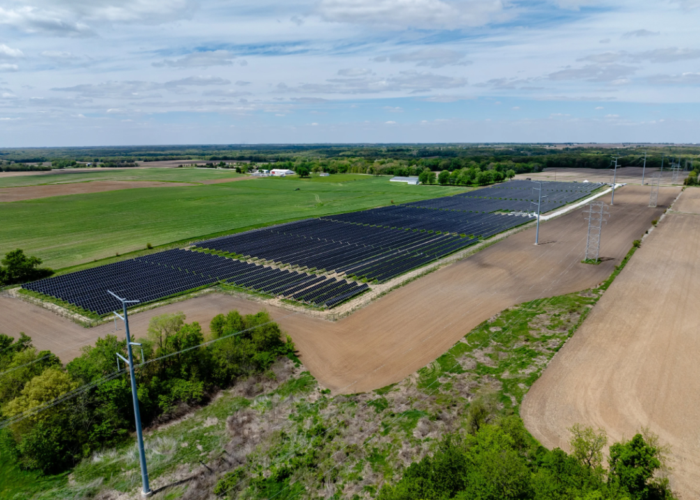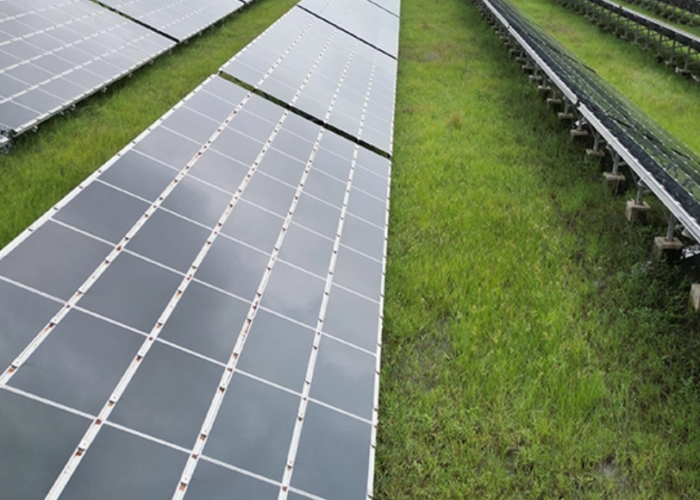
Mint Renewables has referred the Magpie Hill Solar Farm, a hybrid solar-plus-storage development with a capacity of up to 375MW paired with a 375MW/3,000MWh battery energy storage system (BESS), to Australia’s Environment Protection and Biodiversity Conservation (EPBC) Act.
The project would be built on a 1,221.78-hectare site of freehold farmland 6km southwest of Tarago and 17km northeast of Bungendore, New South Wales, split by the Mulwaree River into northern and southern sections across the Goulburn Mulwaree and Queanbeyan-Palerang council areas.
Try Premium for just $1
- Full premium access for the first month at only $1
- Converts to an annual rate after 30 days unless cancelled
- Cancel anytime during the trial period
Premium Benefits
- Expert industry analysis and interviews
- Digital access to PV Tech Power journal
- Exclusive event discounts
Or get the full Premium subscription right away
Or continue reading this article for free
Mint Renewables initially scoped the project at up to 450MW with a matching 450MW/3,600MWh BESS to allow for future changes in battery technology, before revising the solar generation capacity down to 375MW following further design review.
The project would connect to an existing 330kV overhead transmission line at the southwest corner of the site, which the proponent says has sufficient capacity to connect Magpie Hill to the National Electricity Market (NEM).
Construction is anticipated to begin in mid-2028 and take around 24 months, with operations expected to commence in mid-2030 and continue for 30 to 35 years. Peak construction is expected to employ around 328 full-time equivalent workers, with roughly 10 required for ongoing operations and maintenance.
In its referral, Mint Renewables described an “urgent need to develop and connect new sources of dispatchable renewable energy in NSW” as the state’s grid continues to shift away from coal-fired generation, positioning solar-plus storage hybrids as well-suited to storing daytime generation for release during evening and morning demand peaks.
The referral’s ecological assessment found no EPBC-listed threatened fauna species and only one threatened flora species, Black Gum, recorded within the project area, with the design avoiding all eight identified Black Gum trees through a 30-metre buffer.
A separate planted population of Paddy’s River Box, a tree species that is also EPBC-listed, will be avoided entirely, with the proponent noting that these individuals sit outside the species’ natural range and are unlikely to represent an important population.
Potential habitat remains for the Striped Legless Lizard, with additional targeted surveys planned for spring/summer 2026 to confirm the species’ absence, though expert consultation to date suggests a significant impact is unlikely.
Mint Renewables’ design has already shifted in response to environmental and community feedback, removing around 15 hectares of habitat correlating with a critically endangered ecological community in the project’s northeast and relocating the proposed BESS location north after preliminary noise assessment found compliance could not be achieved at its original site near the grid connection point.
The proponent has committed to a 100-metre exclusion buffer around the Mulwaree River and will proceed with only one of two possible river crossings to link the site’s northern and southern sections.
Part of a wider wave of large storage projects moving through Australia’s EPBC process
Magpie Hill is not Mint Renewables’ first project to draw regulatory and community attention in the current storage build-out.
The company’s 200MW/400MWh Dederang BESS in northeast Victoria was fast-tracked by the Victorian government’s Development Facilitation Program in 2025, despite opposition from the local Alpine Shire Council, and sits within the Ovens Murray Renewable Energy Zone (REZ) alongside Trina Solar’s proposed 500MW/1,000MWh Kiewa Valley BESS.
Last month, Windlab and Squadron Energy referred the Bungaban Solar Project to the EPBC Act, a 500MW solar facility paired with a 500MW BESS in Queensland’s Western Downs region, anchored by an offtake agreement supplying around 80% of output to Rio Tinto.
That project forms part of Windlab’s broader South Queensland Renewable Generation Hub, developed in partnership with Squadron Energy following the latter’s completion of an AU$2.7 billion (US$1.93 billion) portfolio refinancing designed to support expansion into battery storage and hybrid assets.
The volume of large-scale renewable energy and storage projects entering the EPBC process has drawn scrutiny from industry bodies over implementation speed.
The Clean Energy Investor Group recently called for faster, more consistent decisions under the reformed Act, representing developers and investors with more than 16GW of installed capacity and a project pipeline exceeding 46GW nationally, warning that ongoing gaps in National Environmental Standards, an offsets calculator and a formal definition of “net gain” risk slowing the pipeline of projects, including hybrids like Magpie Hill, that Australia needs to replace retiring coal generation.