The shifting US policy landscape has successfully reduced reliance on solar module imports from a number of Southeast Asian countries, but more work needs to be done to encourage domestic manufacturing deployment to completely fill this gap.
This is a takeaway from Crux’s latest report into the US clean energy supply chain, covering shipment and manufacturing announcements across a number of clean energy technologies. Published this week, ‘The State of the Clean Economy Supply Chain’ makes immediately clear that efforts to onshore US renewable energy manufacturing capacity have been a “success” story, pointing to the successes of policies such as the 45X advanced manufacturing tax credit that have encouraged investment in domestic manufacturing.
Try Premium for just $1
- Full premium access for the first month at only $1
- Converts to an annual rate after 30 days unless cancelled
- Cancel anytime during the trial period
Premium Benefits
- Expert industry analysis and interviews
- Digital access to PV Tech Power journal
- Exclusive event discounts
Or get the full Premium subscription right away
Or continue reading this article for free
The report also notes that advances in US solar manufacturing, and foreign policies such as the anti-dumping and countervailing duties (AD/CVDs), have helped reduce reliance on the import of solar components from several countries. Crux notes that in the first half of 2024, four Southeast Asian countries were responsible for 86% of US crystalline silicon (c-Si) imports, but that this figure fell to just 2% in the first half of this year, with the Department of Commerce (DOC) conducting several AD/CVD investigations in this part of the world.
For India, Indonesia and Laos in particular, the targets of the most recent AD/CVD investigations, their contribution to US module imports has risen and fallen spectacularly. These countries accounted for 9% of US c-Si modules in the first half of 2024, before jumping to 72% as AD/CVD investigations advanced in other countries, before coming back down to 19% by the first half of 2026 as the investigations began to target these countries.
This all comes as the total value of solar imports to the US has fallen over the last two years. As shown in the graph below, taken from the Crux report, import value fell from a peak of over US$6 billion in 2024 to less than US$4 billion in the second quarter of this year.
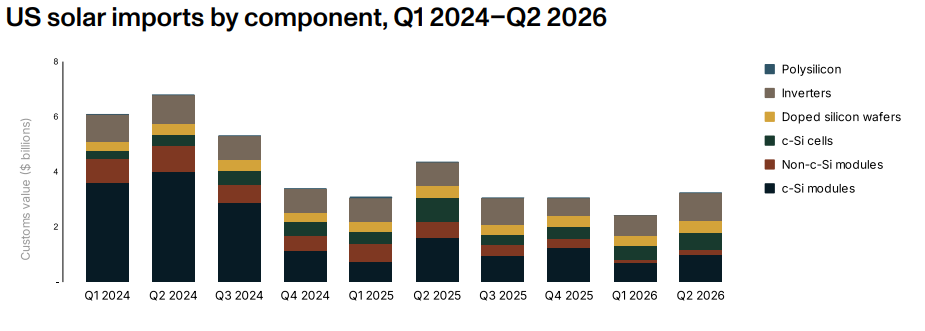
There is also a notable disparity in the value of different parts of the solar supply chain that the US is currently importing, which reflects how the domestic manufacturing picture has changed. In the first half of 2024, modules accounted for 73% of the value of all solar imports; by the first half of 2026, this fell to 35%. This translates to a fall in value from US$7.6 billion to US$1.7 billion, and reflects how the US has been able to build new module manufacturing capacity more successfully than other parts of the solar supply chain.
The US has also made efforts to address this balance through investments made into other parts of the supply chain. The Crux report shows that, as of the second quarter of this year, companies have announced US$7.3 billion in new US module facilities, a smaller figure than the leading US$8.9 billion announced in new cell investments.
Gaps remain in the domestic supply chain
While the billions of dollars of new manufacturing capacity investment is a positive step, the Crux report notes that the US is not in a position of complete supply chain independence. Even the announced investment figures “overstate the footprint,” according to the report; US$2.1 billion has been announced in new ingot and wafer facilities, but all of this is tied up in the work of a single company, Corning, so US production of ingots and wafers is by no means expansive.
Even in modules, where the US has had some success in building enough new manufacturing capacity to meet current demand, it has not necessarily done enough to meet future demand growth. As a result, even for modules, the US remains reliant on overseas imports, and the plethora of AD/CVD investigations means that, rather than eliminating imports of modules entirely, US buyers are now forced to look elsewhere.
The graph below shows how different countries accounted for the US’ module imports in the first half of 2024 and the first half of 2026. While the most influential countries in 2024—Vietnam and Thailand, which collectively accounted for over two-thirds of US module imports—saw their influence reduced to a negligible amount in 2026, US buyers have instead shifted their attention to countries like the Philippines and Ethiopia.
Considering the DOC has started an AD/CVD investigation into Ethiopian cell production, there is a risk that any new source of overseas modules will eventually be subject to AD/CVD investigations, affecting supply at a time when US manufacturers cannot yet plug the gap.
While Ethiopia is a new participant in US cell imports—its contribution to US cell purchases jumped from nothing in 2024 to 13.5% in 2026—there is more stability in the US’ primary cell provider, South Korea. South Korean cells accounted for 39.1% of US imports in the first half of 2024 and 35.9% in the first half of 2026, and earlier this year Crux head of policy Hasan Nazar told PV Tech Premium that countries such as South Korea could be an essential part of ‘friend-shoring’, an initiative to source key components not yet produced in the US from allied nations.
The Crux report also included a survey component, asking 75 organisations involved in development, supply or manufacturing of key components in the US for their opinions on the current supply chain landscape. The survey reported that “firms are absorbing tariff costs” rather than switching suppliers, due to a lack of domestic supply and concerns over the long-term viability of sourcing components from overseas manufacturers, showing how the combination of tariffs and AD/CVD investigations are creating challenging economic conditions for US project developers.
Indeed, 89% of survey respondents said that at least some of their tariff-exposed inputs “have no domestic substitute that is available at a competitive price,” and 47% said that an absence of a domestic producer at sufficient scale is the “single biggest barrier” to robust domestic supply.
Crux calls for ‘holistic’ policy approach
Most of the new US manufacturing capacity can be tied to the strength of incentivising policies like the 45X tax credit, while there are certainly some benefits to foreign policies like the AD/CVD investigations that dissuade reliance on foreign products. The survey’s respondents said that a “holistic” approach, combining both types of policy, would be to the benefit of the industry as a whole.
“A holistic carrot-and-stick approach works where neither instrument succeeds alone, and sequencing matters as much as the mix,” reads the Crux report. “Cutting off Chinese supply before sufficient domestic or allied alternatives are available can put project financeability at risk.”
When asked about the most important parts of the supply chain that could be covered by these policies, the survey respondents, perhaps unsurprisingly, pointed to areas where the US lacks robust domestic supply. A total of 29% of respondents said that wafers and ingots would be the “highest priority” for inclusion in 45X coverage, followed by 16% who said polysilicon.
Read more of our coverage of the US policy landscape in our monthly editor’s blog series; the most recent edition looked at the Indian AD/CVD investigations and bans on power equipment produced overseas.
The US policy landscape will be discussed in more detail at the PV CellTech USA conference on 13-14 October 2026. Read the full agenda here and book tickets on the event website.