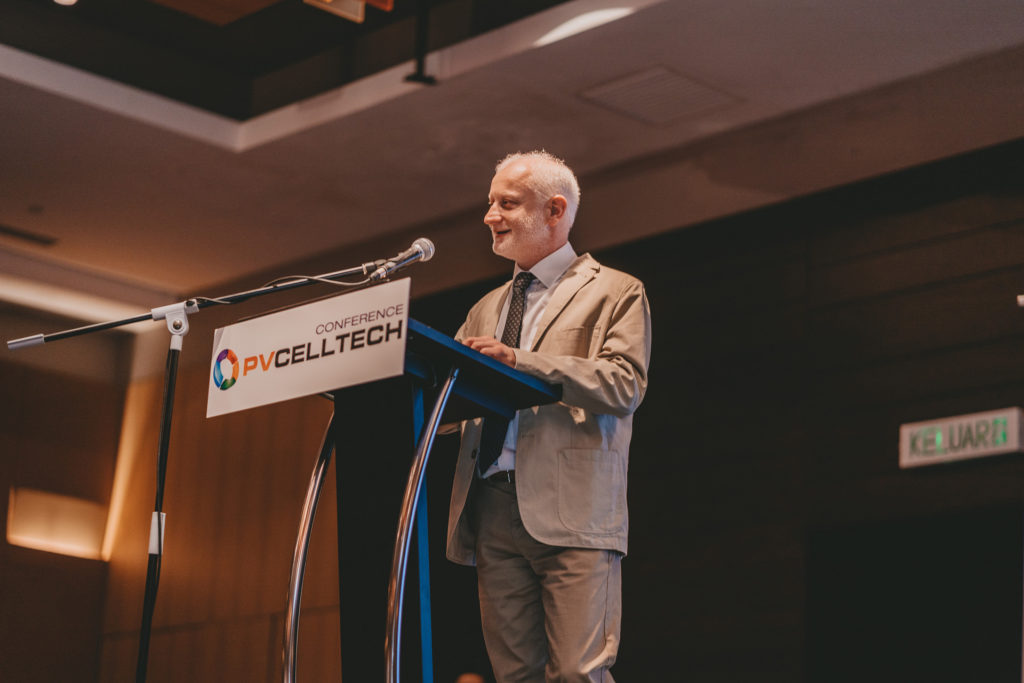
“Cell factory creation will ultimately be the determining factor to assess how successful the US government policy will be,” Finlay Colville, head of research at PV Tech has said ahead of the PV CellTech USA conference in San Francisco next week.
“Bringing new cell factories online in the US would represent a pivotal moment,” Colville said in a statement today. “The solar industry right now is suffering due to a severe manufacturing downturn, expected to extend into 2026, which will likely reshape the production landscape globally.”
Try Premium for just $1
- Full premium access for the first month at only $1
- Converts to an annual rate after 30 days unless cancelled
- Cancel anytime during the trial period
Premium Benefits
- Expert industry analysis and interviews
- Digital access to PV Tech Power journal
- Exclusive event discounts
Or get the full Premium subscription right away
Or continue reading this article for free
Colville first forecasted a downturn in November 2023 in a blog for PV Tech, which predicted that capital expenditure for new manufacturing plants would drop off and many companies would slip into the red financially as capacities surged and prices collapsed. He updated and extended that prediction last month and said that the downturn is set to run into 2026.
Concurrently, efforts have been ramping up to bring solar manufacturing capacity to the US. So far, most of that has been for module assembly, which Colville said is “progressing steadily.” Cell production capacity has lagged behind.
“The required investment and technical know-how [for establishing cell capacity] is significantly more complex and substantial [than modules]”, Colville said.
This disparity has created a lot of political noise in recent months as various coalitions of US solar manufacturers have lobbied for greater support for upstream manufacturing. The Solar Energy Manufacturers for America (SEMA) coalition, headed up by ex-Department of Energy Advisor Michael Carr, has repeatedly called for expansions to the manufacturing provisions under the Inflation Reduction Act (IRA) and identified what it called “glaring gaps” in US production of cells, wafers and ingots.

Early this year, PV Tech Premium explored the difficulties facing US efforts to bring upstream manufacturing capacity onshore.
There are plans for cell capacity in the US from Korean-owned Hanwha Qcells, US producer Silfab and Canadian-owned manufacturer Heliene among others, but the country is still overwhelmingly reliant on imports.
In a statement ahead of the PV CellTech USA event, Colville said: “Excluding thin-film panel technology from US-based First Solar – the only non-silicon provider – China’s Southeast Asia hubs account for 85 per cent of production, emphasising the critical need for cell fabrication in the United States.”
There is now growing pressure on that Southeast Asian cell supply, too. This week the Department of Commerce’s (DOC) International Trade Commission (ITC) released a preliminary determination of countervailing duties (CVD) for some solar cell manufacturers in the region. The preliminary determination will apply varying rates of tariffs which could bring uncertainty into the US solar industry and restrict some imports of solar cells to the market.