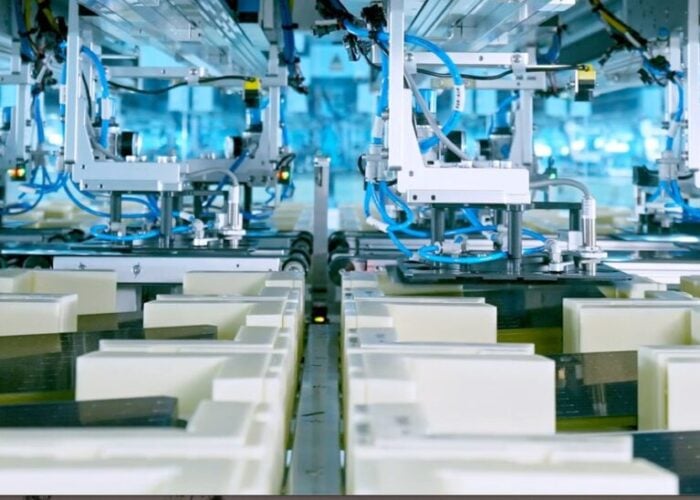
Product Briefing Outline: SOMONT, a subsidiary of 3S Industries AG, has had success with the RAPID stringer and lay-up systems for high throughput cell stringing in module production with capacity ranges of 10-40MW per year. However, a new stringing system, CERTUS, has been developed for production capacities from 50-100MW per year.
Problem: The need to balance between higher level module capacity, to reduce overall manufacturing costs and to enable higher throughputs of individual tools while retaining the smallest environmental footprint requires a fresh approach to every process step in assembly production.
Try Premium for just $1
- Full premium access for the first month at only $1
- Converts to an annual rate after 30 days unless cancelled
- Cancel anytime during the trial period
Premium Benefits
- Expert industry analysis and interviews
- Digital access to PV Tech Power journal
- Exclusive event discounts
Or get the full Premium subscription right away
Or continue reading this article for free
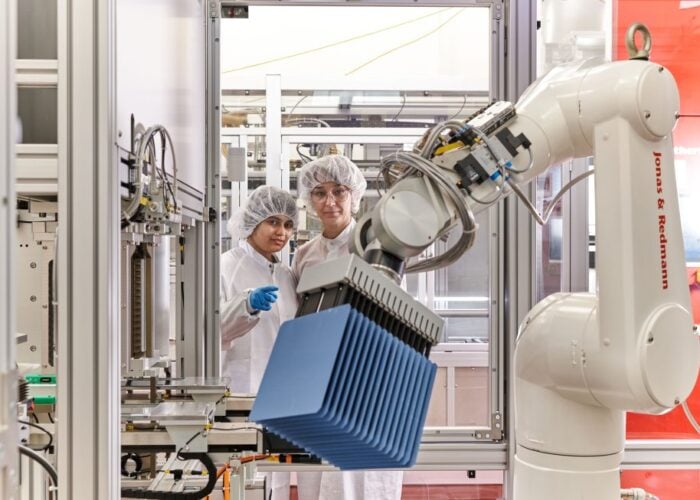
Solution: The CERTUS utilizes a modular concept to match the desired capacity requirements that integrates all the elements needed at the front-end of the module production line. New, state-of-the art technology for the stringer includes in-line string testing, matrix lay-up, interconnection, matrix testing and lay-up on the glass plate. It has a new technology that applies flux on to the ribbons. Improved cell handling and new temperature management for the unique soft touch soldering process are all help increase the throughputs. After cell soldering, the entire string is tested with a new, in-line test system consisting of a 3-D camera, flasher and dark current measurement. Only strings matching the required specifications are forwarded with a special transport system to the matrix lay-up station. After completion of the lay-up, the entire matrix is forwarded to the interconnection station that handles the required ribbons and soldering. The completed matrix is tested once again and carefully placed on the glass plate. The entire stringer is compact, with a sleek design.
Applications: Cell stringing in module production.
Platform: The new CERTUS can be configured with a series of options as well as integrated in existing module production lines.
Availability: September 2009.