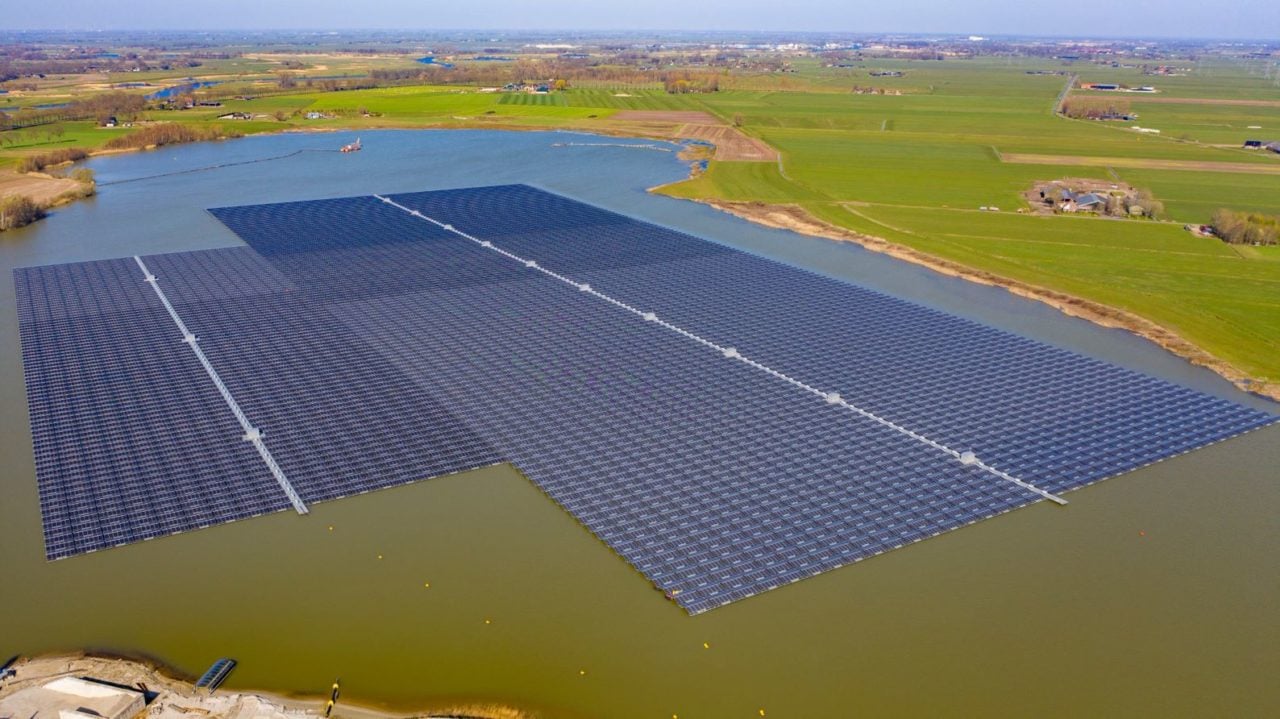
Driven by increased investor interest and a growing project pipeline, utility-scale floating solar installations are set to take off globally over the next few years, a report from Fitch Solutions says.
The consultancy estimates that nearly 10GW of new floating solar capacity will be installed in the next five years, with Asian markets such as China, South Korea, India, Thailand and Vietnam expected to outperform.
Try Premium for just $1
- Full premium access for the first month at only $1
- Converts to an annual rate after 30 days unless cancelled
- Cancel anytime during the trial period
Premium Benefits
- Expert industry analysis and interviews
- Digital access to PV Tech Power journal
- Exclusive event discounts
Or get the full Premium subscription right away
Or continue reading this article for free
While floating PV has been available for more than a decade, the report notes that a lack of knowledge and standards, in areas such as environmental impacts and regulations, have made projects relatively high risk. The technology is said to have remained under utilised, with less than 3GW installed globally by year-end 2019 – less than 1% of installed solar capacity around the world.
However, falling costs, a range of successful pilot projects and a better understanding of the benefits are leading to a growing interest and use of the technology.
When installed on reservoirs, Fitch highlights floating PV's potential to reduce water evaporation and limit algae growth, while the water can have a cooling effect on the panels, increasing energy yield at some sites. Meanwhile, the co-location of floating solar farms with hydropower projects means that transmission and distribution infrastructure is already in place, removing some construction costs related to connecting to the grid.
The report reveals that while some Asian countries have land constraints for ground-mounted solar due to unsuitable terrain, coastal regions or large bodies of water such as the Mekong could be used to grow floating PV's capacity.
A Fitch database of floating solar parks over 50MW contains 16 projects, totalling more than 11GW of additional solar capacity, that are either in the planning stages or under construction. Asia dominates the technology’s project pipeline, with the region accounting for 14 of the 16 projects.
The continent is home to the world’s current largest floating PV facility, the 320MW Cixi plant in China, while construction of a 2.1GW project in South Korea is underway. Activity is also picking up in India, where power companies Damodar Valley Corporation and NTPC are both looking to develop extensive floating PV portfolios.
Outside Asia, Fitch notes a growing interest in the technology in countries such as Brazil, Tunisia, France and the US, with many projects falling below the firm’s 50MW threshold to be included in its database.
The adoption of floating solar projects is said to have been relatively slow in the US given the wide availability of land for ground-mounted solar projects. While projects are relatively small in size, with the largest being a 4.4.MW plant installed in New Jersey in 2019, Fitch expects to see continued interest in the technology and sees high potential in the country.