Trina Solar hits 23.39% efficiency for ‘industrial’ PERC cell

March 9, 2020
Facebook
Twitter
LinkedIn
Reddit
Email
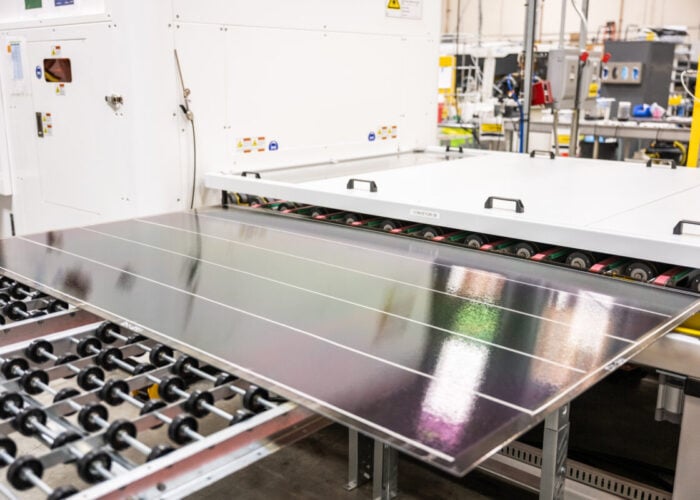
The cell was fabricated at Trina Solar’s State Key Laboratory (SKL) of PV Science and Technology (PVST),  using manufacturing equipment typically seen in standard volume production lines. It has an area of 252 sq cm with nine busbars. Image: Trina Solar

‘Solar Module Super League’ (SMSL) member Trina Solar has produced a bifacial Passivated Emitter Rear Cell (PERC) conversion efficiency of 23.39% using conventional ‘industrial’ manufacturing equipment, believed to be the highest figure to date. The cell was calibrated at ISFH CalTeC.

The cell was fabricated at Trina Solar’s State Key Laboratory (SKL) of PV Science and Technology (PVST),  using manufacturing equipment typically seen in standard volume production lines. It has an area of 252 sq cm with nine busbars.

This article requires Premium SubscriptionBasic (FREE) Subscription

Try Premium for just $1

  • Full premium access for the first month at only $1
  • Converts to an annual rate after 30 days unless cancelled
  • Cancel anytime during the trial period

Premium Benefits

  • Expert industry analysis and interviews
  • Digital access to PV Tech Power journal
  • Exclusive event discounts

Or get the full Premium subscription right away

Or continue reading this article for free

“Progress in PERC cell manufacturing is continuing to be very fast in the whole PV industry”, said Dr. Zhiqiang Feng, the vice president of Trina Solar and the director of SKL, “and we are delighted to announce that our R&D team is at the forefront”.

Dr. Yang Yang, the director of the PERC research group at SKL, added: “Our aim is to develop processes that can be transferred to production, therefore we decided to fabricate such champion PERC cells purely on equipment that is part of standard manufacturing lines, like metallization with standard screen-printers”.

Trina’s principal scientist Dr. Pietro P. Altermatt said: “Each world record refers to a certain category, like ‘laboratory cell’, or ‘cast material’. There is no precisely defined category ‘industrial cell’ because equipment in mass production evolves over time, and it is difficult to provide evidence of exactly how the reported cell was processed. Sometimes, higher PERC cell efficiencies are announced, but without stating details about metallization, or whether passivating contacts were used. This makes it difficult to assess progress in the field. This is why we are open about our manufacturing details”.

Trina Solar noted that the only difference to a mass production version of the cell was in the deposition of the antireflection coating, which was adjusted to improve light trapping properties during calibration in air as the cell has when encapsulated in a module. 
13 October 2026
San Francisco Bay Area, USA
PV Tech has been running an annual PV CellTech Conference since 2016. PV CellTech USA, on 13-14 October 2026 is our third PV CellTech conference dedicated to the U.S. manufacturing sector. The events in 2023, 2024 and 2025 were a sell out success and 2026 will once again gather the key stakeholders from PV manufacturing, equipment/materials, policy-making and strategy, capital equipment investment and all interested downstream channels and third-party entities. The goal is simple: to map out PV manufacturing in the U.S. out to 2030 and beyond.

Read Next

March 10, 2026
A roundup of European solar stories, with developments from Sonnedix, Helleniq, Nuveen Infrastructure and Nord/LB.
March 9, 2026
The latest domestic solar-grade polysilicon transaction prices from the Silicon Industry Branch of the China Nonferrous Metals Industry Association show that all domestic n-type solar-grade polysilicon products have plunged, with steep declines across the board.
March 9, 2026
Hanwha Qcells has resumed normal production at its solar module assembly plants in the US state of Georgia after some of its products were detained by US customs.
March 6, 2026
US solar manufacturer Silfab Solar has disputed some reports of chemical spillages at its manufacturing facility in Fort Mill, South Carolina.
March 6, 2026
Silfab solar has paused operations at its module manufacturing plant in South Carolina following chemical spills.
Premium
March 5, 2026
Analysis: Just as the energy crisis following Russia’s invasion of Ukraine led to a European pivot on clean energy, the US-Israel war on Iran presents another potential turning point, this time with a wider global reach.

Upcoming Events

Solar Media Events
March 24, 2026
Dallas, Texas
Solar Media Events
April 15, 2026
Milan, Italy
Solar Media Events
June 16, 2026
Napa, USA
Solar Media Events
October 13, 2026
San Francisco Bay Area, USA
Solar Media Events
November 3, 2026
Málaga, Spain