In June, China’s leading module manufacturers were locked in a new round of competition. Companies including Trina Solar, Jinko, LONGi and JA Solar frequently showcased their R&D prowess through record-breaking feats, aiming to outpace rivals.
On 10 June, JA Solar announced that its n-type TOPCon module had achieved a conversion efficiency of 25.5%, with front-side power output exceeding 700W.
Try Premium for just $1
- Full premium access for the first month at only $1
- Converts to an annual rate after 30 days unless cancelled
- Cancel anytime during the trial period
Premium Benefits
- Expert industry analysis and interviews
- Digital access to PV Tech Power journal
- Exclusive event discounts
Or get the full Premium subscription right away
Or continue reading this article for free
Just two weeks later, Jinko Solar announced that, per third-party testing and certification, its subsidiary Zhejiang Jinko had independently developed an n-type TOPCon high-efficiency PV module with a peak conversion efficiency of 25.58%, thereby breaking JA Solar’s previous world record for such modules.
On the broken world record, JA Solar said that technological competition would continue. The company’s plan outlines a structured progression in cell and module efficiency: cell efficiency is set to increase by at least 0.6% annually and module efficiency by at least 0.5%.
Trina Solar has also made notable strides in setting world records for TOPCon cell and module conversion efficiency. Last November, the company announced that its self-developed high-efficiency n-type bifacial i-TOPCon cell had achieved a certified peak efficiency of 26.58%, setting a new world record for TOPCon cell efficiency at the time.
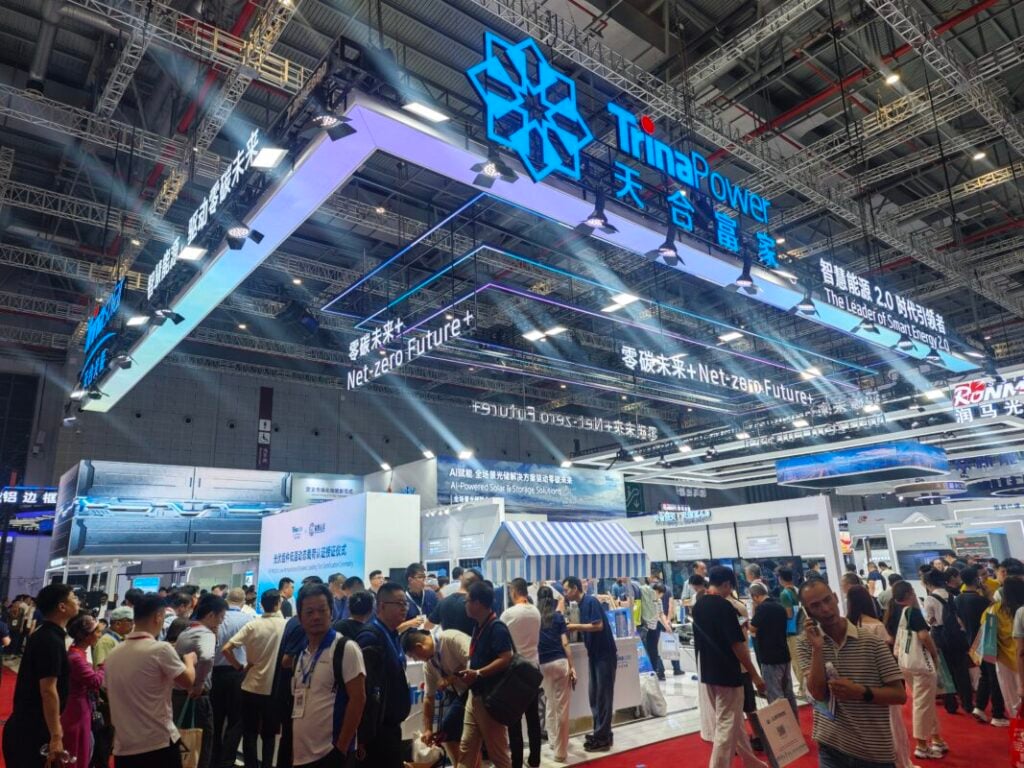
This year, Trina Solar has been showcasing its cutting-edge R&D capabilities primarily through tandem technology. In June, the company announced that its perovskite/c-Si shingled module had achieved a conversion efficiency of 30.6% and a power output of 829W – both breaking world records. Specifically, a 1185cm² lab shingled module achieved an efficiency of 30.6%, making Trina Solar the first global PV company to surpass the 30% efficiency threshold for shingled modules. At the SNEC expo, the company further announced that its perovskite/c-Si shingled module had reached a power output of 841.5W, setting yet another world record.
A disruptive technological leap
Theoretical efficiency limit stands at 28.7%, with 27% achievable in mass production. Currently, TOPCon cells have reached an efficiency of around 27%. With further advancements in passivation technology, they may even exceed 28%. However, to achieve further breakthroughs, tandem technology will be indispensable.
Jinko’s latest TOPCon module set a new world record, achieving a 0.08% efficiency increase. As Jin Hao explained, at the module level, the company integrated multiple key innovations and cutting-edge designs, which include encapsulant patterning, SMBB (super multi-busbar), and reflective film to attain a module conversion efficiency of 25.58%.
TOPCon represents the mainstream technological path in the Nntype PV era. Among China’s leading module manufacturers, JA Solar, Jinko and Trina Solar are primarily focused on this technology, whereas LONGi and Aiko Solar chiefly promote back-contact (BC) technology.
In terms of efficiency, LONGi has also made competitive breakthroughs, concurrently announcing new efficiency records. First, its self-developed large-area (260.9cm²) c-Si-perovskite tandem solar cell was certified by the U.S. National Renewable Energy Laboratory (NREL) to have a conversion efficiency of 33%, thereby setting a new global record for large-area tandem cell efficiency. Second, the efficiency of its BC modules exceeded 26%. Both achievements were featured in the 66th edition of the Solar Cell Efficiency Tables.
While higher conversion efficiency directly lowers power plant system investment costs and levelised cost of electricity (LCOE), world records are typically set in lab-developed products. Due to challenges in high-efficiency module reliability and manufacturing costs, a gap remains in scaling these technologies to mass production.
Currently, the PV industry is witnessing concurrent advancements across multiple technological routes, thereby intensifying competition among companies. Some firms, such as Aiko Solar, are accelerating the transition from lab-breaking innovations to mass production in their chosen technological trajectories, aiming to shorten product iteration cycles.
Aiko Solar chairman Chen Gang said: “Aiko’s n-type ABC [all back contact] modules are not merely about lab efficiency; we prioritise tangible mass-production efficiency. At the June SNEC Expo, Aiko launched its full-screen module, which achieved a field efficiency of over 25%. Mass production is slated for Q4 of this year. Aiko has ranked first in global mass-production module efficiency for 17 consecutive months, maintaining a 1% absolute efficiency edge over competing technologies.”
Chen Gang emphasized: “The successful mass adoption of new technologies hinges on three conditions: first, technical feasibility; second, quality excellence; third, cost-effectiveness.”
He elaborated that during the mass production of Aiko Solar’s ABC technology, the team developed several key low-cost, high-volume manufacturing technologies. For instance, in cell production, Aiko pioneered innovations in cell architecture, patterning, and silver-free metallisation—all of which have been successfully deployed in mass production.
On the future path of PV technology, Chen Gang noted that tandem and perovskite technologies face significant challenges in achieving reliable high-volume production in the short term. “We urge scientists and PV experts to explore alternative technologies—including photon multiplication, photon recycling and silicon-silicon tandem cells—until we ultimately reach our ideal objective: the Carnot limit efficiency of 95%.”