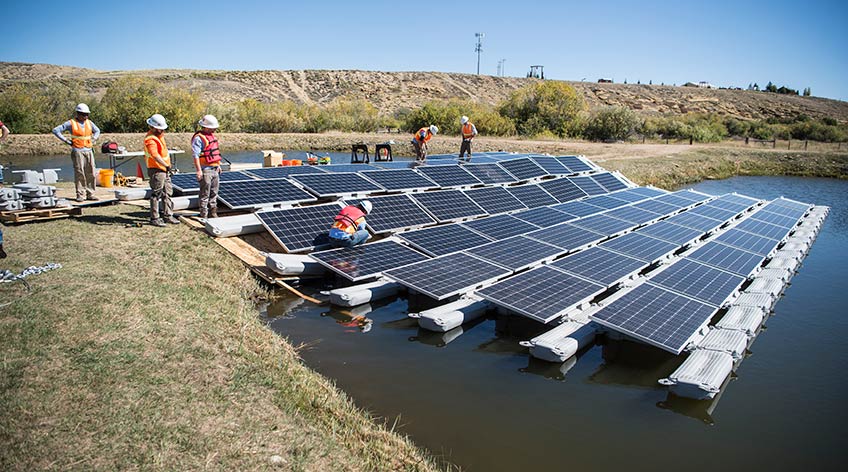
The US National Renewable Energy Laboratory (NREL) has evaluated the potential for floating solar (FPV) across the US in a new study, notably highlighting its benefits on water reservoirs in arid regions as well as alongside hydroelectric facilities.
The US may have claimed the first FPV installation around a decade ago on an irrigation pond in Napa Valley, California but few projects have materialised since. China and Japan have lead FPV installations, while demand is expected to increase across South East Asia and Europe, due to announced projects.
According to NREL researchers, FPV projects across more than 24,000 man-made US reservoirs could generate around 10% of US annual electricity production, which would reduce the land requirements for conventional ground mount PV power plants by at least 2.1 million hectares.
Try Premium for just $1
- Full premium access for the first month at only $1
- Converts to an annual rate after 30 days unless cancelled
- Cancel anytime during the trial period
Premium Benefits
- Expert industry analysis and interviews
- Digital access to PV Tech Power journal
- Exclusive event discounts
Or get the full Premium subscription right away
Or continue reading this article for free
NREL noted that its study had intentionally been conservative in its findings, due to the relative underdevelopment of FPV technology and overall global installations.
“In the United States, it’s been a niche application; where in other places, it’s really been a necessity,” said Jordan Macknick, the lead energy-water-land analyst for NREL and principal investigator of the project that produced the paper “Floating PV: Assessing the Technical Potential of Photovoltaic Systems on Man-Made Water Bodies in the Continental U.S. “We’re expecting it to take off in the United States, especially in areas that are land-constrained and where there’s a major conflict between solar encroaching on farmland.”
“Floating solar is a new industry enabled by the rapid drop in the price of solar PV modules,” said Warren, director of NREL’s Integrated Applications Center. “The cost of acquiring and developing land is becoming a larger part of the cost of a solar project. In some places, like islands, the price of land is quite high, and we are seeing a rapid adoption of floating solar.”