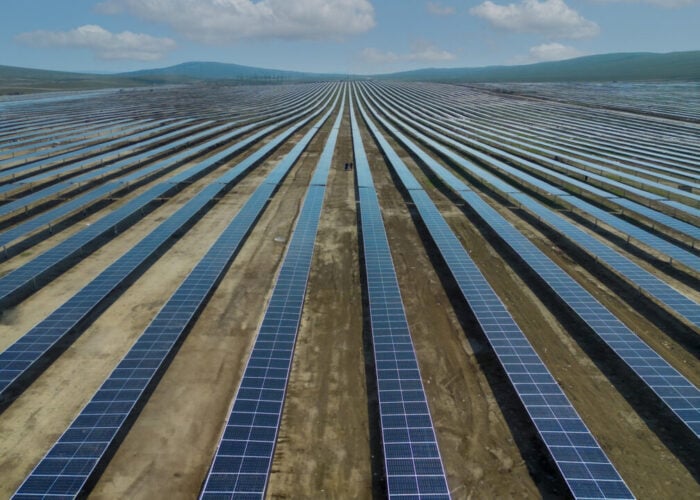
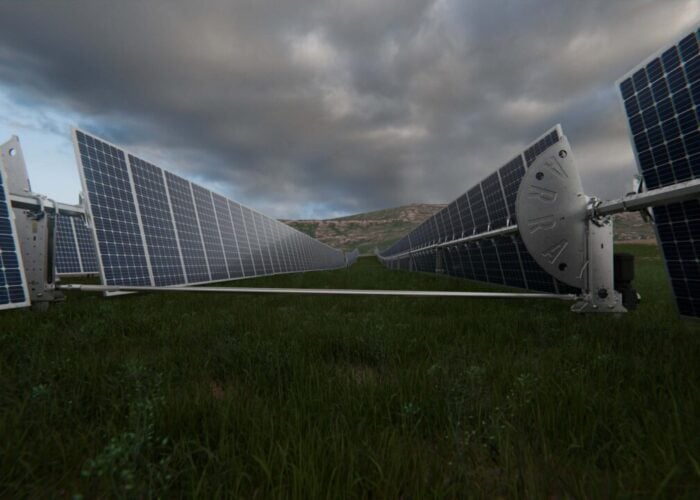
Solaria has begun shipping its tracker-optimized, monocrystalline-silicon photovoltaic solar modules to customers in North America, Europe, and Asia. Although the company would not reveal the amount of shipments nor the financial details of any of the agreements, sources said that the modules have been designated for project-level installations.
One of Solaria’s customers is Roseville, CA-based Solar Power, Inc.
Try Premium for just $1
- Full premium access for the first month at only $1
- Converts to an annual rate after 30 days unless cancelled
- Cancel anytime during the trial period
Premium Benefits
- Expert industry analysis and interviews
- Digital access to PV Tech Power journal
- Exclusive event discounts
Or get the full Premium subscription right away
Or continue reading this article for free
“We’ve been testing Solaria’s new modules at our multimegawatt facility in California,” said Eric Hafter, SPI’s chief strategy officer. “The modules have been yielding excellent performance; Solaria’s high-efficiency modules offer industry-leading costs with the reliability and performance of traditional crystalline solar modules. Since Solaria’s modules are built to industry standards, they’re ready to install on standard trackers using conventional installation methods.”
Solaria’s 1.6 × 1m modules use patented technology, incorporating a low-concentration PV design with singulated cell strips combined with special optics, to provide the reliability, performance, and quality of a standard silicon module at a low cost. The Fremont, CA-based company says it uses only proven, UL-listed, industry standard materials, thereby eliminating risks associated with new materials.
The Solaria module, available in 210-, 220-, and 230W models, is the first low-concentration flat-plate module to achieve international certification, having met both the UL1703 and IEC61215 standards. Its performance and reliability has also been validated by independent laboratories.
According to Columbia University’s Center for Lifecycle Analysis, the carbon footprint per watt of modules manufactured with Solaria’s technology is approximately one-third less than that of competing technologies, with an energy payback time of less than one year.