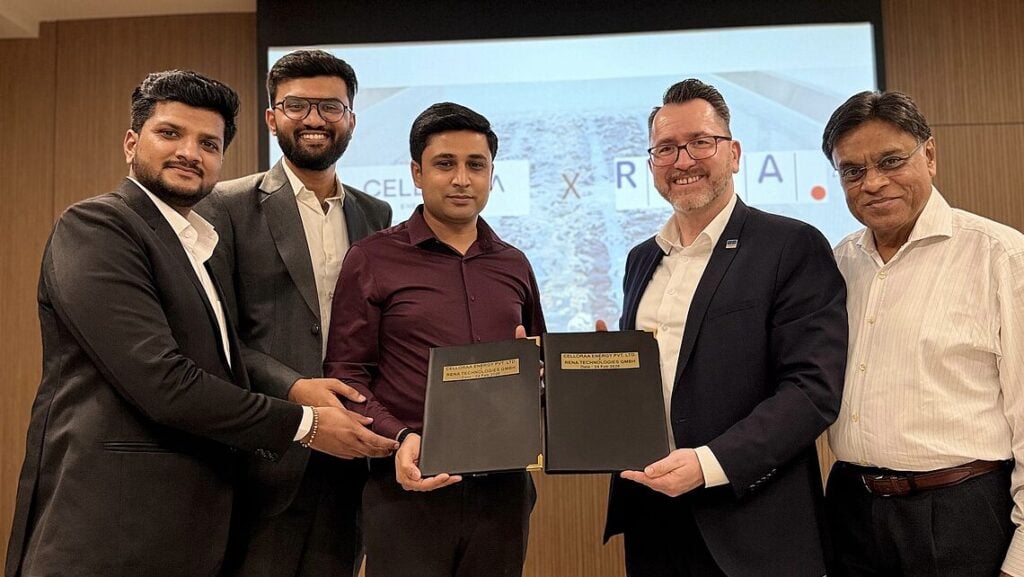
German wet processing equipment manufacturer RENA Technologies will supply its equipment to a planned 1.2GW TOPCon solar cell production facility in India.
RENA signed a deal with Celloraa Energy ltd. to supply advanced wet chemical processing systems to a planned tunnel oxide passivated contact (TOPCon) solar cell facility in the Indian state of Gujarat.
Try Premium for just $1
- Full premium access for the first month at only $1
- Converts to an annual rate after 30 days unless cancelled
- Cancel anytime during the trial period
Premium Benefits
- Expert industry analysis and interviews
- Digital access to PV Tech Power journal
- Exclusive event discounts
Or get the full Premium subscription right away
Or continue reading this article for free
Celloraa said it expects to begin producing cells at the site at the end of the 2026-27 financial year.
It joins a wave of Indian companies currently building solar cell manufacturing capacity, motivated by the Indian government’s financial incentives and demand-side policies to encourage domestic solar manufacturing capacity. Its Production Linked Incentive (PLI) and Approved List of Models and Manufacturers (ALMM) schemes reward domestic production and fence off state and national auctions for domestic products, respectively, and have resulted in hefty expansions of solar module and cell production capacity.
RENA and Celloraa said this 1.2GW TOPCon facility will be the first advanced solar cell production line in the state of Gujarat. “This partnership with RENA Technologies marks a significant milestone in establishing state of the art and first of its kind, 1.2GW TOPCon manufacturing facility in Surat, Gujarat,” said Brijesh Gondaliya, director of Celloraa Energy.
The companies also said they are working on a memorandum of understanding (MOU) to collaborate on developing RENA’s cell processing technology and pursue next-generation interdigitated back contact (IBC) solar cell technologies.
Solar cell production efficiency
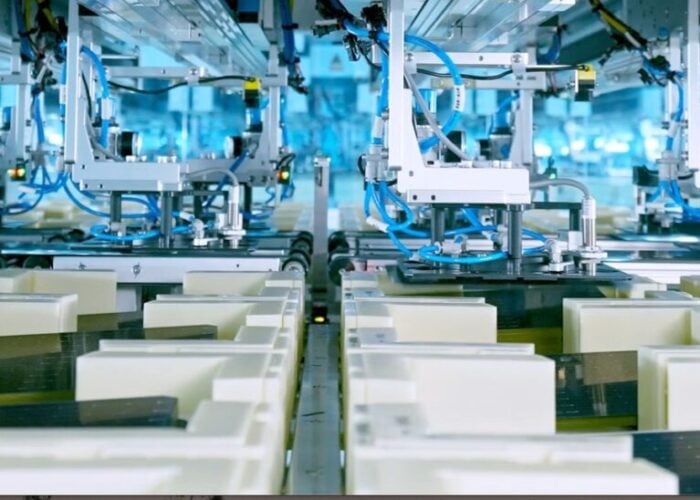
RENA said it will supply Celloraa with its “latest generation” of wet processing equipment, specifically the InEtchSide 4+, BatchPolyClean N600, BatchEtch N600 and BatchTex N600 systems.
It said these systems were “specifically engineered” for maximum water efficiency and could deliver a roughly 50% reduction in water consumption and wastewater. RENA did not say what baseline this reduction was based on.
RENA also said the systems remove the need for hydrogen peroxide in “key wet chemical steps”, which it said offers a number of benefits, including improved operational safety, less need to store hazardous chemicals, simplified logistics and regulatory requirements and less chemical waste.
“By combining high-efficiency processing with environmentally responsible engineering, the systems enable manufacturers to achieve superior cell performance while maintaining competitive production costs,” RENA claimed.
“Our N600 batch platforms and InEtchSide system combine cutting-edge process performance with industry-leading sustainability standards. Together with our local service presence through IMC(International Marketing Corporation), we are committed to ensuring a smooth installation and a successful ramp-up toward production at the end of FY 2026-27,” said Sebastian Kress, deputy CEO & global lead PV at RENA Technologies.
European PV equipment producers like RENA could be well-placed to profit as countries around the world try to build new solar supply chains. Back in early 2024, RENA said it had received “gigawatts” of PV manufacturing equipment orders from the US and India, and last year the company’s head of solar sales told PV Tech Premium that plans to establish solar cell manufacturing capacity in the US offered a big opportunity for European equipment producers.