Join us for this free webinar on 20th July as Finlay Colville, Head of Research at Solar Media, provides a detailed update on the UK's solar industry today:
Where is growth coming from, how much deployment is likely over the next 12-18 months?
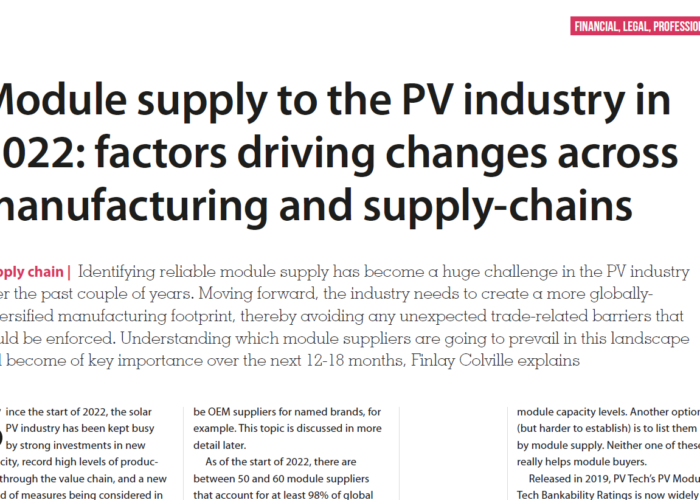
The large-scale solar farm pipeline at 40 GW and still going up – how much is getting built today?
Commercial rooftops - the big story of UK solar in 2022; but is this just the tip of the iceberg?
Why are PV module prices going up? What will happen in the next couple of years?
The era of PV modules at 500 Watts and above: what is driving this?
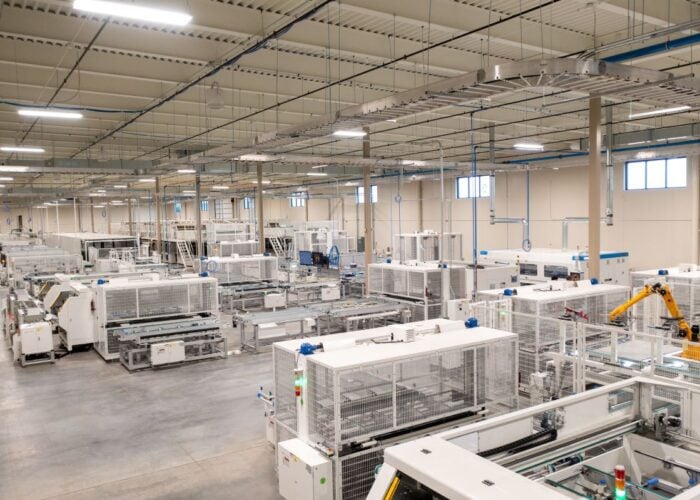
Identifying reliable module supply has become a huge challenge in the PV industry over the past couple of years. Moving forward, the industry needs to create a more globallydiversified manufacturing footprint, thereby avoiding any unexpected trade-related barriers that could be enforced. Understanding which module suppliers are going to prevail in this landscape will become of key importance over the next 12-18 months, Finlay Colville explains.
The PV industry is on track for strong growth in 2020, despite 10 months of the year being shrouded in uncertainty and perennial pessimism. And while almost all in the sector have been lamenting supposed softness in demand this year, attributed to the COVID-19 pandemic, it turns out that the limiting factor to production and shipment volumes this year simply comes down to the supply of raw materials, namely polysilicon.
As a platform designed to map full industrial ecosystems, MAPPES.io is helping identify gaps and bottlenecks in PV manufacturing hotspots such as the US and India, explains its CEO, Ankit Singhal.