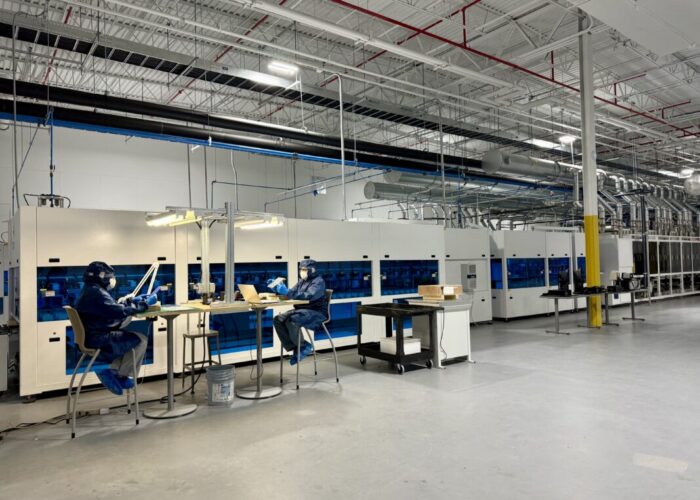
Canadian Solar (CSI) and GCL Silicon Technology have signed new long-term supply agreements, in which GCL will provide 510 metric tons of high-purity polysilicon feedstock over the next two years and approximately 1.8 GW of solar wafers to CSI from 2010-2015.
Linde has signed a long-term contract with Sodiff Advanced Materials for the supply of electronic-grade silane. The agreement, the duration and cost of which were not specified in the announcement, will see the delivery of the silane from Sodiff’s facility at Youngju, Korea, which comes on line in the second half of 2009. This contract will account for a large proportion of Sodiff’s 2,000-tonne silane production output.
In the third part of this week’s series exploring the US solar supply chain, we track how quickly announced manufacturing capacity is translating into real production.
PV Tech Premium spoke with Mike Carr, executive director of the SEMA Coalition, about the hollowing out of domestic demand for US solar manufacturing under the Trump administration, the way that US companies are piecing together supply chains and the reasons to still hope for the sector’s future.
The first Chinese polysilicon manufacturer has secured a certification from the Solar Stewardship Initiative’s (SSI) supply chain traceability standard.
Australia and India have formalised a broadened energy partnership that spans renewable energy deployment, supply chain resilience, critical minerals, rooftop solar training and uranium exports.
As solar imports to the US face increasing restrictions, domestic manufacturers are racing to build upstream production capability. With 66GW of module capacity chasing just 11GW of domestic cells, the supply chain crunch is reaching a critical inflection point, write Moustafa Ramadan and Joe Hennessy.