Japanese solar manufacturer Toyo is doubling down on the US as it builds out a policy-aligned, domestically anchored supply chain—one that the company’s chief strategy officer, Rhone Resch, says was designed from the outset to anticipate tightening trade rules rather than react to them.
Speaking to PV Tech Premium, Resch outlines a strategy centred on “certainty” for developers navigating tariffs, domestic content requirements and financing constraints, with Texas emerging as the company’s operational core.
Try Premium for just $1
- Full premium access for the first month at only $1
- Converts to an annual rate after 30 days unless cancelled
- Cancel anytime during the trial period
Premium Benefits
- Expert industry analysis and interviews
- Digital access to PV Tech Power journal
- Exclusive event discounts
Or get the full Premium subscription right away
Or continue reading this article for free
“From day one, Toyo has been built around one market—the US utility-scale solar. Every decision we’ve made about manufacturing, sourcing, technology and investment has been made with the US customer in mind,” notes Resch.
Texas as the ‘backbone’
“Our plan was to establish a US onshore production base as part of our Made in America for America strategy,” says Resch. Many of these efforts have focused on Texas, as it offers proximity to key markets and logistical advantages.
“Texas for us becomes a very important location because of its large utility-scale marketplace. We’re going to keep it as our core centre of manufacturing, and then we will expand from there,” Resch says.
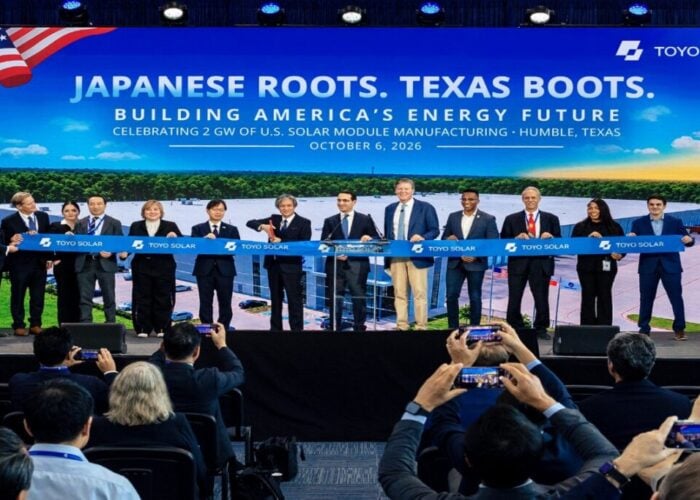
The Houston facility is being scaled into a vertically integrated site, with nearly US$20 million invested in the 567,140 square-foot plant.
“We’re using that space and location to have kind of a very closed loop with respect to cell manufacturing, module manufacturing,” Resch adds. “It gives us the ability to really customise the product for our customers.”
Toyo’s long-term strategy is to localise as much of the solar supply chain in the US as possible, moving beyond module assembly to upstream components.
“Our intent is full integration over time,” Resch said. “Everything downstream from polysilicon and ingots, wafers—our intent is full integration.”
Alongside localisation, Toyo is investing in next-generation technologies, including heterojunction (HJT) cells and perovskite development.
“Our planned cell facility will be built around HJT architecture,” Resch notes. “We truly believe [it] is the next meaningful step with respect to efficiency and performance.”
He adds that the company is also preparing for future technology shifts.
“We know that perovskites are going to be part of this marketplace,” he said. “Our goal is not to transplant yesterday’s manufacturing to America, but to give the US a genuine opportunity to leapfrog to the next generation of solar technology.”
Policy as a design principle
While many manufacturers have been forced to adjust to shifting US trade measures, Resch argues Toyo’s model was built with those constraints in mind.
“Trade policy has never been a constraint for us. It’s been a design principle from the beginning,” he says. “What is happening now is less of a shift in strategy and more of a convergence between policy direction and our strategy.”
He added that repeated policy shocks have disrupted the broader solar sector, forcing manufacturers to anticipate regulatory shifts well in advance.
Since the beginning of Trump’s second term, US solar has entered a period of heightened policy-driven uncertainty, shaped by executive actions that deprioritise renewables, such as the passage of the “One Big Beautiful Bill”, the shortening tax credit eligibility and new Foreign Entity of Concern (FEOC) and tariff measures that are reshaping project economics and supply chains.
Resch notes that many manufacturers have been forced to shut down factories, relocate production and shift markets amid widespread disruption in the sector, describing the situation as “chaos” for the industry. He adds that, ultimately, it is US customers who bear the cost.
By contrast, Resch says that Toyo’s emphasis on greater domestic manufacturing helps navigate these obstacles.
“Customers today are navigating tariffs, domestic content requirements (DCR), federal Investment Tax Credit (ITC) eligibility and lender requirements that are the strictest,” Resch says. “Onshore manufacturing provides clarity across all of these dimensions in a way that imports simply cannot.”
“US manufacturing isn’t just about cost, it’s about certainty and in this market, certainty has real commercial value that frankly, imports just cannot replicate.”
Despite the incentives offered by the Inflation Reduction Act (IRA), Toyo is cautious about overreliance on subsidies.
“We have not factored 45X tax credit revenue into our public guidance this year, because we don’t want a business model that requires a government subsidy to be viable,” Resch notes. “When those credits are available, they accelerate our plans, but they can’t be our foundation.”
Ethiopia-Houston supply chain link
Toyo’s global expansion has been structured to serve US demand, beginning with a 2GW n-type tunnel oxide passivated contact (TOPCon) production factory in Vietnam, followed by a 4GW cell facility in Ethiopia that came online in 2025.
“In 2025, we brought a 4GW cell factory online in Ethiopia, which made us the largest Japanese solar manufacturer and the largest producer of non-FEOC TOPCon cells in the world,” Resch says.
This international footprint feeds directly into Toyo’s US ambitions. The company has already established a 1GW module facility in Houston and is expanding it to 2GW this year, alongside plans for a domestic cell plant.
Toyo’s Ethiopian facility plays a key role in scaling production and supporting US operations, particularly in the near term where domestic cell capacity remains limited.
“Building the facility in Ethiopia allowed us to scale rapidly. It was a way for us to bring a critical part of the supply chain into the US, which are cells,” Resch emphasises.
The site also helped establish reliability in a market where delivery consistency has been a challenge.
“A big part of what this industry has struggled with is manufacturers who are not able to deliver their product in the volume on time at the price that was agreed to,” he says.
Crucially, the Ethiopian output feeds into US manufacturing as Toyo builds out its domestic base.
Toyo began production at its 4GW Ethiopian solar cell processing plant in April 2025 and has set a solar cell shipment target of 5.5GW-5.8GW for FY2026-2027. The company shipped 4.5GW of cells in FY2025, surpassing its full-year target of 4.2GW–4.4GW.
‘We anticipate trade policy to continue to tighten further’
Looking ahead, Resch expects US trade rules to tighten further but believes Toyo is well prepared.
“We anticipate trade policy to continue to tighten further, and Toyo is one of the best positioned companies in the industry to navigate this.”
According to Resch, this confidence stems from Toyo’s early structural decisions.
“The structural decisions we’ve made were made specifically to perform well in a restrictive environment. Toyo is not chasing after the policies; we are disciplined in how we built our business.”