As Europe’s utility-scale solar market prepares for significant expansion, electrical balance-of-system specialist Voltage Energy Group is positioning itself to address one of the industry’s most pressing challenges: reducing installation costs while improving project quality and execution speed.
Speaking with PV Tech, Ruiyan Ge, President of Voltage Energy, outlines the company’s strategic focus on the European market and explains how the firm’s approach to eBOS differs fundamentally from traditional methods that still dominate the continent’s solar installations.
Try Premium for just $1
- Full premium access for the first month at only $1
- Converts to an annual rate after 30 days unless cancelled
- Cancel anytime during the trial period
Premium Benefits
- Expert industry analysis and interviews
- Digital access to PV Tech Power journal
- Exclusive event discounts
Or get the full Premium subscription right away
Or continue reading this article for free
Targeting Europe’s utility-scale opportunity
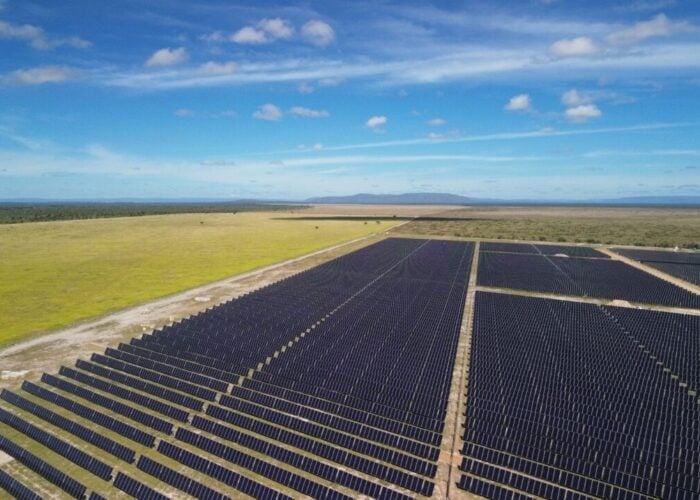
Voltage Energy’s European strategy centres exclusively on utility-scale ground-mounted projects, deliberately avoiding residential, commercial, or industrial segments. “In Europe, the expectation for utility-scale project installations in 2025 is around 31.8GW – larger than the US market and among the largest globally,” Ge explains. The company identifies Spain, Germany, Italy, and Nordic countries like Finland as particularly fast-growing markets.
This focus comes at a pivotal moment for the industry. While module and tracker prices have fallen dramatically, Ge emphasises that these commodity-priced components no longer represent the primary opportunity for cost reduction. “A large chunk of a project’s capex – something like 30-40% – is installation cost,” she says. “How you can reduce installation costs is crucial for future cost reductions and for making solar even more competitive among other energy resources.”
Three approaches to solar wiring
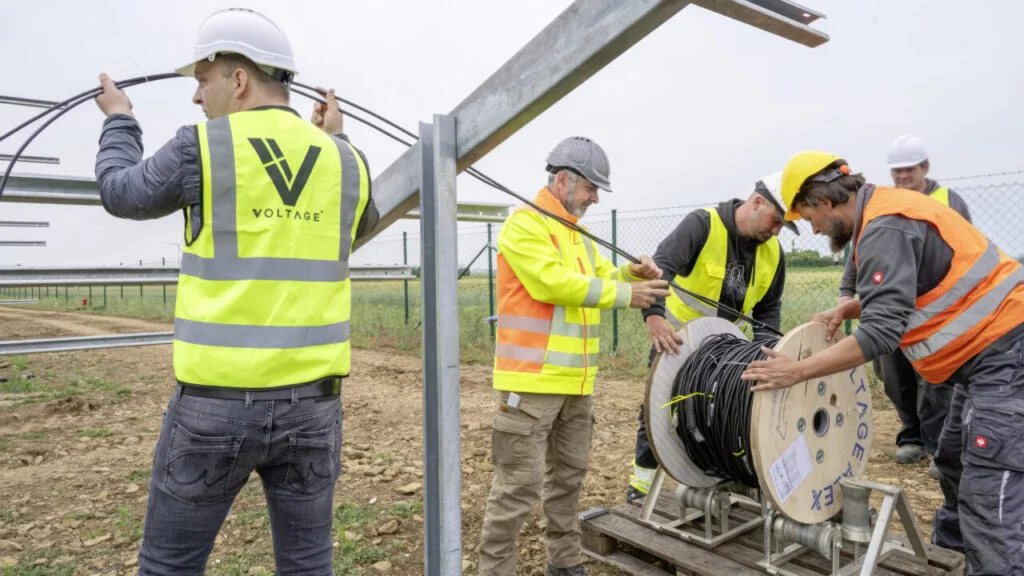
Ge describes three distinct approaches currently competing in the eBOS market, with stark differences in efficiency and quality control. The first and most prevalent method, still used in approximately 95% of European projects, relies on traditional “home-run” wiring. In this approach, cable suppliers deliver loose cable to site, where teams must manually locate, measure, cut, and crimp connectors on location. “There’s no factory-level QA/QC process,” Ge explains.
The second approach uses plug-and-play jumper cables, which are pre-cut to length but still require significant on-site sorting and matching. A typical solar array using 12-16 strings, each with 12-16 sets of jumper cables of varying lengths, means field crews must identify and connect the correct jumpers to the appropriate inputs on string and combiner boxes.
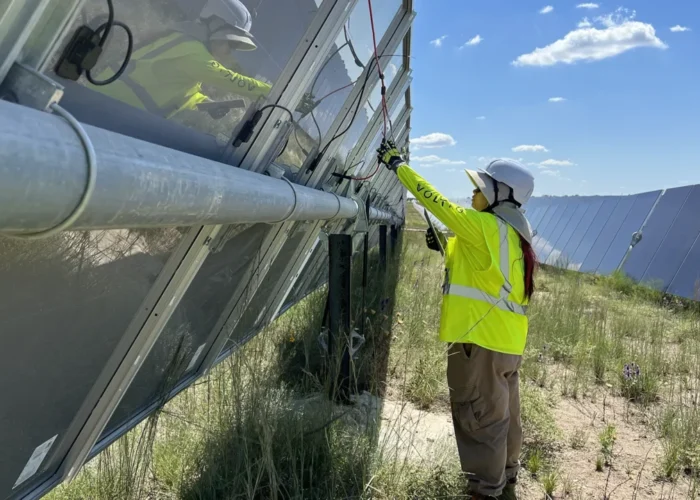
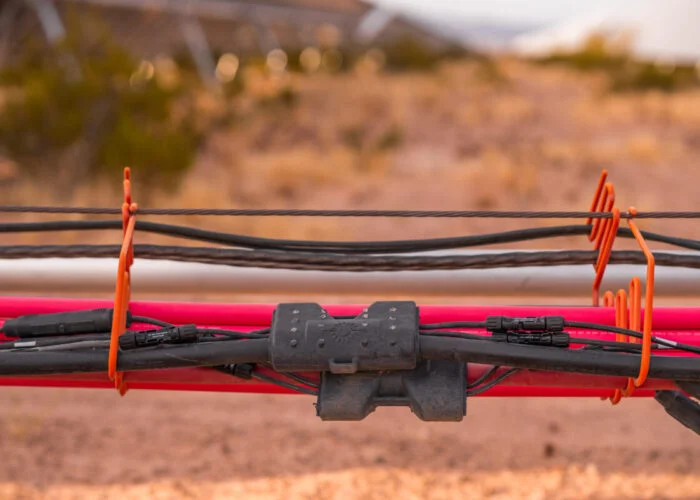
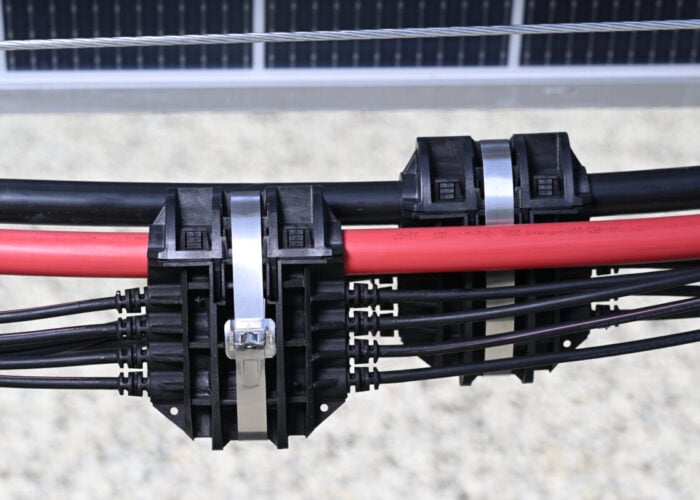
Voltage Energy’s third approach represents a more comprehensive departure from these methods. The company delivers pre-assembled, pre-grouped plug-and-play harness solutions, a model it has already deployed across 53GW of projects in the United States. “We pre-group whatever is needed for this row into a single set of integrated multi-string solutions, including positives and negatives,” Ge says. “Strings are also pre-labelled with the inverter number, combiner box number, and row number.”
Quantifying the benefits
The efficiency gains from Voltage’s approach are substantial. Ge provides concrete numbers for a typical 100MW solar farm, which would be divided into approximately 20 blocks, each consisting of over 250 strings with 20-30 modules per string. This translates to roughly 22,000 DC-cable connections and over one million metres of DC cabling across the site.
“Compared to that, our solution can save over 22,000 DC connections – those will either be eliminated or completed within our facility – and eliminate over 342,000 metres of cabling,” she explains. The company’s method reduces cable length by around 33%, uses 67% fewer connectors, and enables installation to be approximately 50% faster with higher efficiency.
Beyond speed, Ge emphasises quality improvements, particularly regarding connector reliability, a known point of failure in solar installations. “We can minimise those mistakes and ensure a higher-quality solar installation.”
Digital design tools for complex terrain
European projects present unique challenges compared to many US installations, with more difficult terrain and hilly sites requiring detailed wiring solutions. Voltage Energy addresses this through a suite of digital engineering tools that engage early in the project lifecycle.
When EPCs bid on projects with preliminary site plans, Voltage’s 2D team provides quotations, product checklists, and single-line diagrams using proprietary design tools. Simultaneously, the 3D team begins creating visualised services, including 3D layout reports, simulation videos, and 360-degree walkthroughs. “We provide a virtual site where you can click through to see how the wires are managed and designed,” Ge explains.
Utility-scale solar projects are often won or lost in the field. Crew availability fluctuates, drawings get re-read, and a missing component can stall an entire block. Join us on October 14 for an exclusive webinar and live Q&A.
The company also offers a virtual reality training program called Voltage Reality. “We have lots of unskilled workers coming in from different industries who have no clue what a solar site looks like before they get on one,” Ge says. “This VR system helps them gain some understanding of the real world.”
Project execution and lifecycle management
Voltage’s digital ecosystem extends beyond design through its Voltage Connect platform, which serves as a centralised information hub from bidding through installation to digital O&M support. The platform provides real-time visibility into product status, including whether products are in design, material preparation, production, or transit. For EPCs and developers, the platform provides greater transparency across the project lifecycle, helping teams manage schedules, track design revisions, and improve execution certainty. Following installation, customers can continue to use the platform for digital O&M support and service requests.
Standardising at 2kV
As the industry transitions from 1,500V to 2kV system designs, Voltage Energy has taken a distinctive approach. Rather than treating this as a gradual product-rating extension, the company has standardised its entire product line at 2kV DC rating. “That means our customers who are building their site currently at 1,500V are actually receiving products certified for 2kV,” Ge says. “If they have to upgrade in the future, they don’t need to change their products.”
The system-level benefits are measurable: approximately 0.5-0.8% increase in annual energy yield from reduced resistance losses and improved string optimisation, plus 10-15% reduction in eBOS material usage. The 2kV architecture also enables longer strings with fewer module connection points and fewer inverters, simplifying field installation.
New product platforms
Voltage’s LYNX PLUS solution addresses the cost and labour intensity of traditional combiner boxes. Originally launched in 2019 and upgraded this year, the trunk bus solution can eliminate combiner boxes entirely. By adopting a cluster LYNX PLUS design, projects can avoid underground trenching, keeping everything above ground for easier management.
The IBEX PLUS solution responds to higher currents from new modules. As module ratings increase, larger cables are needed to transmit current without power loss. “Copper is becoming increasingly expensive, so there’s a trend: how can we transition from copper to aluminium?” Ge explains. IBEX PLUS combines copper and aluminium wire, with aluminium upsized to accommodate higher current needs while maintaining cost competitiveness.
Adapting to industry evolution
Voltage Energy is also responding to broader industry trends, including increased tracker adoption, battery energy storage integration, and emerging DC power demands from AI data centres. The company introduced a dedicated eBOS solution for BESS applications a year ago to address system-level complexity.
This evolution from wiring solutions provider to system-level eBOS platform reflects Voltage Energy’s strategy of constantly engaging with customers to understand future project needs. “As projects move to higher power, higher voltage and more demanding execution schedules, they require more than just a simple wiring component,” Ge explains. “What customers need is an integrated eBOS architecture that can simplify construction, reduce labour and material usage, and improve reliability.”
With Europe’s utility-scale solar market poised for substantial growth and installation costs representing an increasingly significant portion of project capex, Voltage Energy’s approach to standardisation, digitalisation, and pre-assembly positions the company to address what may be the industry’s next major cost-reduction frontier.
Find out more by visiting the Voltage Energy website.