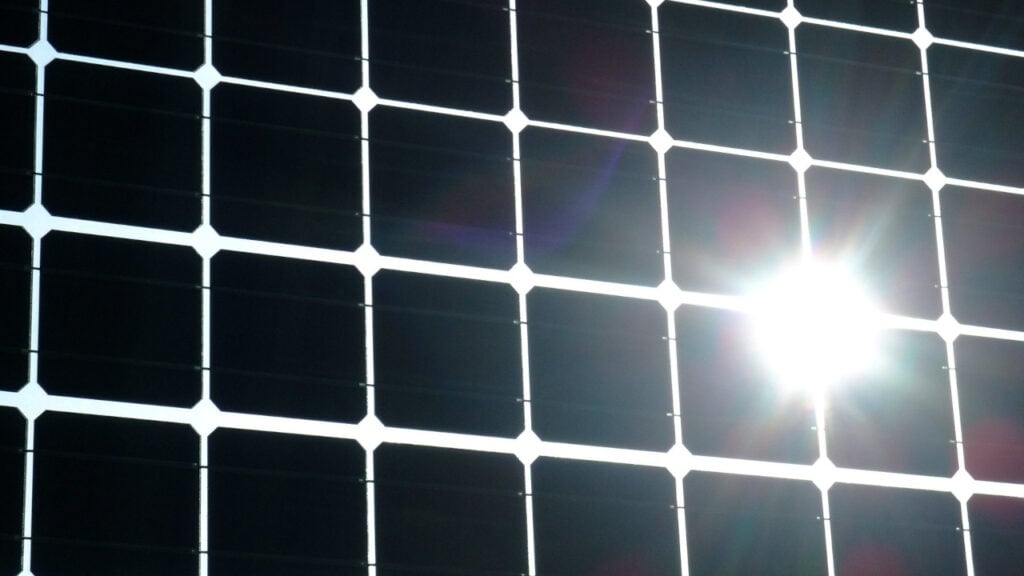
A new IEA PVPS report published here [PDF], “Glare Legislation and Assessment Methods for BIPV Modules and Systems”, describes the range of legislation and governmental guidelines affecting glare from PV installations and finds substantial variation in extant policies and requirements regarding glare, both internationally and at relatively local levels.
The report’s authors note that there are no widely accepted limits on glare, nor agreed-upon methods for measuring it. One of the few areas of congruence across all the geographies they examined was the need for glare mitigation measures around transport hubs, especially aviation centres.
Try Premium for just $1
- Full premium access for the first month at only $1
- Converts to an annual rate after 30 days unless cancelled
- Cancel anytime during the trial period
Premium Benefits
- Expert industry analysis and interviews
- Digital access to PV Tech Power journal
- Exclusive event discounts
Or get the full Premium subscription right away
Or continue reading this article for free
The report also discusses common methods for reducing glare from solar panels, including anti-reflective coatings, post-installation measures such as film application, and issues related to module orientation, tilt, and physically obstructing panel arrays from view.
United Kingdom
In the UK, formal planning conditions usually apply only to solar farms and large rooftop arrays when they are located near roads, railway lines, or an airport. The stipulations regarding glint from PVs are similar to those governing the amount of light reflected from tall or mirrored building construction (as in Canada, see below). There is no universal assessment method for glare (or “glint”, is it’s termed in the UK), but “veiling luminance” crosses the threshold for concern at 500 cd/m2.
Europe
There is no EU-wide requirement to reduce glare, except under specific European aviation rules, but several member states publish their own guidelines and stipulations.
Germany uses the Light Guideline section of its Federal Emission Protection Law in this area. An ‘appreciable disturbance’ is defined as when properties neighbouring the installation are affected for more than 30 minutes a day or 30 hours annually.
Similar but non-binding guidance is enshrined in Switzerland‘s Environmental Protection Act. It sets a daily threshold of 30 minutes of reflections affecting other dwellings, although longer durations are allowed on a small number of days, with an overall maximum of 60 hours of glare annually. A luminance threshold of 50,000 cd/m² is used to denote problematic reflections in Switzerland.
Austria withdrew technical guideline OVE R11-3 in December 2024, and currently has no active PV-specific glare regulation. Denmark and Italy use civil nuisance laws to address any issues of excessive reflections, and in France, the Netherlands, Norway and Spain, a mixture of planning controls, building requirement regulations and/or assessment on a case-by-case basis can affect solar installations.
In all the above, solar arrays near transport infrastructure are usually treated as special cases with more stringent requirements to mitigate glare affecting pilots, train or vehicle drivers, etc.
Asia, Oceania and the US
PV arrays in Japan and South Korea are subject to local government recommendations and guidance rather than blanket national legislation. In the US, the Federal Aviation Administration issues rules on glare near air traffic control towers, but outside airports, requirements are often defined locally on a per-municipality basis. For example, Boston requires glare studies for proposed major developments, including solar developments, and California’s environmental assessment framework also includes sections on reflected glare.
In many areas, the rules around the effects of glass-fronted or mirrored building facades are also considered to apply to large solar installations. A case in point is Canada, where municipal discretion is usually given to local authorities regardless of whether the issue is a glass-fronted skyscraper or a large solar farm.
Coatings, surfaces and orientation
Many solar manufacturers use sand-blasting or acid etching to produce an anti-reflective coating over cells. Such surfaces outperform flat glass in that they can absorb light at a greater degree of sunlight incidence. However, an overly anti-reflective treatment can negatively affect a panel’s overall efficiency. Panel coatings and glare-reducing treatments commonly applied by the manufacturer do not, however, cut reflected light to a significant degree as seen by an outside observer, the report notes.
The least effective measure, both in terms of overall panel efficiency and glare reduction, is the post-installation application of additional films or coatings onto panels, the report surmises. It states some films create undesirable reflection patterns that affect the panel’s operations, and although treatment film application may be cheap, such treatments lack the durability and reliability of a manufacturer’s common surface treatments.
Similarly, changing modules’ orientation or tilt can help reduce the times during which unwanted glare is produced, but there are trade-offs to a solar installation’s overall efficiency. Obstructing direct views of installations is clearly effective in many situations, but must be done with care to minimise its impact on power production.
The IEA recommends early, site-specific glare assessments, even where these are not mandatory, to incorporate mitigation measures before construction. The issue of glare, it says, should best be addressed during the design phase of any solar project of significant scale, a time when considerations around textured surfaces or system adjustments can be implemented with as few performance penalties as possible.