US tax credits for solar PV, wind power and electric vehicles are facing dramatic cuts, while those for energy storage are likely to be sustained.
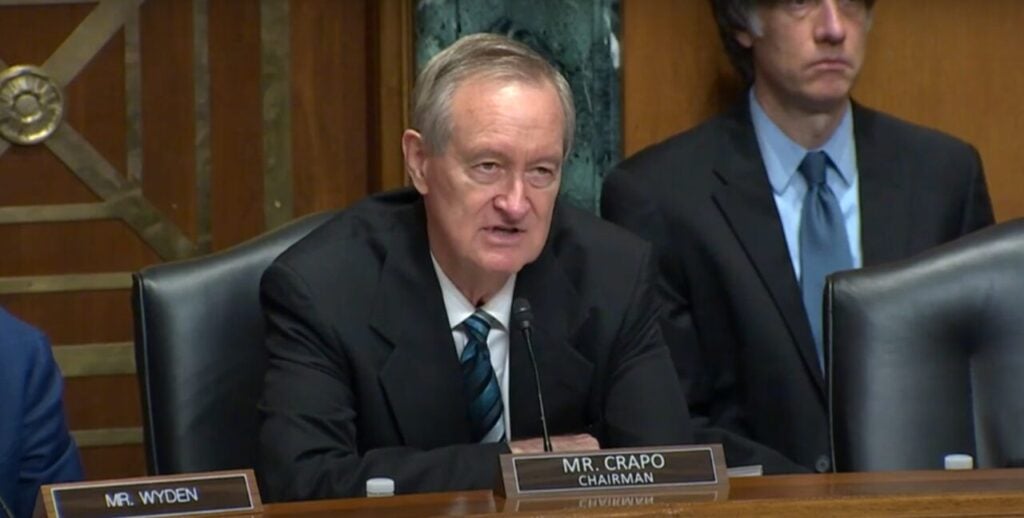
The chairman of the US Senate Finance Committee, Senator Mike Crapo, released draft legislation yesterday (16 June) for the portions of the budget reconciliation bill that fall under the committee’s jurisdiction.
Try Premium for just $1
- Full premium access for the first month at only $1
- Converts to an annual rate after 30 days unless cancelled
- Cancel anytime during the trial period
Premium Benefits
- Expert industry analysis and interviews
- Digital access to PV Tech Power journal
- Exclusive event discounts
Or get the full Premium subscription right away
Or continue reading this article for free
In a brief statement, Crapo said that the legislation would, among other things, “achieve significant savings” through major cuts to Green New Deal spending while “preserving and protecting them for the most vulnerable.”
The bill arrived at the Senate’s door in late May after just passing the House of Representatives by one vote.
At that time, its provisions included immediate termination of tax credits for electric vehicles (EVs) and residential clean energy and drastically shortened runways to the end of tax credits for solar PV, wind and energy storage. The version that emerged from the House of Representatives was even more hardline in its treatment of clean energy incentives than the one that had entered it.
As it now stands in the committee proposal, solar PV and wind investment tax credits (ITCs) will begin to phase out in 2026. Any projects beginning construction during the 2026 calendar year would be eligible for just 60% of the credit’s value. From 2027, they would receive only 20% and nothing in the following year. The same timeline would be applied to ending clean electricity production tax credits (PTCs) for solar and wind.
However, regarding the ITC, “other qualifying facilities,” which include geothermal, nuclear, hydroelectric and energy storage, would continue the original timeline in which a phaseout begins in 2032, receiving 100% of the credit in 2033, 75% in 2034, 50% in 2035 before it falls to zero in 2036. Another positive aspect of the bill appears to be that transferability for tax credits that are retained will be kept in place.
The proposal restricts access to credits for projects receiving material assistance from prohibited foreign entities (PFEs) or foreign entity of concern (FEOC) companies. Any such project that commences construction after 31 December 2025 would not receive any credits.
For solar PV, the specifics of the FEOC and PFE language will be particularly important. While the US imports very few PV components directly from China (which is one of the designated countries), Chinese-backed companies and facilities in Southeast Asia, and potentially Chinese technology, could well be included in the provisions and make remaining tax credits hard to access.
Advanced manufacturing credits look set to remain in place, but again, restrictions on material assistance from PFEs or FEOCs could be a limiting factor to the ability to invest in US domestic production.
The bill could be passed by Senate and handed over to the US president to be signed into law as early as 4 July, although most sources believe a late September or early October passing is more realistic.
The Senate Finance Committee posted both the bill’s full draft text and a section-by-section summary on its website.
‘Harder to do business in America’
In a recent interview with our sister site, Energy-Storage.news, Isshu Kikuma, energy storage analyst at BloombergNEF (BNEF), said energy storage, solar and wind installations could be expected to “plummet” in the US if the reconciliation bill led to an effective repeal of the Inflation Reduction Act (IRA), which introduced or extended many of the incentives for a decade from 2022.
President and CEO of the US Solar Energy Industries Association (SEIA), Abigail Ross Hopper, speaking on behalf of member organisations in both solar and storage, said that the finance committee bill contained “modest improvements on several provisions,” but did not go far enough to protect “one of the greatest economic success stories in American history.
“As drafted by the Senate Finance Committee, this proposal would pull the plug on homegrown solar energy and decimate the American manufacturing renaissance,” Hopper said. “This bill makes it harder to do business in America for US manufacturers and small businesses and will undoubtedly lead us to an energy-strained economy with higher electric bills over the next five years.”
The American Council on Renewable Energy (ACORE) president and CEO Ray Long said the bill represented a “premature rollback of solar and wind tax credits,” which would be a “major setback to American energy dominance, and risks jeopardising billions of private investments that are currently benefiting communities throughout the country.”
“This represents a retreat from the certainty and scope the market needs to make the energy investments needed to meet escalating electricity demand.”
Read the full version of this story on our sister site, Energy-storage.news.