As the US faces the prospect of a fifth solar-related anti-dumping and countervailing duty (AD/CVD) case swinging into action, the logical conclusion is that American PV manufacturers will continue pursuing manufacturers they believe to be using Chinese products until there is nowhere left for them to hide.
The timing for the anti-circumvention request couldn’t be any more significant either, with US president Donald Trump on an official visit to China the same week the request was filed.
Try Premium for just $1
- Full premium access for the first month at only $1
- Converts to an annual rate after 30 days unless cancelled
- Cancel anytime during the trial period
Premium Benefits
- Expert industry analysis and interviews
- Digital access to PV Tech Power journal
- Exclusive event discounts
Or get the full Premium subscription right away
Or continue reading this article for free
This is the first such visit from a sitting US President in nine years and has turned US attention towards east and Southeast Asia. The AD/CVD tariff impacted predominantly Southeast Asian firms, and there is an ongoing case against manufacturers in India, Indonesia and Laos.
However, the Alliance for American Solar Manufacturing and Trade (AASMT)—which is comprised of First Solar, Hanwha QCells, DYCM Power, Great Lakes Solex PR, Silfab Solar, Suniva, Swift Solar (as Solx) and Talon PV—has now turned its eyes on a different region entirely; Ethiopia has become the first non-Asian country to be targeted by US manufacturers.
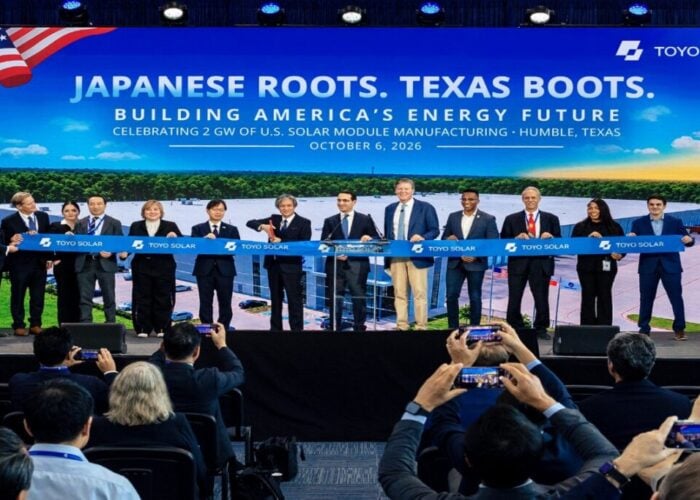
Just two solar manufacturers—Toyo Solar and Origin Solar Manufacturing—in Ethiopia could be affected by this request made to the US Department of Commerce to initiate an anti-circumvention inquiry into crystalline silicon (c-Si) PV cells and modules assembled in Ethiopia using Chinese-origin components.
According to the coalition of manufacturers, the two companies are allegedly circumventing existing AD/CVD orders “on solar products by routing Chinese wafers and components through minimal Ethiopian solar manufacturing operations before shipping finished cells and modules to the United States.”
The fact that Ethiopia is the next country that could face trade scrutiny is interesting, as it was one of the first emerging markets to announce new manufacturing capacity in Africa. Toyo Solar was one of the leading companies to establish operational solar manufacturing capacity in the country and the broader MENA region as manufacturers looked for alternatives after Indonesia, Laos, and India were hit with AD/CVD actions, says Aaron Hall, president of renewables data platform Anza.
“That’s impactful because Toyo was among the first movers into the region, and now they are among the first to face trade scrutiny there. It raises the possibility that other emerging manufacturing hubs could face similar scrutiny if production continues shifting geographically,” explains Hall.
A case about anti-circumvention
There are a few factors that make this slightly different from previous solar AD/CVD investigations. The first is that this is a question of anti-circumvention, not an attempt to prove that there was dumping and subsidies that were countervailed, but rather whether the companies have engaged in minimal processing in a third country to evade existing duties, an industry expert tells PV Tech Premium.
In its statement, the coalition points to existing duties on Chinese c-Si PV goods, which were the recipient of the first solar AD/CVD order back in 2012.
The expert added that, in anti-dumping and countervailing duty cases, the International Trade Administration (ITA) within the US Department of Commerce determines whether there has been dumping or prohibited subsidies. This then goes to the International Trade Commission (ITC), which does the same and determines whether or not there has been injury or a threat of injury to the domestic industry.
The industry expert explains that in general, three out of four petitions result in duties, but that when a petition fails to result in duties, it usually stems from the ITC not finding examples of wrongdoing. With this latest anti-circumvention request against Ethiopia, the ITC would not be involved due to the fact that the China Solar One case in 2012 already established that there was injury. If the US Department of Commerce moves forward with the AASMT’s request, it will investigate this case solely, without involving the ITC.
“That means the odds of getting a ruling are higher because the Department of Commerce is very, very favourable to petitioners,” said the expert.
The outcome is yet to be seen, but it is worth noting that we have a similar precedent in a 2022 anti-circumvention case against four Southeast Asian countries—Vietnam, Thailand, Cambodia and Malaysia—in which these countries were found to use Chinese wafers and Chinese bill of materials.
“A critical issue has emerged regarding supply chain transparency. While Toyo maintains that the majority of its wafers originate from Indonesia, complainants have presented shipping data suggesting that Indonesia has not exported these wafers to Ethiopia. This discrepancy underscores the paramount importance of robust supply chain traceability—particularly in the current environment where US manufacturers are coordinating efforts to insulate domestic production from international competition,” explains Moustafa Ramadan, head of PV Tech’s Market Research.
More cases to come soon?
Another key difference with this latest request is that the US manufacturers’ coalition filed it before a final decision was made on the ongoing AD/CVD investigation against India, Indonesia, and Laos.
The industry expert told PV Tech Premium that: “This is a more rapid rate of filing of cases than we’ve seen in the past, and we should expect more rapid filings in the future.”
As discussed previously on PV Tech, America’s solar trade cases have the characteristics of a game of “whack-a-mole” in which one manufacturing hub is excluded from the US market only for another to pop up, which is then the target of legislation, and so on. But considering that this time it has not waited for a final decision in the ongoing AD/CVD case against India, Indonesia and Laos, this begs the question of how quickly US manufacturers will file the next one and how far they will go in protecting their market?
“The initiation of the AD/CVD investigation targeting Ethiopia represents a continuation of the protectionist trend that originated with China and has progressively expanded to encompass Southeast Asia and India,” explains Ramadan. “Ethiopia’s inclusion in this investigation is particularly concerning, as it signals that US manufacturers are prepared to challenge any entity that imports solar cells or modules into the US if they find gaps in their supply chains.
“This development raises an inevitable question: Will Egypt and Turkey be next?”
In its press release, the AASMT highlighted other countries and regions with similar trends from previous cases, which could possibly hint at who will be next. In its statement, the AASMT mentioned the Philippines, Nigeria, Egypt and the Middle East.
Domestic disparity between operational modules and solar cells
The other problem this request raises is the lack of available solar cells for the US market, which comply with Foreign Entity of Concern (FEOC) requirements and are not subject to tariffs.
Data from PV Tech’s Market Research shows that the bottleneck of solar cells is becoming critical, with over 11GW of domestic solar cell capacity versus over 66GW of domestic module manufacturing capacity.
The cumulative available capacity of cells that is not impacted by any AD/CVD tariffs and is FEOC-compliant wouldn’t cover the US’ annual manufacturing capacity for modules. This shortage of cells is likely to become even more critical with the combined 6.2GW of annual nameplate capacity for solar cells from Toyo and Origin Solar in Ethiopia likely to be tariffed.
Given the lack of domestic solar cells, some companies have abandoned the idea of sourcing both domestic solar cells and modules, focusing only on domestic modules, explains Hall.
“For the US supply chain, ‘domestic content lite’ is something a lot of companies are pursuing, where you don’t necessarily need a domestic cell. For companies that were planning to source cells from Ethiopia, this filing may now create hesitation because of the retroactivity risk once the case progresses further.
“It will not affect domestic-content cell modules that are manufactured in the US and do not use Ethiopian supply. The exposure here is specifically tied to cells coming from Ethiopia,” says Hall. He adds that this negative development could potentially immediately affect prices.
“A significant number of companies use Toyo as an OEM supplier, so those buyers may now need to source elsewhere. It will probably create some inflationary price pressure, potentially right away. Not significantly on a global basis, but modestly, because many buyers are using those cells,” explains Hall.
Furthermore, an industry expert explains that the AD/CVD cases may advantage US cell makers, but do not make the US a good place to process solar cells. “It’s hard to build factories in the US, and it’s hard to invest in the US when you don’t know what’s going to happen in a few years. We don’t have the stability to make the US a good place for investing in cell manufacturing.”
The upcoming edition of our journal, PV Tech Power, to which our subscribers have access, will further explore the current state of the US supply chain and its challenges, including tariffs and other trade barriers.
Additional reporting from Ben Willis.