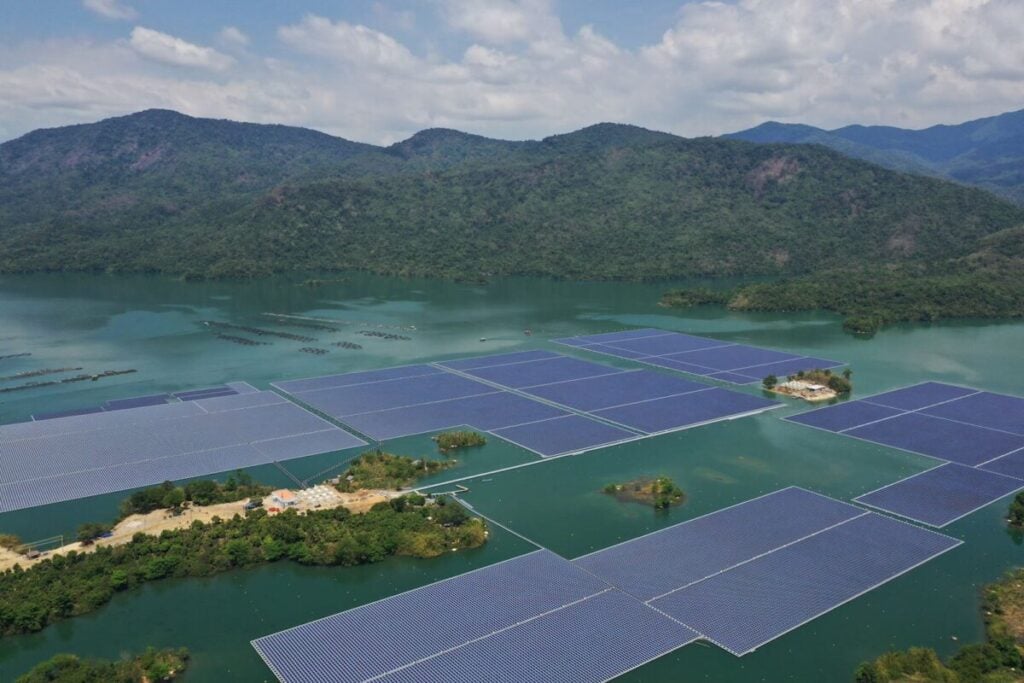
The Vietnamese state power utility Vietnam Energy Generation Corporation 1 (EVNGENCO1) has proposed the development of 270MW of floating solar PV capacity on three hydropower reservoirs.
The three projects will represent an investment of approximately VND4.4 billion (US$116,938), the utility said. The proposed sites are all in the Lam Dong province of southern Vietnam; the 96MW Dai Ninh Lake project, the 100MW Ham Thuan Lake project and the 70MW Da Mi Lake site.
Try Premium for just $1
- Full premium access for the first month at only $1
- Converts to an annual rate after 30 days unless cancelled
- Cancel anytime during the trial period
Premium Benefits
- Expert industry analysis and interviews
- Digital access to PV Tech Power journal
- Exclusive event discounts
Or get the full Premium subscription right away
Or continue reading this article for free
The Lam Dong region has an existing hydropower reservoir system, which Nguyen Tien Khoa, chairman of the board of EVGENCO1, said makes it a “region with great potential” for floating solar PV projects.
The utility – a subsidiary of Vietnam Electricity – said its proposal is in line with Vietnam’s revised Power Development plan VIII, which looks to expand renewable energy and improve electricity reliability over the coming years.
It also said that floating PV can improve the efficiency of reservoir utilisation as well as expanding renewable energy capacity without sacrificing land. The 49MW Da Mi Lake floating solar project, operated by another subsidiary of Vietnam Electricity, was the first floating PV project in Vietnam to come online, in 2019. EVGENCO1 said that project provides a “practical basis” proving the case for its plans for larger floating PV systems.
Southeast Asia has been a major growth market for floating solar, partly due to the relative lack of suitable land in the region for large-scale ground mounted photovoltaics. Rystad Energy has previously predicted that the technology will play a “key role” in the region’s solar expansion.
In February, construction began on Malaysia’s largest floating PV project. The 300MW project in Batang Berjuntai, Malaysia is being built by EDRA Global Energy, a subsidiary of China General Nuclear Power Corporation (CGN).
Last week, the Norwegian technical consultancy DNV released a set of technical standards and guidelines for floating solar projects, covering the design, operations and maintenance and the specific mooring technology used for the projects.