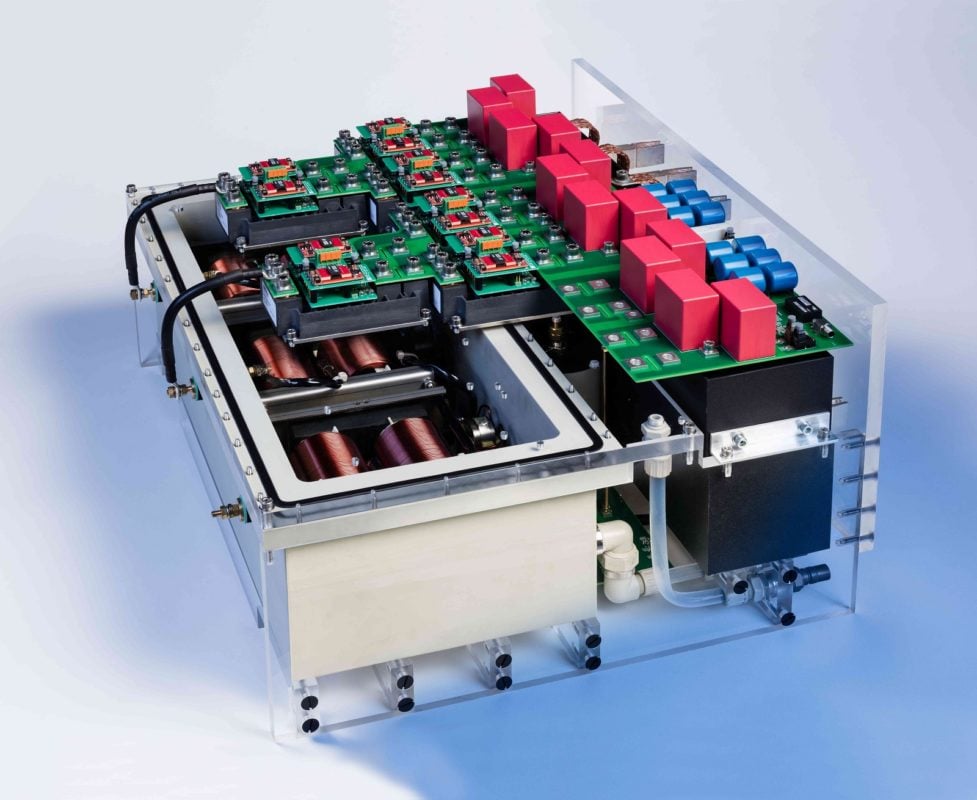
A research project has produced a silicon carbide inverter capable of enabling large-scale solar systems to connect directly to medium-voltage grids without the need of a transformer.
The project, led by researchers at the Fraunhofer Institute for Solar Energy Systems ISE, has demonstrated the use of silicon carbide (SiC) transistors in a compact inverter, posing numerous benefits to both solar arrays and grids in general.
Try Premium for just $1
- Full premium access for the first month at only $1
- Converts to an annual rate after 30 days unless cancelled
- Cancel anytime during the trial period
Premium Benefits
- Expert industry analysis and interviews
- Digital access to PV Tech Power journal
- Exclusive event discounts
Or get the full Premium subscription right away
Or continue reading this article for free
Solar systems are predominantly connected to low-voltage grids, but require coupling with 50Hz transformers to connect to medium-voltage grids. Enabling their connection to medium-voltage grids directly would open up a multitude of new opportunities and benefits for solar, Fraunhofer ISE said.
The ‘SiC-MSBat – medium-voltage inverters with high-voltage SiC power modules for large-scale storage and system-serving distribution grids’ project saw researchers at Fraunhofer ISE collaborate with other partners to produce a highly compact inverter capable of directly feeding electricity into the medium-voltage grid, as well as other tasks in support grids.
Fraunhofer ISE said the use of new types of SiC transistors offered very high blocking voltages, making it possible to connect inverters using them directly to the medium-voltage grid, while also achieving significantly higher power densities than conventional inverter designs.
The project saw the development of a 250kW inverter stack for feeding into 3kV AC grids. Novel 3.3kV SiC transistors were used in the design of the inverter stack, promising lower power losses which, in turn, allowed for the inverter stack to operate with a switching frequency of 16kHz, around 10-times higher than switching frequencies possible using other silicon transistors.
The inverter stack was then tested in Fraunhofer ISE’s laboratories in Germany and demonstrated an efficiency rate of 98.4% at its rated power.
Fraunhofer ISE said the design of the device would allow for modular interconnection of numerous inverter stacks to achieve an end output up to several megawatts, making them ideal for use in utility-scale solar systems.
Furthermore, its compact design – taking around 40% of the size of commercial inverter systems of the same voltage class – would also allow for systems to be deployed in more inner-city areas where there is less available space, the research institute said.
“With the 1500V PV technology that has been available for a few years, the low-voltage directive is already being fully exploited. The next step here will be the transition to feed-in at medium-voltage level, which will bring further potential for savings and improvements in the system concept of PV power plants,” Andreas Hensel, who head’s up Fraunhofer ISE’s medium voltage power electronics team, said.
The project was funded by the German Federal Ministry for Economic Affairs and Energy, and Fraunhofer ISE’s partners in the project included Semikron Elektronik and STS Spezial-Transformatoren Stokach.