A coalition of Australian climate groups, unions and renewable energy organisations has issued a stark warning to the data centre industry: provide your own firmed renewable energy sources or face inevitable community opposition.
The joint statement, coordinated by the Carbon Zero Initiative, establishes eight public interest principles that new data centres must meet to earn social licence in Australia’s rapidly expanding digital economy.
Try Premium for just $1
- Full premium access for the first month at only $1
- Converts to an annual rate after 30 days unless cancelled
- Cancel anytime during the trial period
Premium Benefits
- Expert industry analysis and interviews
- Digital access to PV Tech Power journal
- Exclusive event discounts
Or get the full Premium subscription right away
Or continue reading this article for free
Signatories include the Australian Conservation Foundation, WWF-Australia, the Electrical Trades Union, the Clean Energy Council, the Smart Energy Council, and the Nature Conservation Council NSW, among others.
The Australian Energy Market Operator (AEMO) projects data centre electricity demand will surge from 3TWh today to as much as 30TWh by 2035 – equivalent to adding another manufacturing sector to the grid.
Without proper planning, this growth threatens to push up retail power prices, increase climate pollution and strain electricity grids already under pressure from the renewable energy transition.
Tim Buckley, director of Climate Energy Finance and a signatory to the statement, emphasised the urgency of the situation in a LinkedIn post.
“Without effective planning to enable new renewable energy, the surge in demand will push up retail power prices, significantly increasing climate pollution, slowing the transition to renewables, the realisation of a Future Made in Australia, and straining electricity grids and scarce water resources,” Buckley wrote.
The coalition’s first and most critical principle demands that data centres be “powered by 100% additional renewable energy.”
This requirement goes beyond purchasing renewable energy certificates from existing projects. Instead, new facilities must be matched with additional renewable energy generation or curtailed generation equivalent to at least 100% of their electricity demand from the day facilities open.
The principle aims to ensure data centres expand Australia’s renewable energy supply rather than competing for existing clean power.
This approach aligns with global trends in the sector. Readers of PV Tech are likely aware that the growth of data centres and AI will transform the global energy sector, driving a surge in energy demand over the next decade.
According to a recent report from the International Energy Agency, global electricity demand from data centres is set to more than double by 2030 to 945TWh annually, driven by AI-optimised data centres, which are set to more than quadruple in the same period.
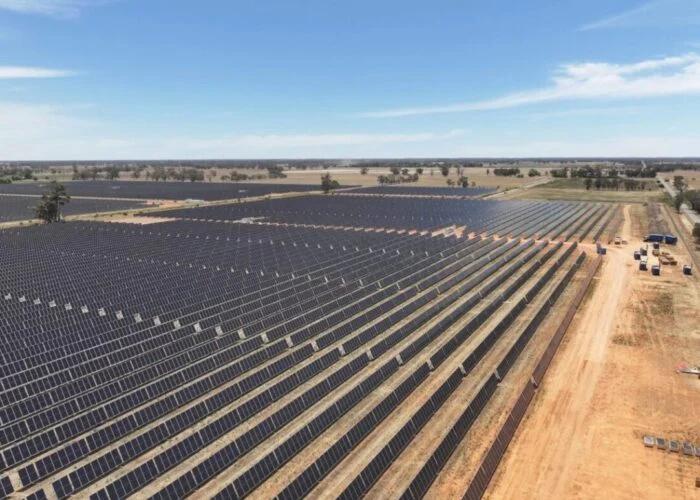
Major technology companies are already responding to these pressures in Australia. Amazon’s AU$20 billion (US$14 billion) investment in Australian data centres powered by solar PV represents one of the largest commitments to renewable-powered digital infrastructure in the region.
The investment demonstrates how hyperscale operators are increasingly linking data centre expansion with clean energy development.
The coalition’s principles acknowledge that perceived AI demand is a key driver of data centre growth and must be managed consistently with Australia’s climate, water and energy goals.
Amazon is not the only tech giant seeking to power its data centres in Australia with renewable energy.
Last year, Microsoft penned a 15-year power purchase agreement with developer Fotowatio Renewable Ventures Australia for a 353MW solar PV power plant in New South Wales. FRV Australia’s 353MW New South Wales PV plant with Microsoft data centre PPA was set to power Microsoft-owned data centres in the state.
The coalition’s second principle requires data centres to “strengthen grid stability” through demand response, storage deployment and grid-support services.
This includes providing firming capacity, controllable load and participation in contingency services. The principle recognises that data centres, if properly managed, could become valuable grid assets rather than simply additional demand.
How co-location with renewables could address challenges
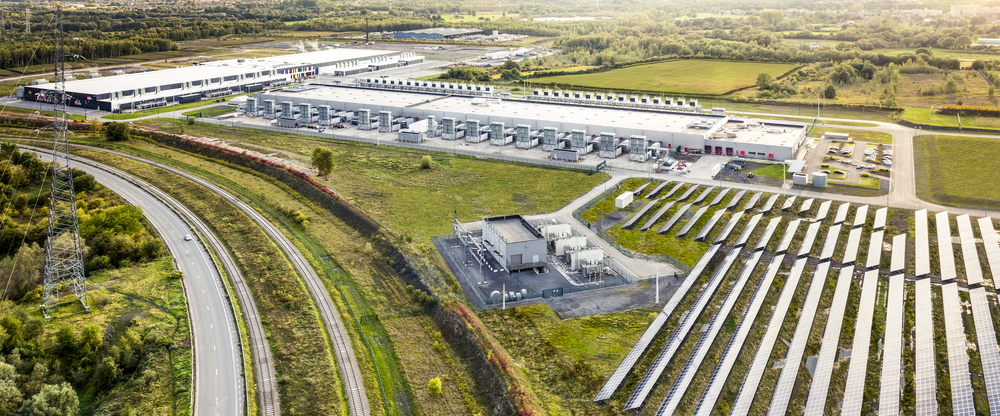
Carbon Zero Initiative research suggests co-locating data centres within Renewable Energy Zones (REZs) could address multiple challenges simultaneously.
By building facilities close to solar, wind and storage projects, operators could cut grid congestion, anchor new renewable energy projects with long-term offtake certainty, and deliver regional jobs where needed most. This approach would transform REZs into what the organisation terms “Digital Energy Zones.”
The coalition’s remaining principles address broader sustainability concerns. Data centres must be appropriately sited to minimise impacts on nature and land use, following smart siting principles that avoid high-value biodiversity areas and prioritise already-cleared or industrial land.
Facilities must also meet best-practice standards for energy efficiency and water use, with benchmarks including NABERS and Green Building Council of Australia five- to six-star ratings.
Water usage is a particular concern, with the coalition calling for highly efficient cooling systems and closed-loop systems in areas where potable water resources are stressed.
The principle reflects growing awareness that data centres’ water consumption for cooling can strain local resources, particularly in regions already facing water scarcity.
Transparency requirements form another key element, with the coalition demanding that data centres over 1MW report hourly energy mix, water use, annual emissions and cooling methods to a public database.
This should differentiate between AI-intensive and non-AI workloads, given their markedly different energy, water and emissions profiles.
The social licence principle acknowledges that public acceptance depends on demonstrable community benefits. Data centre proponents must engage meaningfully with communities and commit to local benefit-sharing arrangements.
The coalition suggests applying mechanisms from the Capacity Investment Scheme and Future Made in Australia frameworks to ensure fast-tracked approvals are conditional on binding social licence commitments.
The final principle addresses workforce development, requiring data centres to contribute to training through apprenticeships, traineeships, and accredited programs that address critical skill shortages across the construction, maintenance, and operations phases.
The stakes are considerable. Carbon Zero Initiative research indicates that, without proper planning, Australia faces an 11 TWh clean energy shortfall by 2030, likely to be made up by coal generation, prolonging fossil fuel use.
The organisation warns that data centres could add 10-15% to Australia’s total electricity demand by 2030, equivalent to the entire manufacturing sector.
However, the coalition argues that, handled wisely, this new demand could become a powerful driver for renewable energy investment. Data centres could anchor new solar, wind and battery projects, financing firming capacity and supporting regional economic development.
The difference between these outcomes, the coalition suggests, is not technical but political – requiring coordinated policy action to ensure Australia’s data centre boom supports rather than undermines the clean energy transition.
The Energy Storage Summit Australia 2026 will be returning to Sydney on 18-19 March. It features keynote speeches and panel discussions on topics such as the Capacity Investment Scheme, long-duration energy storage, and BESS revenue streams. ESN Premium subscribers receive an exclusive discount on ticket prices.
To secure your tickets and learn more about the event, please visit the official website.