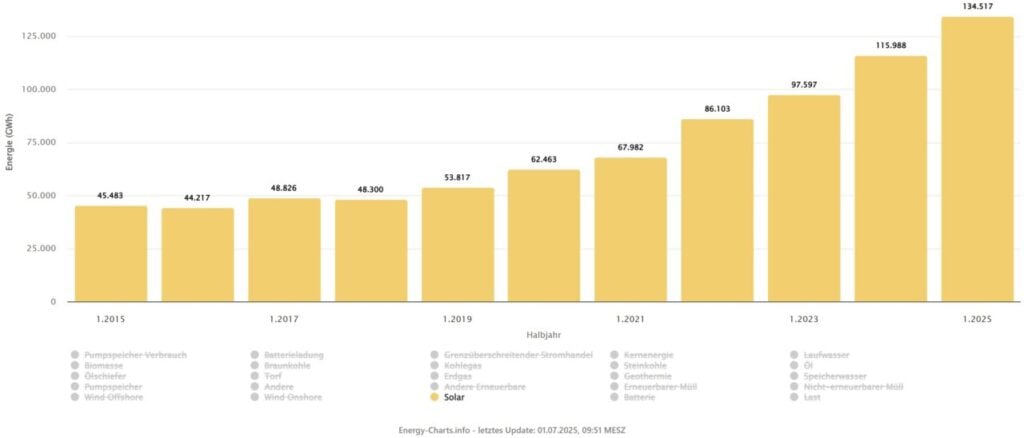
Many European countries generated record levels of solar power in the first half of 2025, according to figures presented by the Fraunhofer Institute for Solar Energy Systems (ISE).
Germany led the way, with PV systems feeding a total of 40TWh into the grid, 30% more than the 30.7TWh in the same period last year.
Try Premium for just $1
- Full premium access for the first month at only $1
- Converts to an annual rate after 30 days unless cancelled
- Cancel anytime during the trial period
Premium Benefits
- Expert industry analysis and interviews
- Digital access to PV Tech Power journal
- Exclusive event discounts
Or get the full Premium subscription right away
Or continue reading this article for free
Other European countries also saw notable increases in PV-generated power in the first half of the year: in France, PV systems contributed 15.1TWh in the first half of 2025 compared to 11.3TWh in the same period last year; Denmark reached 2.3TWh compared to 2.0TWh last year; and Poland increased its feed-in of solar power from 8.8 TWh in the first half of 2024 to 10.3 TWh in the first half of 2025.
But despite the increased contribution of solar power to net public electricity generation across Europe, the overall contribution of renewable energy fell from 358.1TWh in 1H 2024 to 344.4TWh in 1H 2025 due largely to the falling contribution from wind energy.
In Germany, for example, wind power’s contribution fell from 73.4TWh in 2024 to 60.3TWh in 2025, resulting in a share of net public electricity generation of 31.6%.
“That’s around six percentage points less than in 2024, simply because there was less wind than last year,” said Professor Bruno Burger, senior scientist at Energy Charts at Fraunhofer ISE. “The increase in solar power generation was only able to partially compensate for this.”
Overall, the share of renewable electricity in Germany’s net public electricity generation was 60.9%, down from 65.1% in the first half of 2024
The evaluation is based on data from the platform energy-charts.info.