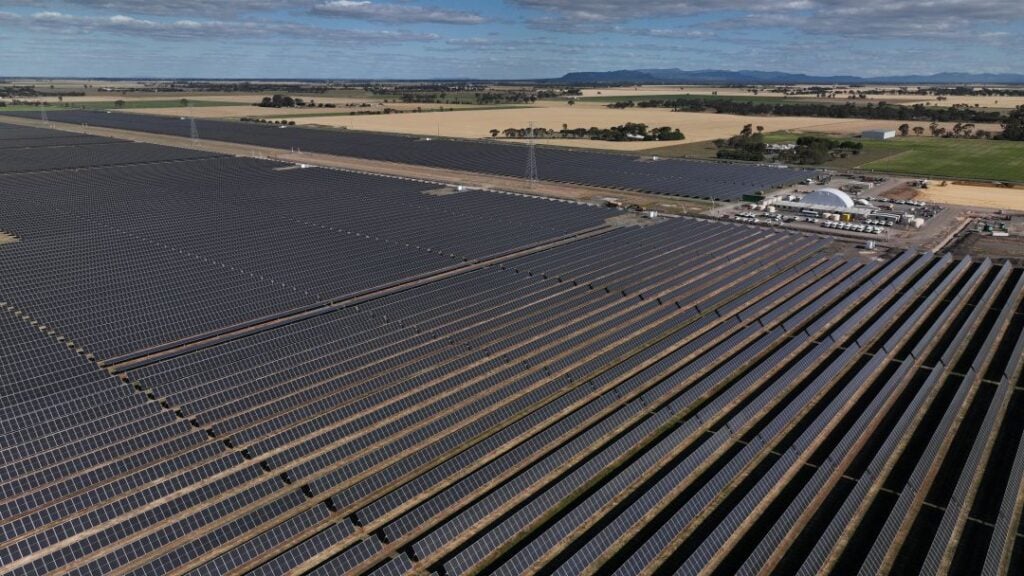
May 2026 delivered the steepest monthly solar generation decline since the summer peak, as the National Electricity Market (NEM) moved into the latter stages of autumn and daylight hours contracted further across the NEM’s southern states.
Combined utility-scale and rooftop solar output reached 3,038GWh for the month, a 21.2% fall from April’s 3,856GWh and a continuation of the seasonal contraction that has progressively reduced output from January’s combined high of 5,698GWh.
Try Premium for just $1
- Full premium access for the first month at only $1
- Converts to an annual rate after 30 days unless cancelled
- Cancel anytime during the trial period
Premium Benefits
- Expert industry analysis and interviews
- Digital access to PV Tech Power journal
- Exclusive event discounts
Or get the full Premium subscription right away
Or continue reading this article for free
Analysis of data sourced from Open Electricity (formerly OpenNEM) shows that May’s combined output nonetheless represented a 9.8% increase from May 2025’s 2,661GWh, maintaining the year-on-year growth trajectory that has been consistent throughout the past twelve months.
That improvement reflects the ongoing impact of capacity additions across both segments, even as seasonal factors suppressed absolute output to its lowest monthly level since June 2025.
The month’s generation profile was materially shaped by a sustained period of low output in the final ten days of May, when cloud cover and reduced irradiance pushed both segments well below their monthly averages.
This pattern, combined with a sharp mid-month pricing spike driven by generation shortfalls, marked May as the most volatile month of 2026 to date from a pricing perspective, a notable reversal from the stability observed in April.
Utility-scale outperforms rooftop on year-on-year basis
Utility-scale solar generated 1,327GWh in May 2026, a 21.6% decline from April’s 1,693GWh. The result nonetheless represented a 10.6% increase from May 2025’s 1,200GWh, continuing a run of double-digit year-on-year gains that has been consistent since the segment saw accelerated capacity buildout in late 2024.
Daily utility-scale generation ranged from 21.5GWh on 18 May to 56GWh on 21 May, a spread of 160.5%, which is substantially wider than April’s 56.1% spread and the largest daily range recorded so far in 2026.
The month is divided into two distinct phases: the first 20 days averaged 45.6GWh per day, broadly consistent with April’s performance, before a sustained deterioration in conditions drove the final 11 days to an average of just 30.3GWh. Daily generation exceeded 52GWh on only four days in May, compared with April where nine days reported more than 60GWh in generation.
Rooftop solar generated 1,711GWh in May, a 20.9% decrease from April’s 2,163GWh. The year-on-year comparison showed a 3% increase from May 2025’s 1,661GWh, the smallest year-on-year gain recorded by the rooftop segment in at least 12 months, and a further deceleration from April’s 6.1% growth.
Daily rooftop generation ranged from 24.1GWh on 18 May to 67GWh on 20 May, a spread of 178%.
The pattern closely mirrored that of utility-scale solar, with strong output in the first three weeks followed by a sharp decline in the final ten days of the month. Days 26 through 28 were the weakest consecutive three-day period recorded in the dataset since winter 2024.
The generation balance between the two segments continued its convergence trend. Utility-scale solar accounted for 43.7% of total output, compared with rooftop solar’s 56.3%, for a ratio of 1.29:1.
This is broadly consistent with April’s 1.28:1 and continues the trend away from the 1.55:1 ratio recorded in January, reflecting utility-scale solar’s relative resilience during the seasonal contraction compared to distributed rooftop installations.
The highest combined daily output occurred on 20 May at 118GWh, well below April’s 156GWh peak, while the lowest was 18 May at 45.6GWh, the weakest combined daily output recorded since July 2025.
Pricing spike reverses April’s stabilisation
May’s pricing environment marked a sharp departure from the relative calm of April, with a sustained mid-to-late month period of elevated prices driven by the same generation shortfall that suppressed output in the final third of the month.
Utility-scale solar prices ranged from AU$5.50/MWh (US$3.92/MWh) on 8 May to AU$225.88/MWh on 18 May, a range of AU$220.38/MWh. This represents a dramatic reversal from April’s AU$48.35/MWh range and is the widest monthly pricing range recorded in 2026 for the utility-scale segment.
Notably, there were no negative pricing events recorded for utility-scale solar across the entire month, a first since October 2025, reflecting the absence of the oversupply conditions that have periodically suppressed midday prices during stronger generation periods.
The pricing spike on 18 May, when utility-scale solar reached AU$225.88/MWh, coincided with the month’s weakest generation day at 21.5GWh.
The eight-day period from 17 to 26 May averaged AU$98.50/MWh for utility-scale solar, more than double the AU$41.70/MWh average recorded across the first 16 days of the month.
Rooftop solar experienced a near-identical pattern, with prices ranging from AU$3.15/MWh on 8 May to AU$224.50/MWh on 18 May, a spread of AU$221.35/MWh. As with the utility-scale segment, no negative pricing events were recorded across the month.
The absence of negative prices for both segments in the same calendar month is consistent with a grid that is increasingly absorbing midday solar surplus through battery storage rather than spilling it as negative-priced energy.
That shift is a direct consequence of the accelerating battery storage buildout documented across the NEM. As reported by Energy-Storage.news, Australia has emerged as the world’s third-largest utility-scale battery storage market, with 4.3GW of large-scale battery storage reaching financial close in 2025, placing it behind only the US and China in annual deployment volume.
Battery storage set prices in 32% of NEM trading intervals during Q1 2026, overtaking hydro as the most frequent price-setting technology, a structural shift whose effects are now visible in the reduced frequency of negative pricing events even during months of softer solar generation.
May’s 9.8% year-on-year growth in combined solar output, against a backdrop of the steepest month-on-month decline since summer, confirms that long-term capacity expansion continues to offset the seasonal compression that characterises the NEM’s autumn and winter period.
Whether June sustains that year-on-year trajectory will depend on how quickly conditions normalise following the weak close to May.
You can explore previous solar generation performance in our NEM Data Spotlight series, with all entries available to PV Tech Premium subscribers.