Since 2024, Nextpower has been expanding its portfolio of products it offers and has gone from working as a tracker manufacturer, as was reflected in its old name, Nextracker, before rebranding to Nextpower and evolving into a “full-platform provider” of integrated energy solutions.
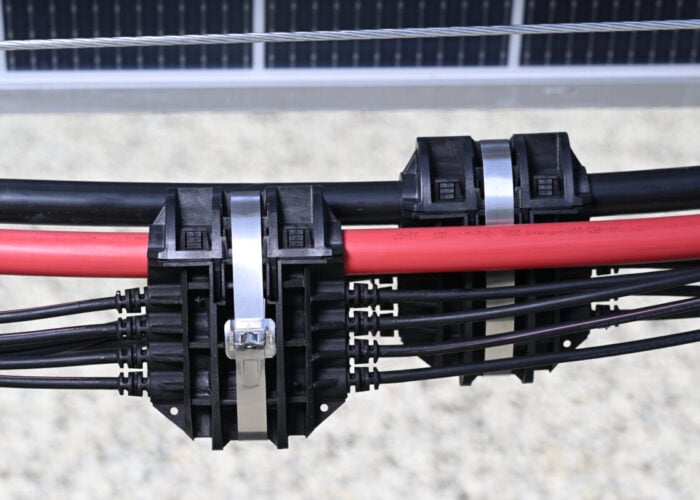
Now, Nextpower owns and offers an array of products covering trackers, solar foundations, eBOS, robotics, steel frames and a few days ago entered into the utility-scale BESS market with the acquisition of Prevalon Energy.
Try Premium for just $1
- Full premium access for the first month at only $1
- Converts to an annual rate after 30 days unless cancelled
- Cancel anytime during the trial period
Premium Benefits
- Expert industry analysis and interviews
- Digital access to PV Tech Power journal
- Exclusive event discounts
Or get the full Premium subscription right away
Or continue reading this article for free
Jenya Meydbray, VP and general manager, advanced steel frames at Nextpower, explains that all these acquisitions made, and the products acquired, by the company will eventually be integrated with the rest of the Nextpower solutions.
“You can’t tell where the foundation stops and where the tracker starts,” he tells PV Tech Premium. “It’s all co-engineered and integrated into one thing.”
Meydbray, who will be speaking at Solar Media’s PV ModuleTech USA Conference in Napa, California, on 16-17 June, gave the example of the acquisition of US-based solar foundation company Ojjo in June 2024 as indicative of how the company integrated Ojjo’s own products with Nextpower’s.
“They took 19 parts and pieces and turned them into one. That makes installation faster, which makes everything cheaper. That’s a great example of the logic that should apply across the board to all the acquisitions,” he continues. “The major trend with what Nextpower is doing is trying to be a complete solution, technology and platform provider.”
“This industry has had a bunch of components that have to be one size fits all. What Nextpower is doing is really a maturing of the industry. Post-tax credits in the US, we’re going to have to take 30% of the cost out, and that’s the way to do it.”
Co-engineering steel module frames with other components
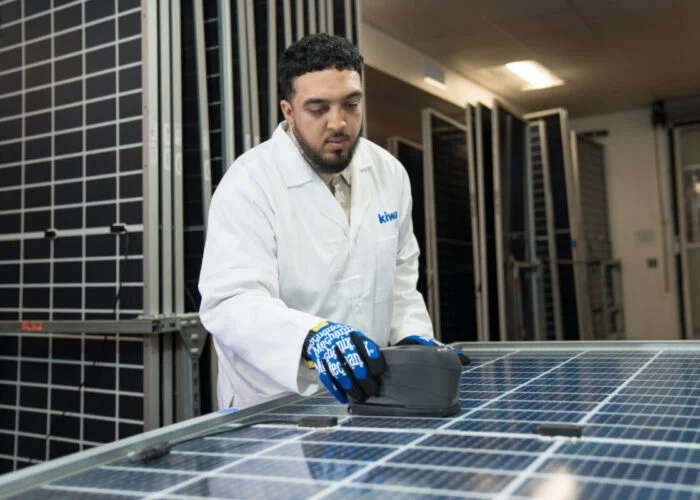
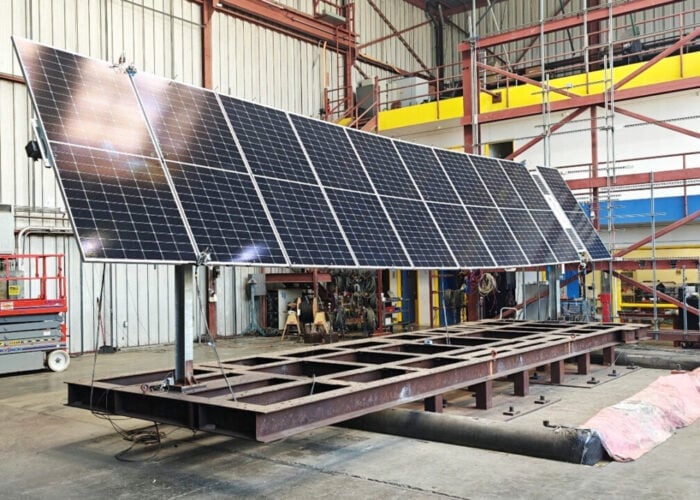
In the case of the steel module frames, following the Origami Solar acquisition in September 2025, Nextpower is currently working on co-engineering this part of the solar panel with the other components that form a solar array, such as the PV trackers and the module rail.
“For the first time in the industry, the company that designs the frame and the company that designs the module rail that the tracker has is the same company,” says Meydbray.
This is more relevant now as modules continue to get bigger, while the glass and the encapsulant used in the panel get thinner, which puts more stress on the module. Earlier this year, a report from the International Energy Agency’s Photovoltaic Power Systems programme (IEA PVPS) identified thin glass as a key contributing factor to increased rates of module breakage, and Meydbray explains that “we need something stronger than an aluminium extrusion.”
Even though interest in steel module frames is not unique to the US market, as shown with recent supply agreements made
The wide availability of steel globally and in the US, also means that developers are keen to use steel in project installations, and Nextpower has already signed a number of steel frame supply deals with Thornova Solar and T1 Energy. Indeed, the company has many manufacturing hubs for steel torque tubes in operation, and sustained use of US-made steel in solar projects will boost the percentage of domestic content in its modules.
“These frames add exactly 6% to the module domestic content in the US, which is a huge number. Everybody in the US is interested in the domestic content benefit before they even start talking about steel,” says Meydbray.
“And what has been happening in the US is that overseas frame companies import frame sections into the US. They cut a 45-degree angle at the ends, drill a hole, and call it made in the US. And they sell it as domestic content, and we have been advised by our trade attorneys that it will not pass an audit, that it will not stand up in the face of scrutiny, and so we do not do that,” explains Meydbray.
He adds that if a company loses that 6%, their whole project could lose the domestic content adders.
Overcoming steel frame manufacturing challenges
When asked what the current biggest challenge is for steel frames, Meydbray says that it is manufacturing. The process to build steel frames is complex with very tight specs and high requirements for precision, he adds.
“That’s one of the big reasons it hasn’t been done before. Because the manufacturing process for this, you know, it looks like a steel stick, but underneath it is actually a very complicated manufacturing process.”
Another downside of steel frames is the weight, with steel frames weighing two to three kilograms more than an aluminium one. “There’s probably potential to optimise the steel utilisation to make it a little lighter over time.”
However, this could soon no longer be an issue if robotics plays a major role in assisting with module manipulation and installation at a solar construction site.
This was one of the topics of conversation covered recently as part of our pre-coverage of PV ModuleTech USA with Frank Oudheusden, founder of consulting firm Azimuth Advisory Services and engineering company Resilient SolarWorks. Oudheusden told PV Tech Premium that robotics could remove the module weight constraints currently in place, as modules are mostly handled by people during installation.
Moreover, if robotics can help with the installation of the module at a construction site, Meydbray mentions that automation robots do not handle small fasteners efficiently compared to human labour.
“But we can develop a system that is co-engineered to be faster, to install either fastener-less or somehow simpler. And robots can do it nicely and quickly,” adds Meydbray. He explains that this would represent the second part of the roadmap set for Nextpower’s steel frames, with the first one starting by having those out in the field and handled by workers.