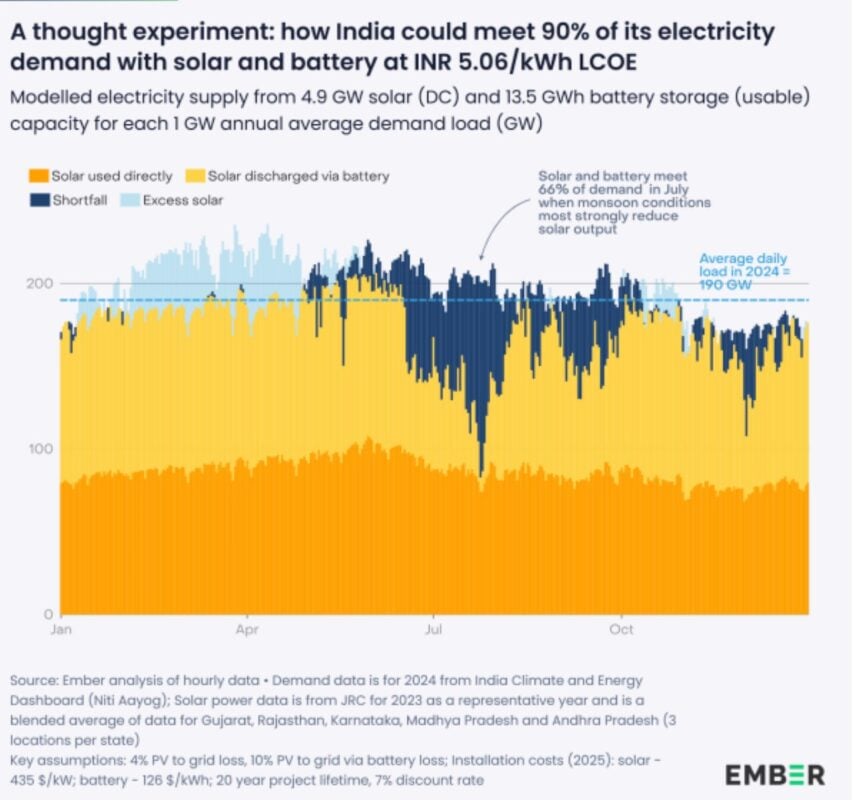
According to a new report from energy think-tank Ember, solar-plus-storage could supply up to 90% of India’s electricity demand at a levelised cost of electricity (LCOE) of INR5.06/kWh (US$56/MWh).
The report, titled Battery storage is now cheap enough to unleash India’s full solar potential, emphasised that to achieve this 90% share, India would need 930GW of solar capacity and around 2,560GWh of battery storage. This translates to 4.9GW of solar and 13.5GWh of battery capacity for every 1GW of average demand load.
Try Premium for just $1
- Full premium access for the first month at only $1
- Converts to an annual rate after 30 days unless cancelled
- Cancel anytime during the trial period
Premium Benefits
- Expert industry analysis and interviews
- Digital access to PV Tech Power journal
- Exclusive event discounts
Or get the full Premium subscription right away
Or continue reading this article for free
The report noted that this requirement represents less than one-third of India’s estimated 3,343GW of feasible ground-mounted solar potential. As of February 2026, India has installed 143GW of solar capacity, just 4% of its total potential.
“Solar and batteries are already delivering power below the prevailing power purchase costs in many states, while rivalling coal in terms of reliability. From here, the economics only becomes more compelling,” Duttatreya Das, Asia energy analyst, Ember, said.
Historically, a key limitation of solar power has been its inability to generate electricity after sunset. However, low battery costs are now enabling solar energy to be stored during the day and dispatched at night.
The report highlighted that during months with strong solar irradiation, particularly between January and April, solar and batteries can meet close to 100% of daily electricity demand. Even during peak summer demand in May and June, the system can meet around 88% of demand.
The primary constraint emerges during the monsoon season, when prolonged cloudy conditions reduce solar output. In July, solar and batteries meet around 66% of demand, highlighting the need for complementary energy sources such as wind, which tends to perform better during this period.
State-level potential shows strong alignment
According to Ember, in India’s ten largest electricity-consuming states, solar-plus-battery systems could meet between 83% and 92% of annual demand using the same configuration.
Seven of these states can achieve 90%-92% of demand at LCOEs ranging from INR4.96 to INR5.09/kWh (US$55-US$56/MWh). Andhra Pradesh leads with 92%, while Uttar Pradesh records the lowest share at 83%.
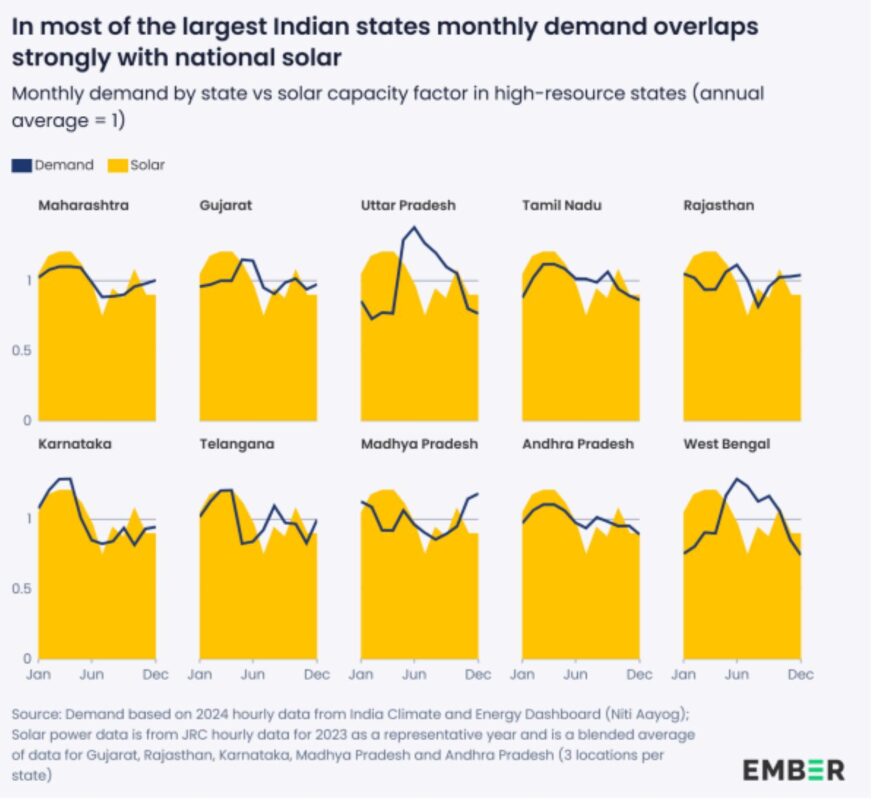
Seasonal alignment between solar generation and electricity demand plays a crucial role in these outcomes. States such as Andhra Pradesh, Maharashtra, Karnataka, Tamil Nadu and Telangana show strong overlap between peak demand and high solar output months, improving system efficiency. In contrast, Uttar Pradesh and West Bengal face less favourable conditions due to higher demand during low solar output periods.
Solar-plus-storage outcompetes coal
The report stated that solar and batteries are already cost-competitive with existing power procurement in many states. In six of the ten largest states, where solar-plus-storage can meet 90% or more of demand, the modelled LCOE is below current average power purchase costs by around 15% on average.
For example, Gujarat can meet 90% of demand at INR5.05/kWh compared with a current cost of INR5.45/kWh, while Karnataka achieves a 21% cost advantage at INR5.04/kWh versus INR6.37/kWh. Even when accounting for transmission and distribution costs – estimated to add INR1.2-INR1.5/kWh – the combined solar-plus-battery solution remains competitive.
The report contrasted these findings with rising costs in India’s coal sector. Recent coal power auctions have resulted in tariffs between INR5/kWh and INR6.3/kWh (US$55-US$69/MWh), driven by higher capital costs, declining coal quality and increased operational requirements.
Unlike solar-plus-battery systems, which offer fixed tariffs over contract durations, coal-based power remains exposed to fuel price volatility and inflation-linked cost escalations. This has prompted some states to move away from long-term power purchase agreements (PPAs).
Ember concluded that solar paired with battery storage offers a lower-cost, more stable alternative to new coal capacity, particularly as storage costs continue to decline.
India’s solar potential remains largely untapped
India’s solar resource base remains vast and underutilised. The country’s estimated 3,343GW of feasible ground-mounted solar capacity alone is more than 23 times its current installed capacity and over 17 times its average demand load in 2024.
This estimate uses just 6.7% of suitable wasteland – less than 1% of India’s total land area – and excludes additional potential from rooftop solar, floating solar and agrivoltaics.
According to the report, this resource base is sufficient to generate electricity equivalent to around three times India’s 2024 demand. With solar already contributing 9.4% of India’s electricity generation in 2025 and meeting around a quarter of demand during peak sunlight hours, its role is set to expand rapidly.