Dutch research and development company TNO, its spin-out Perovion Technologies and Japanese packaging giant Toyo Seikan have announced plans to work towards the industrialisation of perovskite solar cells.
The Dutch parliament established TNO in 1932 and is the largest independent R&D body in the Netherlands. The not-for-profit created Perovion Technologies earlier this year as a vehicle to industrialise perovskite-based solar cell technologies, and the spin-out plans to open a domestic manufacturing plant in 2030. Toyo Seikan’s specialisation is the large-scale manufacture of plastic, paper, glass and metal containers.
Try Premium for just $1
- Full premium access for the first month at only $1
- Converts to an annual rate after 30 days unless cancelled
- Cancel anytime during the trial period
Premium Benefits
- Expert industry analysis and interviews
- Digital access to PV Tech Power journal
- Exclusive event discounts
Or get the full Premium subscription right away
Or continue reading this article for free
The companies said that they would work together on a “joint development roadmap” to deploy perovskite cells where conventional glass-based silicon panels are “unsuitable or difficult to deploy”.
In April 2026, TNO announced a solar roof tile that it said was a world-first in the use of perovskite. The curved tile achieved a 12.4% conversion efficiency, the company said at the time, stating that materials and processes used in its trials of the tile were ready for industrial application under normal conditions.
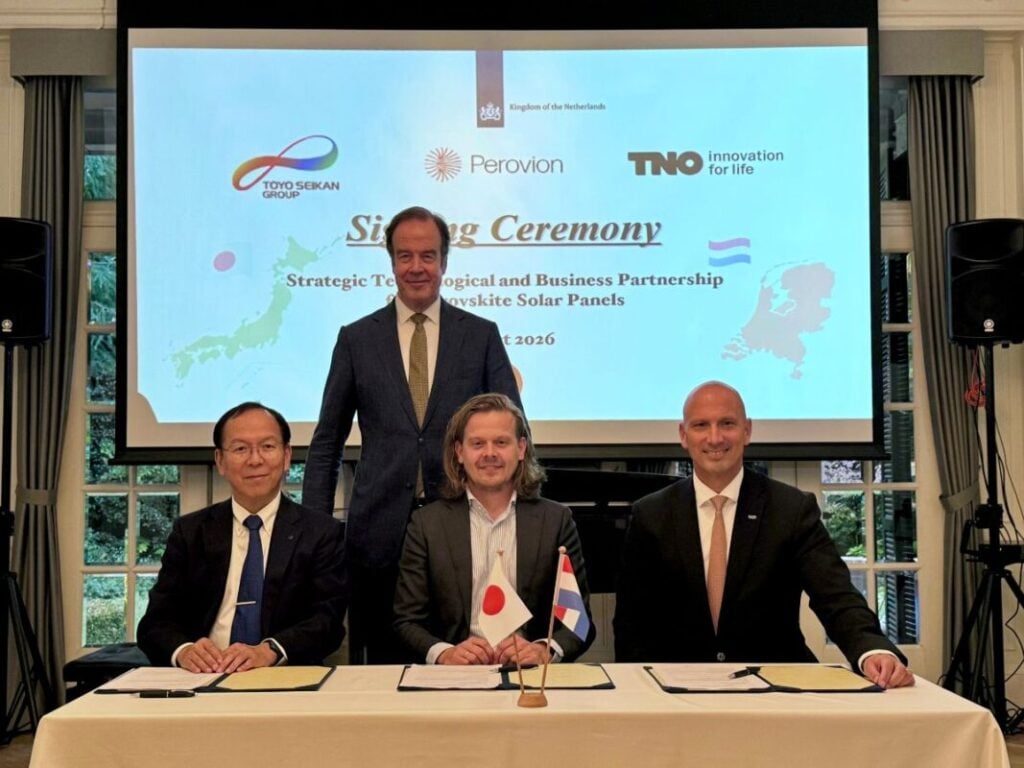
To mark the agreement between the three companies, a signing ceremony was held at the Embassy of the Kingdom of the Netherlands in Tokyo, attended by Takuji Nakamura, president of Toyo Seikan; Gilles Beschoor Plug, the Dutch ambassador to Japan; Stefan van de Beek, the CEO of Perovion; and Tjark-Tjin-A-Tsoi, TNO CEO.

“Dutch technological expertise and Japanese industrial know-how make a powerful combination. By connecting Perovion’s technology with Toyo Seikan’s expertise and market knowledge, we are bringing flexible perovskite solar technology closer to large-scale deployment and the international market,” said Tjark-Tjin-A-Tsoi.
While manufacturers and researchers often state that perovskite cells can be subject to higher levels of degradation over a typical lifespan, companies such as Oxford PV are exploring the use of perovskite in combination with conventional layers of crystalline silicon to create tandem cells.
The combination can create efficiency levels of up to 40%, considerably higher than single junction solar cells. Ahead of this year’s PV CellTech USA conference, PV Tech Premium spoke to Tandem PV CEO Scott Wharton about the company’s plans to build a “gigafactory” to build perovskite-tandem modules in 2028.