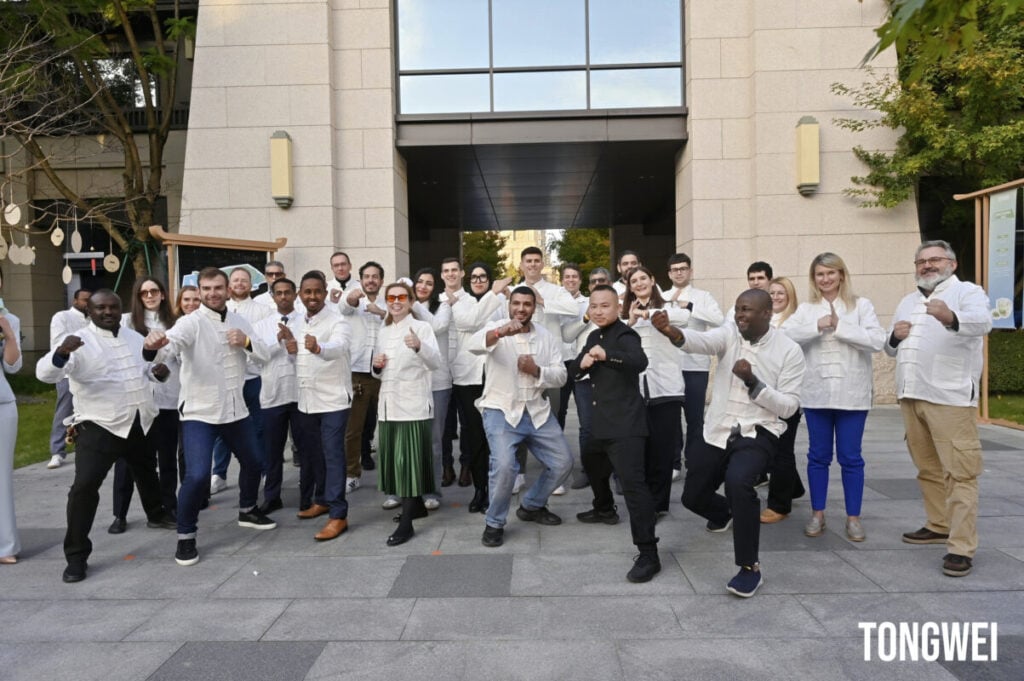
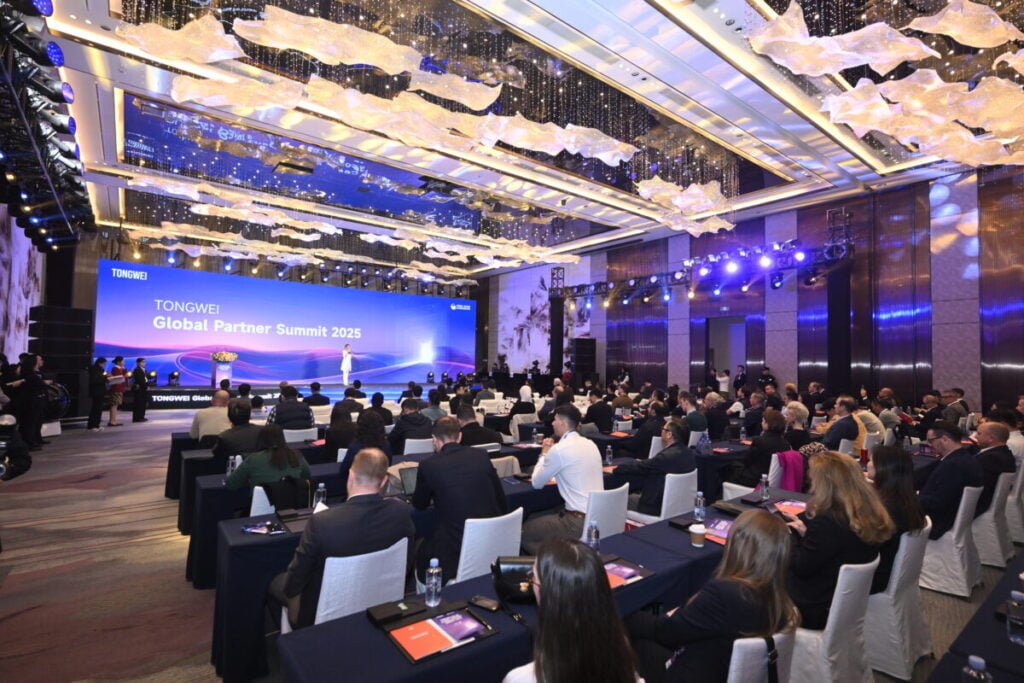
As the global solar industry races to decarbonise power systems while protecting fragile ecosystems, Tongwei used the Tongwei Global Partner Summit 2025 in Chengdu to send a clear message: high-efficiency PV, digital manufacturing and biodiversity protection must advance together.
Over two days of keynotes, technology sessions, factory visits and immersive brand experiences, Tongwei and its partners explored how to align long-term climate goals with concrete, bankable PV solutions in markets around the world.
Try Premium for just $1
- Full premium access for the first month at only $1
- Converts to an annual rate after 30 days unless cancelled
- Cancel anytime during the trial period
Premium Benefits
- Expert industry analysis and interviews
- Digital access to PV Tech Power journal
- Exclusive event discounts
Or get the full Premium subscription right away
Or continue reading this article for free
A milestone partnership with WWF for the Arctic Project
A highlight of the summit was the official announcement of Tongwei’s cooperation withthe World Wide Fund for Nature (WWF) on Arctic protection and responsible renewable energy development.
This partnership marks Tongwei as the first solar company in China to join WWF’s Arctic programme and to commit to long-term collaboration on climate, biodiversity and renewable energy in one of the world’s most climate-sensitive regions.
Winnie Lu, CEO of WWF China, underlined the urgency of joint action amid tightening energy supplies and increasingly frequent extreme weather events. She called for deeper cross-sector collaboration to ensure that clean energy expansion contributes not only to decarbonisation, but also to ecosystem resilience and biodiversity protection.
For Tongwei, the cooperation with WWF is positioned as a multi-year platform to explore replicable models that connect science-based conservation with industrial strength—from environmental monitoring to community engagement. In that sense, the Tongwei-WWF partnership is both a symbol and a testbed for how the PV industry can support global sustainable goals.
G12-Tracker Solution and TNC 3.0: ready for the next system generation
On the technology side, the summit also served as a stage to preview Tongwei’s next wave of product innovation.
Zander Yuan, director of product and technology at Tongwei, delivered a deep-dive into Tongwei’s G12-Tracker Solution and upcoming TNC 3.0 multi-cut modules. Focusing on the system level rather than a single data point, he showed how module design, tracker selection and string configuration can be co-optimised to unlock more value from large-format G12 cells.
By optimising string length and matching electrical parameters with tracker layouts, Tongwei’s G12-Tracker Solution is engineered to enhance DC capacity utilisation, improve energy yield and reduce levelised cost of electricity (LCOE). The concept is to move from “module-first” thinking to “scenario-first” engineering, especially for utility-scale projects in land-constrained or high-albedo conditions.
Yuan also introduced the TNC 3.0 multi-cut module roadmap, building on the field-proven TNC 2.0 platform. TNC 3.0 aims to push the envelope further in terms of module efficiency, system performance and lifetime value, while maintaining compatibility with mainstream trackers and inverters. Industry partners from across the utility value chain joined the session to discuss real project needs—from balance of system (BOS) design and bankability to operations and maintenance (O&M) in harsh climates.
Inside Tongwei’s Lighthouse Factory: digital, traceable, self-optimising
Reliability and manufacturability remain core concerns for investors and asset owners. At the summit, Tongwei showcased how those concerns are being addressed on the factory floor.
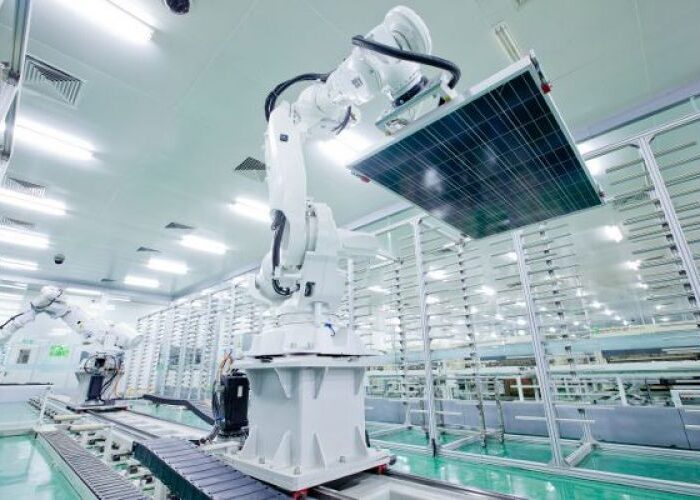
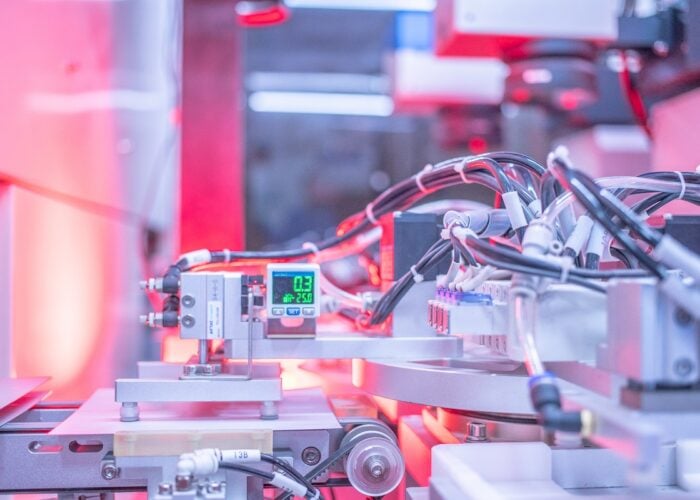
Tongwei’s Meishan production base has been recognised as the world’s first Lighthouse Factory in the PV cell sector, highlighting its leadership in digital manufacturing. During his keynote, Wang Yuxiao, senior supervisor of the Meishan Production Base, explained how Tongwei has built a fully traceable, intelligent and self-optimising production system.
From “one cell, one code” full-process traceability to the use of AI, big data and smart equipment, every critical step—from incoming materials to final EL inspection—is monitored, recorded and continuously optimised. Variations are detected early, root causes are quickly identified and corrective actions can be fed back into the line in near real-time.
This recognition carries particular weight as cells are the core performance drivers of PV modules. Their efficiency, stability and reliability ultimately define module-level output. For developers, lenders and owners, the Lighthouse Factory label becomes a tangible proxy for process control, quality consistency and long-term performance.
Seeing reliability: day-2 factory and R&D tour
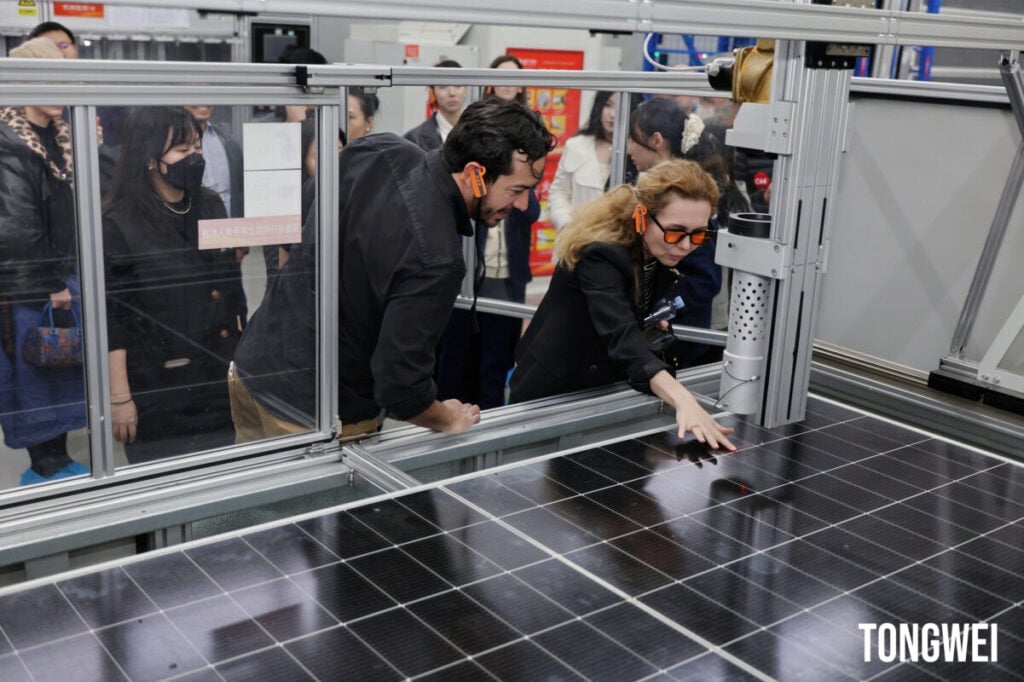
On the second day of the summit, international guests moved from the conference hall to the factory floor.
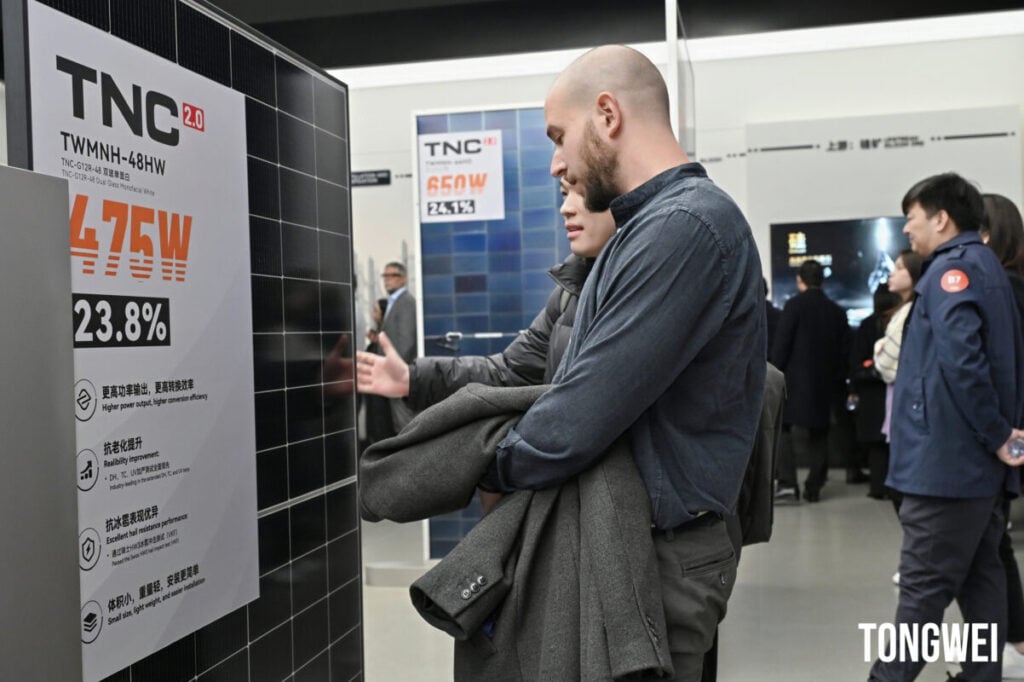
From Tongwei’s Comprehensive Bonded Zone (CBZ) to the global research and development (R&D) centre, partners explored how Tongwei integrates smart manufacturing, supply-chain strength and PV technology leadership into a coherent system. They also saw TNC 2.0 modules up close—products designed for high-efficiency and bankable reliability in real-world projects.
At the Tongwei PV Technology Exhibition Centre, an immersive combination of sound, light and interactive exhibits helped answer a simple but crucial question: why can Tongwei modules remain stable over the long term?
The answer does not lie in a single spec sheet number, but in an end-to-end, traceable and quantifiable quality framework. Guests followed the “journey” of a module across design, materials, cell production, lamination and final testing—and saw how manufacturing, technology and quality management are tightly interlocked.
In Tongwei’s global innovation R&D centre, the concept of “reliability” was broken down into observable steps. TNC 2.0 modules are subjected to sequences of tests under high temperature, high humidity, salt-mist exposure, humidity-freeze cycles and other accelerated stress conditions. For visitors, the process was presented almost like a documentary: no superlatives, only data curves, failure analysis and results repeated until stable.
Trust, the team emphasised, starts when technology becomes visible—and is reinforced when that technology can be understood, challenged and verified by partners.
Symbiosis beyond boundaries: a narrative that connects past and future
To close the summit, Tongwei hosted an evening experience themed “SYMBIOSIS BEYOND BOUNDARIES – LIGHT LEADS THE WAY · TEA TELLS THE STORY.” Using the Silk Road as its narrative backbone, the event wove together projections, sound, light and music into a new kind of “trade route”.
Through a combination of light installations, projections and music, the event drew a line from historical caravans carrying tea and silk across Eurasia to today’s global exchanges of PV technology, investment and expertise. The message was less about nostalgia and more about continuity: just as the old trade routes connected regions through goods and trust, modern “energy routes” can connect markets through reliable, low-carbon power and shared climate objectives.
For Tongwei and its partners, “symbiosis” in this context means three things: aligning industrial growth with ecological boundaries, linking manufacturing scale with data-driven quality and ensuring that the benefits of clean energy are shared across markets rather than concentrated in a few.