Europe’s somewhat delicate position—both literally and metaphorically caught between the massive economies of China and the US—means that it is often difficult to assess the financial strength of the European solar industry without looking to the east and the west.
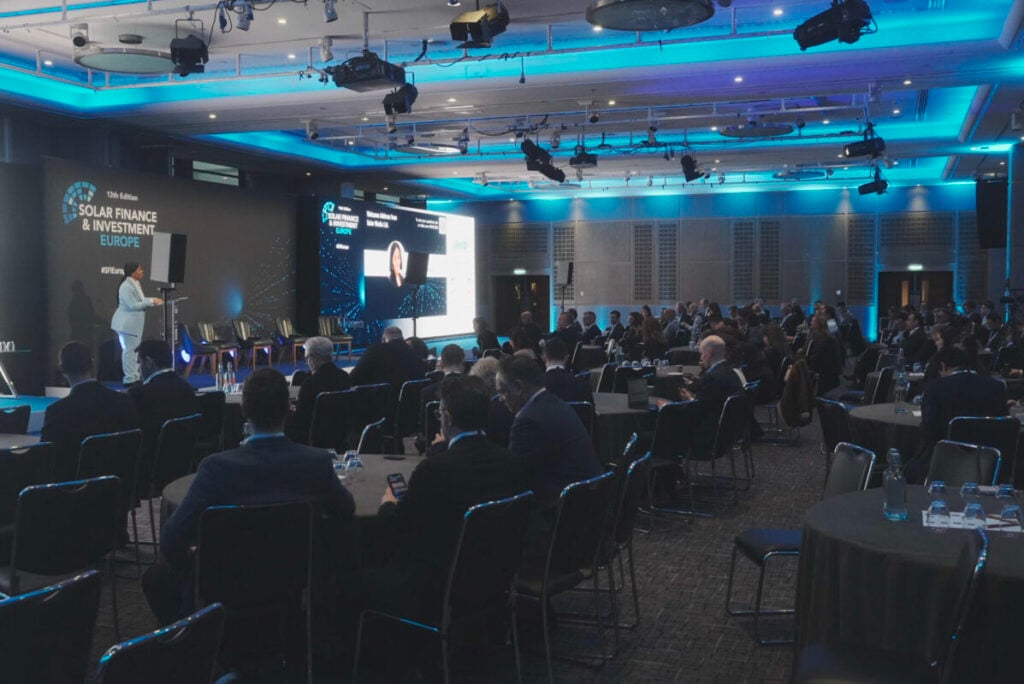
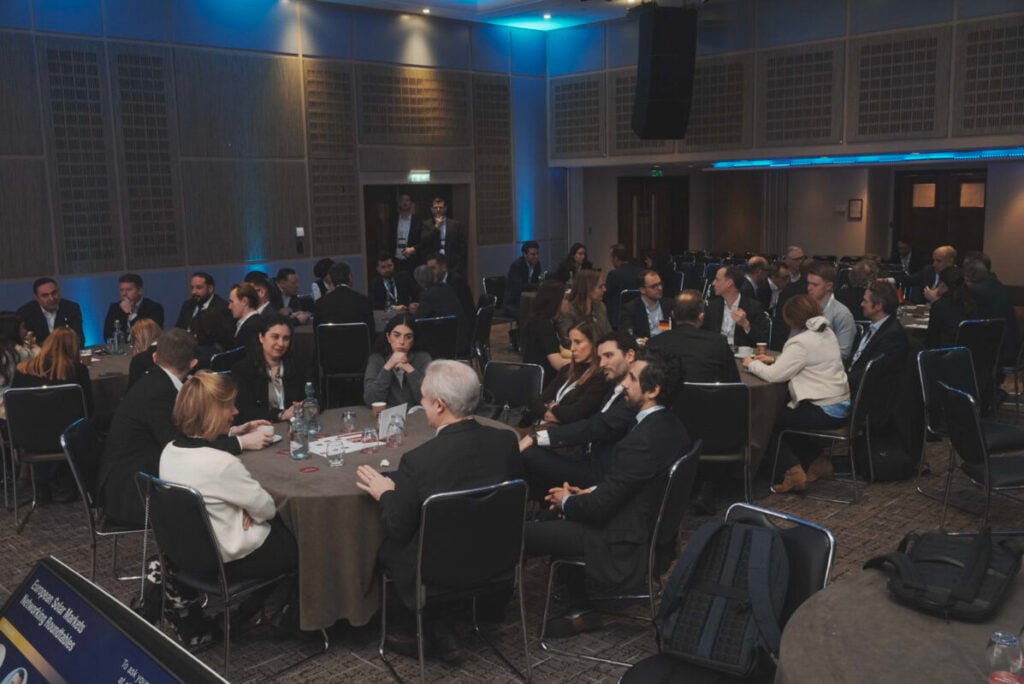
At this year’s edition of the Solar Finance & Investment Europe summit, held in London by PV Tech Premium publisher Solar Media, for instance, several delegates described new investment opportunities in European solar, simply because of the ongoing policy uncertainty, or outright hostility towards renewables, in the US.
Try Premium for just $1
- Full premium access for the first month at only $1
- Converts to an annual rate after 30 days unless cancelled
- Cancel anytime during the trial period
Premium Benefits
- Expert industry analysis and interviews
- Digital access to PV Tech Power journal
- Exclusive event discounts
Or get the full Premium subscription right away
Or continue reading this article for free
According to Domenico Tripodi, partner and co-head of investments at AIP Management, who spoke at the summit’s opening panel, the US has become exposed to country risk, “which is a new component” for financial decision-makers, who are turning to Europe for an investment landscape without those kinds of risks.
“You need to be paying attention to what the US is doing over there, and it may be helping the European countries,” Marta Valien, managing director and head of asset management at the Foresight Group, told PV Tech Premium following the panel. “These macro-factors are something that everyone is monitoring and always has an impact.”
Meanwhile, longstanding profitability challenges in China have introduced uncertainty for the global solar supply chain, with a significant cut in the production of vital materials, such as polysilicon, looming large over European solar, considering the market’s reliance on Chinese products.
“You’re still reliant on, let’s take for example, China, on the solar manufacturing side,” said Jan-Philipp Mai, CEO of Solar Materials, who also spoke to PV Tech Premium at the summit. “You cannot neglect that completely.”
This geographic uncertainty comes as the renewable energy industry in general, and European solar in particular, undergoes technological changes, such as the growth of data centres, which are driving energy demand in a new direction. Scott Douglas, senior director and head of debt advisory at Centrus, told PV Tech Premium at the event that the growth of data centres translates to a “massive investment required in energy generation, and the grid capacity to support that.” His comments are available in full in the video above.
“It’s an issue that’s not just affecting us in the UK, but it’s an issue even across the Atlantic,” he continued. “It’s not an isolated issue, but one that countries around the world are facing and we face an increasing demand for energy.”
Building European resilience
However, the influence of the US and China is not to say that Europe is unable to tackle some of the challenges facing its energy system; as Valien said at the summit, “we have clear players in the industry here; this is the moment where you need to be taking the chance of having those discussions.”

Perhaps the most striking example of this has been Europe’s tentative steps towards rebuilding a solar manufacturing industry within its borders. With industry players like France-based Holosolis ramping up module manufacturing, Mai told PV Tech Premium that other parts of the supply chain, such as module recycling, are well-positioned to be developed in Europe.
“You have completely different angles depending on the region you’re operating in,” he explained, discussing how the demand for industry can differ in different parts of the global solar supply chain. “If we take Europe, for example, you have the Green Deal, you have a lot of environmental, social and governance (ESG) issues that are related to recycling and end-of-life management.”
“Europe is underselling what Europe has to offer, and the position it has in the global economy,” he continued, expressing optimism about the potential for more industrial action in European solar in the future, within the global context of increased appetite for more localised manufacturing and secure supply chains.
“Of course, you have the ‘Make America Great Again’ story, which you can transfer to Europe, maybe from a different angle.”
Uncertainty driving the business case
Mai also stressed that his optimism doesn’t just come from a desire to see the energy transition realised, but genuine faith in the business case for more industrial practices to be developed in Europe. This is particularly significant for Solar Materials’ recycling work, in particular, as the steady ageing of the world’s operational solar assets means there is an increasing demand for the end-of-life care of solar PV projects, regardless of the economic and supply chain dynamics affecting individual markets.
“If you look outside of Europe, it’s more about strategic materials and raw materials you want to recover; the view changes, but the business model is the same: it’s always about recycling stuff,” he said. “We would like to adapt the business model that we have to certain needs, which may mean we have to tell our story differently [such as] recycling and not mining, or the opposite.”
Scott also said that there is strong potential for new business cases in Europe to grow from this global uncertainty.
“What strikes me overall is that there’s a huge opportunity for developers, investors and infrastructure to be a part of the solution to this,” Douglas told PV Tech Premium. “Where you have large requirements to invest in energy generation, and also grid capacity, that will only offer opportunities for investment, which is good for investors, but also good for society as a whole.”
Thinking outside the box
However, Mai was realistic about Europe’s potential to build a new solar industrial sector, admitting that “there is no big solar industry on the manufacturing side left in Europe; if you want to build something circular, you have to think outside the box”.
This kind of ‘thinking outside the box’ is perhaps reflected in the manner that Europe has invested in its manufacturing space, pursuing aspects such as inverter manufacturing and cybersecurity, rather than looking to compete with the US and China on sheer volume of module production.
Alternatively, production of further upstream components remains viable in Europe, particularly in collaboration with the US, with German wafer manufacturer NexWafe announcing a supply agreement with US-based cell producer Talon PV last week.
Mai was optimistic, however, that any kind of uncertain environment will put a premium on secure supply chains and those who can deliver them, which will create opportunities for European suppliers.
“I think one thing that we’ve learned over the last 18 months, with all the tensions in geopolitics increasing the raw materials’ prices, is that all of a sudden, it has become more and more important to recover the materials, which gives an additional push to our business model,” he explained.
“I wouldn’t say we are the ‘winners’ of the crisis, but we’ve profited and shown that you can make something from that change, which is good for everybody; that’s something that we learned and would like to foster more.”
Read all of our coverage of the event, including in-depth analysis of the panel discussion mentioned in this article, here.