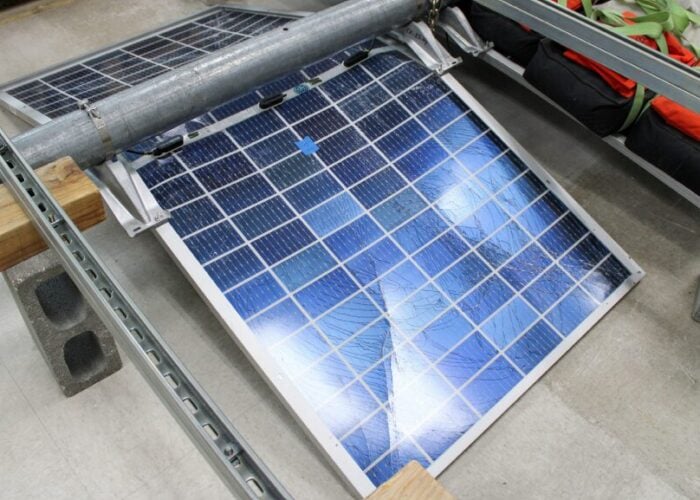
As solar manufacturing capacity multiplies across new geographies, from the US to India to the Middle East, Cherif Kedir, CEO of the US-based Renewable Energy Testing Center (RETC), says he is seeing a pattern repeat itself with striking consistency: every time production moves to a new location, quality drops.
“Every single time a manufacturing plant moves, quality tanks, and it doesn’t matter where they go,” Kedir tells PV Tech Premium.
Try Premium for just $1
- Full premium access for the first month at only $1
- Converts to an annual rate after 30 days unless cancelled
- Cancel anytime during the trial period
Premium Benefits
- Expert industry analysis and interviews
- Digital access to PV Tech Power journal
- Exclusive event discounts
Or get the full Premium subscription right away
Or continue reading this article for free
This has nothing to do with one country being inherently better at manufacturing than another, he stresses. It comes down to the mechanics of setting up a new line: equipment that needs retuning, process and temperature controls that take time to stabilise and, critically, a freshly trained workforce without the experience to catch problems before they propagate through thousands of units.
Kedir alludes to what is popularly labelled in the solar industry as the “whack-a-mole” phenomenon, which has played out over recent years as production has shifted from China to Southeast Asia, then to Africa, Turkey and the Middle East, and now increasingly to the US and India.
The US case is particularly acute, he argues, because domestic manufacturing expertise has atrophied over decades of offshoring.
“The US has completely forgotten how to manufacture,” he says, and the industry is now having to train a workforce from scratch while competing for the small pool of workers who have already gained experience.
The consequence, according to Kedir, is that RETC’s labs are now seeing defects and failure modes resurface that the industry believed it had resolved more than a decade ago. These are not issues tied to emerging technology transitions, such as the sector’s ongoing work to fully understand UV-induced degradation in TOPCon cells. They are basic, fundamental reliability problems.
“Any failure that you can think of, we see in the lab now. We’re all scratching our heads, thinking we haven’t seen these failures in 15 years, and now they’re popping up almost on a daily basis,” he says.
This matters because of the scale of investment now flowing into new manufacturing hubs, including new cell and module facilities and the onshoring of the broader supply chain under local content requirements. Kedir cites a recent ribbon-cutting at an Oklahoma cell factory, launching at 2GW of capacity with plans to scale to 6GW, as emblematic of a wave of new entrants that will need to prove they can meet the quality standards the industry has come to expect.
Kedir is careful to distinguish this pattern from bad faith. “Every single manufacturer is really well meaning,” he says, adding that RETC does not work with companies unwilling to improve, since its certification is not intended as “a rubber stamp”. The quality issues he describes are, in his assessment, a predictable consequence of rapid expansion rather than negligence, but one that nonetheless poses real risk to projects and investors if left unaddressed.
“All of it is solvable, and I’m not saying it’s cataclysmic,” he says. “But it’s a lot of problems that require companies like us to keep watching.”
Why longevity testing matters more as the market expands
Kedir connects this quality picture to a long-running concern about consolidation. He frames the current period of global manufacturing growth as the precursor to an inevitable wave of market shakeout. “The industry is expanding at a rapid rate, which means it will consolidate at a rapid rate in the future,” he says, pointing to China’s consolidation as a template likely to be repeated in India within a year or two, and in the US within three or four years.
For developers, financial institutions and insurers underwriting utility-scale projects, that dynamic makes independent longevity testing essential, Kedir argues, because no project stakeholder can rely on a manufacturer still being in business decades into a project’s operational life.
This is the thinking behind RETC’s Thresher Test, a longevity and reliability testing programme the company introduced in 2010 and has offered freely to competitors ever since, conceived in response to a now-familiar cycle in which leading manufacturers have gone bankrupt within a year of topping global shipment rankings, leaving billions of dollars in installed assets without a warranty backstop. The programme, he says, is designed “to ensure that the product they were investing in would outlast the company that sold it to them as a worst-case scenario”.
Treating solar as a commodity market
Asked what message he would give the industry at this juncture, Kedir returns to a theme he says took him years to internalise after moving from the semiconductor industry, with its high margins, into solar. Solar modules, he argues, sit in a pure commodity market, energy generation, where price is the default differentiator unless manufacturers can demonstrate genuine, verifiable value beyond the sticker price.
He uses a simple analogy: two cans of beans, one considerably cheaper than the other, will sell on price alone unless something, an organic label, for instance, gives a buyer reason to pay more. For Kedir, RETC’s certification marks serve the same function for PV modules, signalling durability and quality that justify a premium.
But he is emphatic that this cannot be a one-off stamp. It requires ongoing verification: RETC conducts quarterly factory inspections and batch-level testing to confirm that production continues to meet the standard a manufacturer demonstrated in its original certified samples.
NRTL status: expanded certification offering
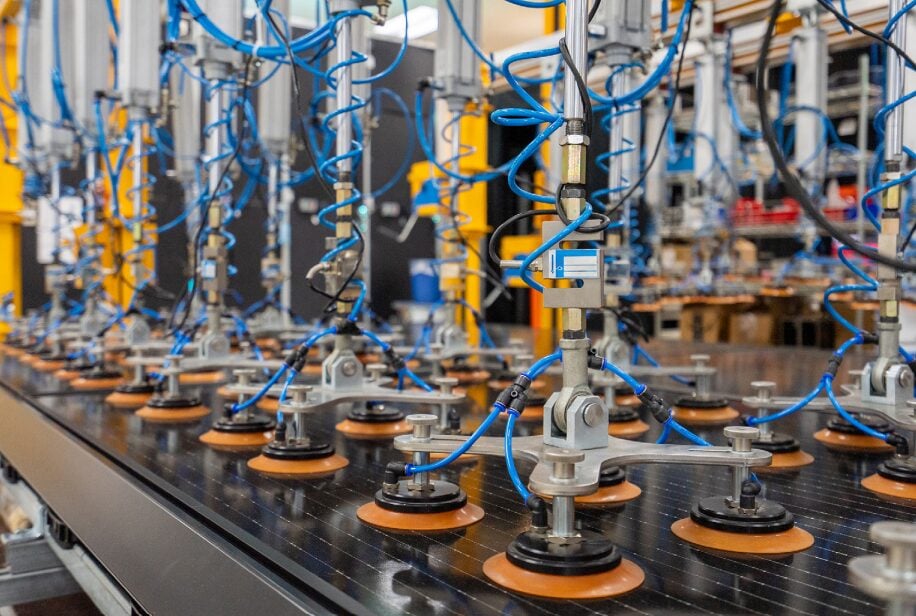
It is against this backdrop of shifting manufacturing geography and uneven quality that RETC’s recent news takes on added significance. Last week, the company announced it had been accredited as a Nationally Recognized Testing Laboratory (NRTL) by the US Occupational Safety and Health Administration (OSHA), a designation held by only around 20 organisations worldwide, and one that governs safety approval for products sold into the US consumer market.
As Kedir explains, regulators are not concerned with how much power a PV module generates, but whether it might start a fire on a rooftop or electrocute someone during maintenance. “The government cannot review your reliability data and what you’ve done, so they rely on agencies, accredited agencies, to do that,” he says.
For RETC, now part of Germany’s VDE following a merger that combined 135-year-old European safety testing heritage with RETC’s renewable energy specialism, NRTL accreditation effectively completes a global certification offering. The company already held National Certification Body (NCB) status recognised outside the US through VDE; the new accreditation gives it an equivalent, universally recognised mark domestically.
“The idea is to have one gold mark that can clearly identify a product as safe and reliable anywhere you want to sell it around the world,” Kedir says.
In practical terms, the accreditation also broadens RETC’s scope beyond modules. The company can now certify UL 1741, a US safety standards that encompasses power electronics, inverters, optimisers, power supplies and ultimately a wider range of grid-connected equipment. To support the expanded remit, RETC plans to triple its US testing capacity within six months, with further investment planned in Germany and Asia over the next one to two years.
Testing rigour in a volatile market
Taken together, the NRTL accreditation and the quality concerns Kedir raises point to the same underlying reality: as manufacturing capacity multiplies across new geographies, and as the industry absorbs the inevitable growing pains of new lines, new workforces, and new supply chains, independent, rigorous and recurring testing becomes not a nicety but a safeguard, for developers, financiers, and ultimately for the credibility of solar as a reliable long-term energy investment.
RETC’s expanded accreditation gives it a broader and more globally recognised mandate to play that role, including for emerging technologies such as perovskites, for which Kedir says RETC has been developing dedicated test programmes since 2021. But as he makes clear, the accreditation itself is secondary to the underlying discipline it is meant to support.
As he puts it, quality assurance is what allows the industry to demonstrate it is worth paying “a few more cents” for, and, in a market defined by recurring consolidation cycles, what will determine which products and companies are still standing to honour their warranties decades from now.