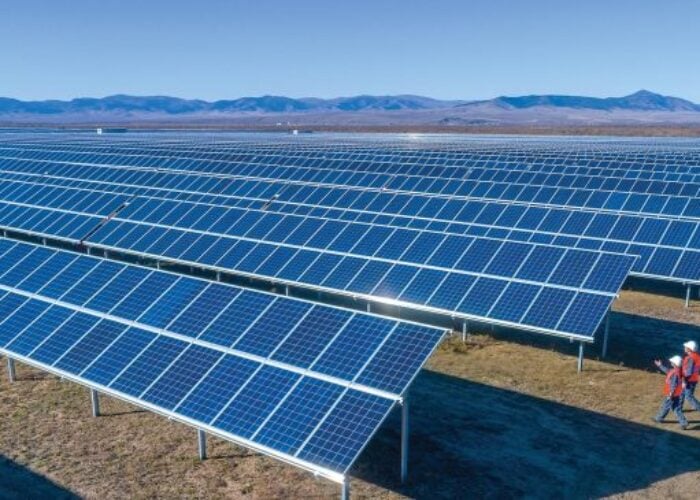
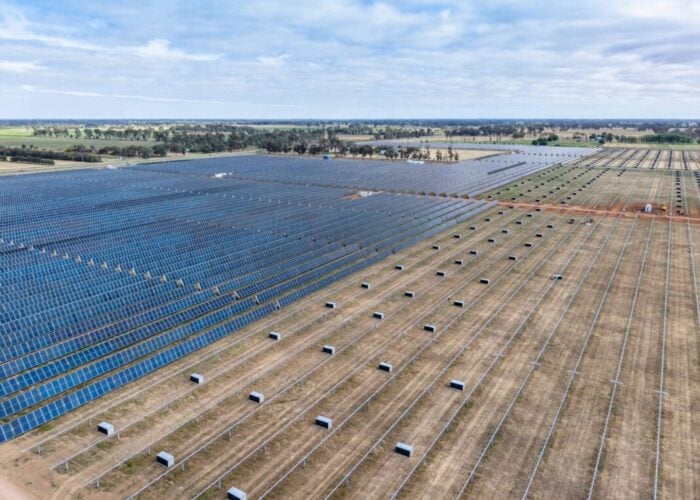
Chinese PV manufacturer Trina Solar has emphasised that a reported divestiture of its solar tracker business is in the preliminary stages and has not yet reached mandatory disclosure thresholds.
Trina’s statement followed a 30 October announcement by gas-fired power producer Shenzhen Nanshan Power (also known as Shennan Power A) of plans to acquire a controlling 51% to 70% equity stake in TrinaTracker from Trina Solar through a cash transaction. The deal would trigger a major asset restructuring and has drawn heightened market attention.
Try Premium for just $1
- Full premium access for the first month at only $1
- Converts to an annual rate after 30 days unless cancelled
- Cancel anytime during the trial period
Premium Benefits
- Expert industry analysis and interviews
- Digital access to PV Tech Power journal
- Exclusive event discounts
Or get the full Premium subscription right away
Or continue reading this article for free
In response to Shenzhen Nanshan Power’s announcement, Trina Solar’s core message to the market was twofold: it intends to bring in strategic partners and strengthen its core PV and energy storage operations, while prioritising innovation in AI data centres and power‑grid coordination.
Shenzhen Nanshan Power said it planned to acquire a 51% to 70% stake in TrinaTracker from Trina Solar subsidiary, Trina Technology, in a cash deal, as part of its efforts to advance its corporate transformation and strengthen its core competitiveness.
Under the proposed structure, Trina Solar would retain a 30% to 49% stake and act as one of the performance‑commitment parties. Analysts said that relinquishing majority control while maintaining joint growth would allow Trina Solar to optimise its asset allocation and sharpen its focus on core businesses during an industry downturn. By keeping a 30% to 49% holding, Trina Solar could continue to share in TrinaTracker’s growth while unlocking capital returns.
Public records show that TrinaTracker was established in February 2019, with a registered capital of RMB138.2 million. In terms of ownership, Trina Technology holds a 100% stake in TrinaTracker, and Trina Technology itself is a wholly owned subsidiary of listed parent Trina Solar.
According to Trina Solar’s prior disclosures, TrinaTracker was the first PV company to set up dedicated tracker R&D and engineering centres in both Europe and Asia. Its self-developed Pioneer series smart trackers are powered by an industry-leading smart control system that enables coordinated operation between core proprietary algorithms and a cloud-based smart platform. They not only align precisely with time-of-use (TOU) tariffs to boost generation efficiency and returns during morning and evening hours, but also provide predictive diagnostics that boost the operational efficiency of PV plants.
TrinaTracker has also built a global production and sales footprint, with operations across China, Asia-Pacific, the Middle East and Africa, Europe, Latin America and the Caribbean, and North America, delivering end-to-end solutions and services to customers worldwide.
According to Wood Mackenzie’s Global Comprehensive Ranking of Solar Tracker Manufacturers, published in June 2026, TrinaTracker retained the number two position globally.
Shenzhen Nanshan Power said the deal aligns with its development strategy and, building on its existing gas-fired power generation and integrated energy services business, will help the company steadily expand into new business segments, cultivate a second growth curve and open up new avenues for growth.
Guohong M&A Research Institute noted that the acquirer in this transaction is a gas-fired power generator backed by Shenzhen municipal state capital, the seller a leading global PV module manufacturer and the target the world’s second-largest PV tracker producer. All parties face operational pressures and strategic transformation imperatives.
For one thing, China’s PV sector remains in a cyclical downturn in 2026 amid ongoing capacity consolidation. For another, traditional energy companies are seeking new growth pillars as their core businesses face limited expansion. This cross-sector deal therefore raises multiple considerations, including asset quality, valuation frameworks, control arrangements and performance commitments. Cross-sector M&A and capacity consolidation in China’s PV industry are still underway, and this transaction offers a useful case study. Pricing reasonableness and post-deal execution remain to be seen.
Trina Solar further noted that subsequent progress in the preliminary discussions with Shenzhen Nanshan Power would be subject to the completion of due diligence, audit and valuation, as well as internal and regulatory approvals. There is no assurance that the parties will enter into a definitive agreement, and investors should refer to the company’s subsequent official announcements for updates, it said.