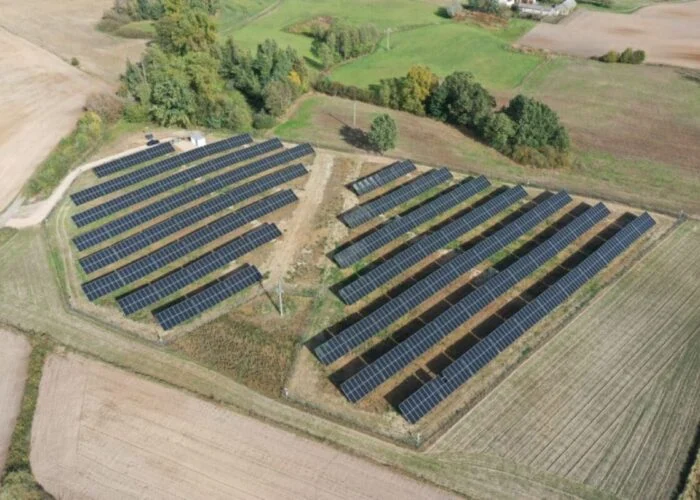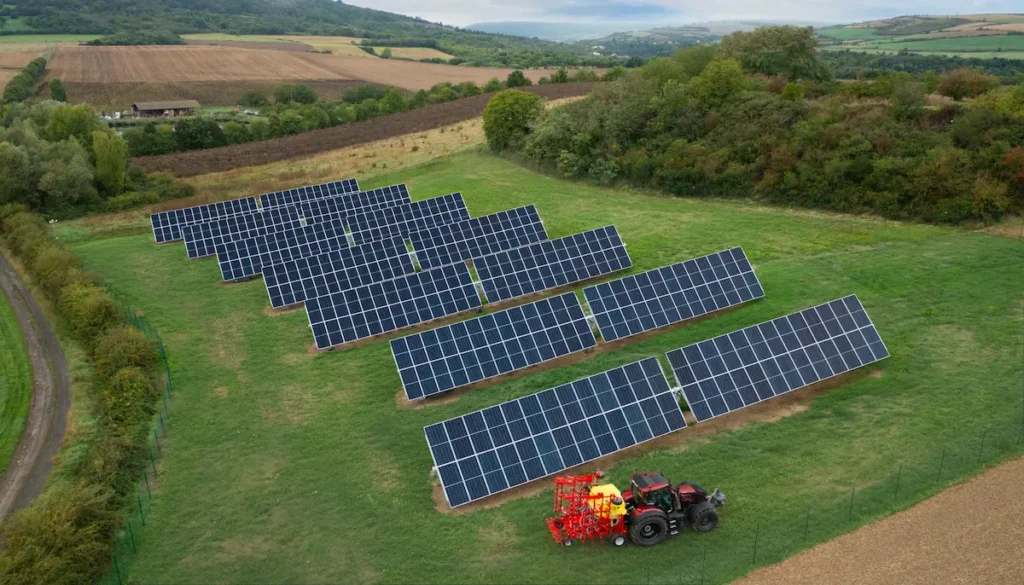
French renewables developer TSE Energy will build a 500MW portfolio of agrivoltaics projects on cooperatively-owned French farmland.
The developer will build the projects over the next decade in a partnership with the Océalia Cooperative Group, an agricultural cooperative with territory across southwestern France.
Try Premium for just $1
- Full premium access for the first month at only $1
- Converts to an annual rate after 30 days unless cancelled
- Cancel anytime during the trial period
Premium Benefits
- Expert industry analysis and interviews
- Digital access to PV Tech Power journal
- Exclusive event discounts
Or get the full Premium subscription right away
Or continue reading this article for free
Agrivoltaics pairs solar PV and agriculture on the same land, making dual use of the same resource and often enabling a supplementary income stream for farmers. TSE described the partnership as a “win-win” for renewable energy production and agricultural communities.
“This partnership with a key player in western France will allow TSE to offer its proven agrivoltaic solutions, designed to support the agricultural sector and produce competitive French electricity,” said Bertrand Drouot l’Hermine, deputy managing director of TSE. “The added value for the region, the supplementary income, and the agrivoltaic services provided to farmers are the strengths of this collaboration.”
The company said that the agrivoltaics projects will be compliant with France’s APER (Acceleration of the Production of Renewable Energies) law, which identifies areas where permitting and administrative processes for renewable energy projects can be accelerated. The APER law also requires that agrivoltaics projects maintain, develop or improve the agricultural production at the site.
TSE said that its partnership with Océalia would help to secure the future of agriculture in the region, as revenue from electricity production can offer a more secure income than farming products, in cases where poor weather conditions, water shortage or other climate change conditions can impact production.
Details of the projects themselves were not provided. Agrivoltaics projects can take a variety of forms, with different solar module configurations suiting different crops or livestock beneath, around or between them. The practice is often more expensive than standard PV development in terms of levelised cost of energy (LCOE), but offers other societal and sustainability benefits which can be useful levers for solar developers in the face of community pushback.
European countries have provided a mixed bag of support and resistance to agrivoltaics. In October, the Spanish government included agrivoltaics projects in its farming subsidy scheme, a move that will make integrating PV and agriculture more widely viable.
By contrast, Italy pursued a plan to tighten the rules around PV on agricultural land that was met with criticism by legal and industry figures. However, the government issued an agrivoltaics tender in April 2025, looking to allocate €323 million (US$385 million) for agrivoltaics development.