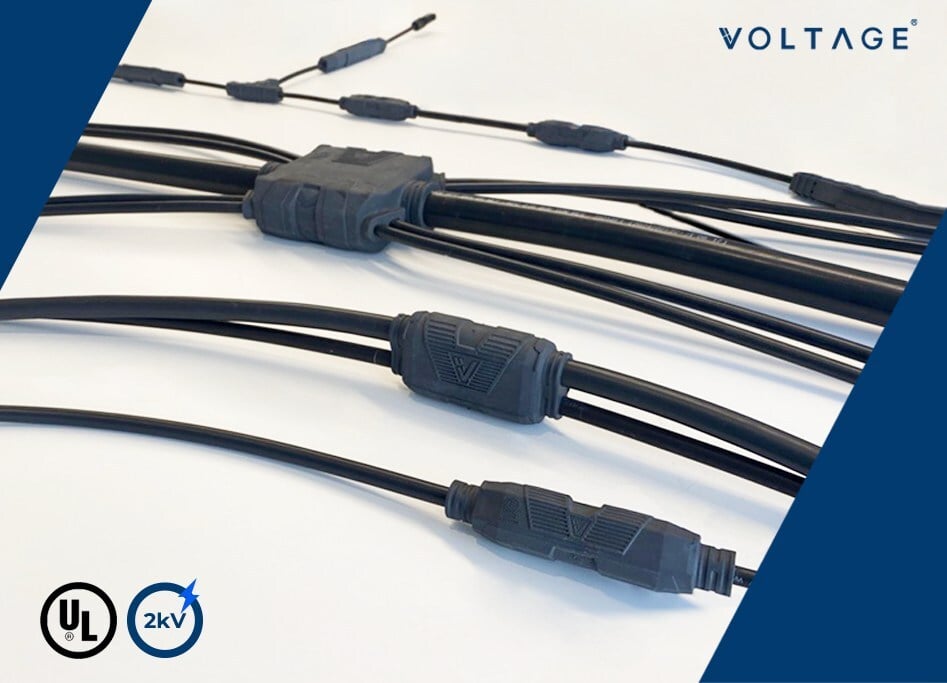
US electrical balance of system (EBOS) equipment supplier Voltage Energy has received what it calls the solar industry’s first full-system 2kV EBOS certification from testing and certification company UL Solutions.
The certification is for the UL9703 standard, a harnessing standard for distributed generation projects, which also includes a certification programme mandated by the National Electricity Code (NEC) to gain access to the North American market. UL Solutions granted the certification to four Voltage products capable of integrating with 2kV systems: the LYNX, IBEX and IBEX PLUS pre-assembled wiring solutions; and the ALEX aluminium extension, which connects string harnesses to combiner boxes and string inverters.
Try Premium for just $1
- Full premium access for the first month at only $1
- Converts to an annual rate after 30 days unless cancelled
- Cancel anytime during the trial period
Premium Benefits
- Expert industry analysis and interviews
- Digital access to PV Tech Power journal
- Exclusive event discounts
Or get the full Premium subscription right away
Or continue reading this article for free
When Voltage launched the IBEX PLUS and LYNX products at the RE+ trade show, held in California in September, it noted that both were designed to comply with UL9703 standards. This week, the company’s leaders stressed the importance of building certified 2kV system architecture as the solar industry more broadly moves to larger voltages.
“Moving to 2kV is not just a component upgrade,” said Angel Lopez, director of quality at Voltage Energy. “It requires coordinated progress across the value chain, with modules, inverters and EBOS validated together, supported by aligned standards and cross-testing that reduce variability in field deployment.”
Lopez called 2kV architecture the “next-generation” of PV design, and increasing system voltage, while keeping current constant, has been touted as a way to increase the volume of power transmitted by a solar system, while reducing the number of components needed on site, reducing cost and complexity.
Earlier this year, Brian Nelson, renewables segment leader for ABB, said that part of the reason for slow adoption of 2kV technology was not the technology itself, but a lack of standardisation for 2kV systems, which has slowed down the integration of 2kV systems into operational solar projects.
“It’s okay to have a science project that is not UL to [show] it is possible, but it’s not okay to have a product that isn’t meeting a UL standard for broad adoption,” he told PV Tech Power earlier this year.
Voltage Energy said that, following the certification of its products by UL, it would work with engineering, procurement and construction (EPC) firms and developers to build “consistent engineering and installation approaches” for 2kV systems.