New research from the University of New South Wales (UNSW) has identified flaws in solar module testing that fail to capture real-world degradation scenarios, calling for industry-wide protocol changes.
This comes following studies showing accelerated failure rates and UV vulnerability in next-generation technologies.
Try Premium for just $1
- Full premium access for the first month at only $1
- Converts to an annual rate after 30 days unless cancelled
- Cancel anytime during the trial period
Premium Benefits
- Expert industry analysis and interviews
- Digital access to PV Tech Power journal
- Exclusive event discounts
Or get the full Premium subscription right away
Or continue reading this article for free
The research has revealed critical gaps in current solar module testing protocols, with researchers advocating for fundamental changes to industry standards following findings that up to one-fifth of solar PV modules degrade 1.5 times faster than average and that thicker aluminium oxide layers provide superior protection against UV-induced degradation in TOPCon cells.
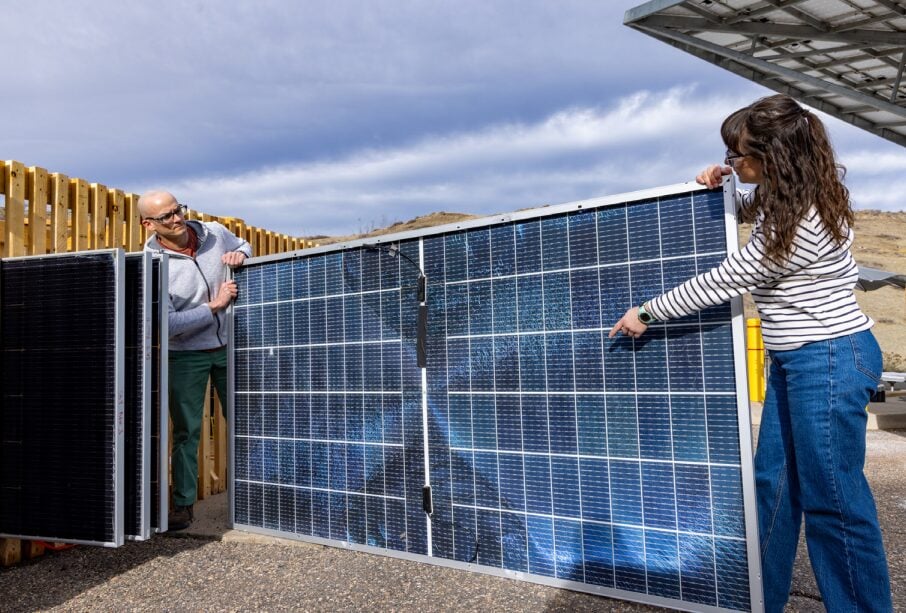
Speaking to PV Tech Premium, Professor Bram Hoex and Dr Fiacre Rougieux from UNSW’s School of Photovoltaic and Renewable Energy Engineering have identified manufacturing defects and inadequate testing protocols as primary contributors to premature module failures, with some systems potentially losing 45% of output by the 25-year mark or reaching end-of-life in just 11 years.
Multi-stressor testing emerges as a critical requirement
Dr Fiacre Rougieux, a senior lecturer at UNSW, emphasises that current IEC 61215 testing protocols miss combinations that lead to extreme degradation outcomes.
“What we show is that fast-degrading modules are more likely to have multiple degradation modes activated,” Rougieux explains.
“Because IEC 61215 testing is primarily a set of separate single-stressor tests run in defined sequences, it can potentially miss the combinations that create extreme outcomes.”
IEC 61215 is the leading international standard that establishes design qualification and type approval for terrestrial PV modules. This standard ensures that PV modules can endure long-term outdoor operation.
It includes tests for environmental durability, such as exposure to UV light, humidity, and thermal cycling, as well as assessments of mechanical strength, including resistance to load and hail. The goal is to confirm that both crystalline silicon and thin-film modules will not fail prematurely.
The research team recommends that manufacturers introduce multi-stressor qualification and screening that better reflects real field conditions, combining heat, humidity, voltage bias, and mechanical load simultaneously.
“The most damaging cases often emerge when stresses act together rather than in isolation,” Rougieux notes, highlighting a fundamental flaw in current testing approaches that evaluate individual stress factors separately.
This finding has significant implications for Australia’s solar market, where harsh environmental conditions, including high UV exposure, temperature cycling, and humidity, create the exact multi-stressor scenarios that current testing protocols fail to capture adequately.
Professor Bram Hoex advocates for dramatic increases in UV exposure testing, moving beyond the commonly used 15kWh to 120kWh or higher, in line with updated international standards.
“I would strongly encourage manufacturers to test their solar cells under much higher ultraviolet exposure than is commonly used today,” Hoex states. “This allows manufacturers to make an informed decision about how much degradation they consider acceptable.”
The research builds on previous findings demonstrating that thicker aluminium oxide layers are the dominant parameter limiting TOPCon UVID degradation. However, Hoex cautions against prescriptive thickness standards, noting that multiple mitigation strategies exist beyond simply increasing aluminium oxide thickness.
“While our research clearly shows that thicker aluminium oxide layers help reduce UV-induced degradation, there are many other known, and likely unknown, ways to improve a module’s resistance to UV damage,” Hoex explains.
“For that reason, it would be misguided to impose a fixed standard for aluminium oxide thickness.”
Next-generation technologies face fundamental challenges
The research reveals that advanced solar cell technologies, including TOPCon and heterojunction (HJT) modules, are inherently vulnerable to degradation as they approach theoretical performance limits.
“As silicon solar cells approach their theoretical performance limit, they also become far more vulnerable to degradation,” Hoex observes.
In record-setting TOPCon cells, the margin for loss has become extremely small, with total recombination so low that minor UV-induced damage can double it, leading to voltage losses exceeding 20 millivolts.
The same level of damage would cause less than 5-millivolt loss in a PERC cell, demonstrating how efficiency gains create new reliability challenges.
“The challenge is compounded by the fact that advanced cell designs can suffer disproportionately from the same atomic-scale damage, because their doped layers are intentionally made lighter to maximise efficiency,” Hoex adds, highlighting the trade-offs between peak performance and long-term durability.
Financial models require degradation reality check
The research findings have direct implications for solar project financing and warranty structures, particularly as Australia’s National Electricity Market (NEM) continues to expand renewable energy capacity.
Rougieux notes that current financial models fail to account for the reality of accelerated degradation in a meaningful fraction of modules.
“Most solar finance models still assume one steady, linear degradation rate, and use P50 and P90 to capture weather and modelling uncertainty,” Rougieux says.
“We believe financiers should also allow for a meaningful fraction of modules that fail early or degrade much faster, and test whether the project can still repay the debt in those bad cases.”
The recommendation extends to operational strategies, with investors advised to monitor performance closely and set aside funds or insurance for repairs or replacement of underperforming modules.
Both researchers advocate for enhanced independent testing that goes beyond current IEC standards. Hoex points to organisations like KIWA PVEL as demonstrating what is possible, but argues the industry needs more comprehensive approaches.
“Existing IEC tests are not designed to guarantee 25-year lifetimes; they are primarily intended to screen out early-life failures,” Hoex notes. “Independent testing organisations demonstrate what is possible, but the industry needs to go further.”
UNSW is developing independent testing protocols that provide more realistic assessments of long-term performance, working with partners to secure funding for both research and commercial deployment of enhanced testing methodologies.
Manufacturing quality control recommendations
The research team’s recommendations for manufacturers focus on process improvements rather than prescriptive material specifications.
Stronger independent testing of randomly selected products from manufacturing lines emerges as a key recommendation, using protocols that reflect current understanding of module failure mechanisms.
The approach recognises that manufacturing cost pressures contribute to quality issues while avoiding overly restrictive standards that could stifle innovation in mitigation strategies. Instead, the focus shifts to comprehensive testing that captures real-world degradation scenarios and provides manufacturers with actionable data for process optimisation.
As Australia’s solar industry continues to expand rapidly, these research findings provide critical insights to ensure long-term system reliability and financial viability in one of the world’s most challenging solar deployment environments.