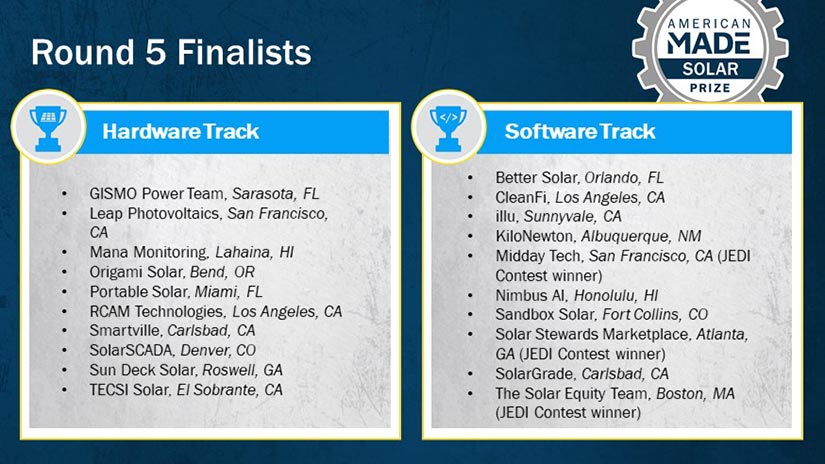
The US Department of Energy (DOE) has announced the 20 finalists moving forward in its American-Made Solar Prize Round 5, which will see 10 hardware-focused and 10 software-focused teams move through to the next round and receive cash prizes.
The American-Made Solar Prize was designed to support innovations in the solar industry that can help build a better, more reliable and resilient solar future. Competitors are tasked with identifying a solar industry challenge and creating a commercially viable solution in the span of months.
Try Premium for just $1
- Full premium access for the first month at only $1
- Converts to an annual rate after 30 days unless cancelled
- Cancel anytime during the trial period
Premium Benefits
- Expert industry analysis and interviews
- Digital access to PV Tech Power journal
- Exclusive event discounts
Or get the full Premium subscription right away
Or continue reading this article for free
The competition is made up of three separate rounds – Ready!, Set! and Go! – with successful companies advancing through each round and accruing cash prizes and assistance from innovation support organisation America-Made Network member as they go. For the first time under Round 5, software innovations have been included in the competition.
Each hardware finalist received US$100,000 in cash prizes and US$75,000 in vouchers to advance their innovation from proof-of-concept to prototype in the final contest. Software track finalists received US$60,000 each. Three software teams received an additional US$33,333 for winning the optional JEDI Contest.
“We need all innovators now more than ever if we’re going to expand solar’s accessibility to Americans and meet our net-zero goals,” said Garrett Nilsen, acting director of the DOE Solar Energy Technologies Office. “Congratulations to these teams, and we look forward to seeing where they can take their products.”
The hardware firms moving forward in the competition and the products they are working on are as follows:
- Gismo Power, Florida – developing a portable carport that has an integrated solar PV system and electric vehicle (EV) charger that can be stored in a garage.
- Leap Photovoltaics, California – developing a silicon solar cell that uses silicon particles instead of traditional silicon wafers.
- Mana Monitoring, Hawaii – developing a plug-and-play energy management system that synchronises on-site solar energy generation with electric vehicle charging.
- Origami Solar, Oregon – developing steel PV module frames manufactured using a roll-forming process.
- Portable Solar, Florida – developing an awning PV panel mounting system that can integrate into the manufacturing process and distribution channels of the manufactured home industry.
- RCAM Technologies, California – developing 3D-printed concrete gravity anchors that are manufactured on-site for floating solar panel installations.
- Smartville, California – developing an energy storage system that combines recycled EV batteries with a novel power conversion system and battery controls.
- Solar SCADA, Colorado – developing a supervisory control and data acquisition (SCADA) system that combines all the sensors, calibration, communication and data feeds needed to operate a solar energy system into standalone, ready-to-use packages.
- Sun Deck Solar, Georgia – developing a solar-powered EV charging station that utilises a self-assembling design to reduce installation costs.
- TECSI Solar Inc., California – developing a solar panel designed for residential use, which simplifies the ordering and installation process by combining the racking, flashing, hardware and power electronics into a single product.
The ten software finalists were:
- Better Solar, Florida – building machine vision software to process electroluminescence imagery and automatically identify PV defects with application to both PV module manufacturing and PV plant maintenance.
- CleanFi, California – developing a platform that seeks to automate solar project financing for the small-and-midscale commercial sector, including facilitating the use of commercial property assessed clean energy.
- Illu, California – building a mobile and desktop tool for operations and maintenance (O&M) workflow management that will assist field technicians and simplify distributed solar maintenance.
- KiloNewton, New Mexico – developing geospatial software to optimally site utility-scale solar and avoid challenging terrain.
- Midday Tech, California – building a platform to connect consumers who purchase voluntary carbon offsets with high-impact rooftop solar projects in underserved communities. (JEDI Contest winner).
- Nimbus AI, Hawaii – creating day-ahead probabilistic solar irradiance forecasts leveraging recent advances in satellite imagery and advanced machine learning.
- Sandbox Solar, Colorado – building software to help design agrivoltaic projects, with a focus on simulating the microclimates under solar modules and predicting crop growth yields.
- SolarGrade, California – building a workflow management platform to facilitate inspection and O&M of PV systems leveraging field technician inputs and data analytics.
- Solar Stewards Marketplace, Georgia – creating a marketplace for a new type of renewable energy credit (REC), a social REC, that allows corporate purchasers to buy RECs produced in underserved communities. (JEDI Contest winner).
- The Solar Equity Team, Massachusetts – developing a platform that connects larger installations that have surplus solar generation with non-profits and underserved consumers to enable an easy peer-to-peer credit sharing transaction. (JEDI Contest winner).
The 20 finalists will present their technologies next at the final Go! Demo Day in September. Only two teams in each track will win the final prize, each receiving even larger cash prizes and support vouchers to help bring their technology to market.