A Chinese satellite carrying prototype heterojunction PV modules produced by the leading PV manufacturer JA has been launched into Earth’s orbit.
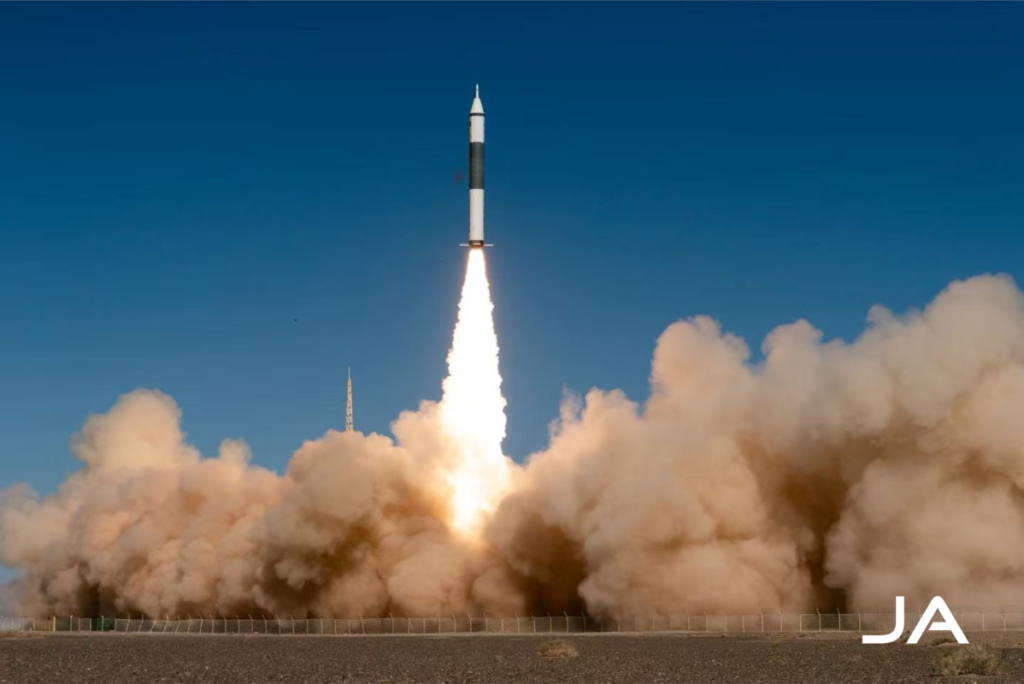
JA said its independently developed and packaged p-type heterojunction (P-HJT) modules were successfully launched aboard a Kuaizhou-11 rocket from the Jiuquan Satellite Launch Centre on 17 September and entered their planned orbit.
Try Premium for just $1
- Full premium access for the first month at only $1
- Converts to an annual rate after 30 days unless cancelled
- Cancel anytime during the trial period
Premium Benefits
- Expert industry analysis and interviews
- Digital access to PV Tech Power journal
- Exclusive event discounts
Or get the full Premium subscription right away
Or continue reading this article for free
The company said the mission marked the first in-orbit test of P-HJT modules, setting the stage for future large-scale applications.
Space-based PV applications have to date been largely dominated by gallium-arsenide technology, which is costly but can withstand the rigours of space, particularly radiation exposure and extreme temperature swings. The anticipated growth in the space economy means cost-efficiency is becoming an increasingly crucial consideration in choosing satellite power-generation technologies, potentially opening the field to crystalline silicon modules if their tolerance to the harsh conditions of space can be demonstrated.
JA said that by comparing in-orbit performance data with results from ground-based simulations, it would assess the long-term reliability and degradation of P-HJT technology in low-Earth orbit.
If the validation targets are achieved, JA said the programme could help accelerate the adoption of mature crystalline-silicon technologies as an alternative to gallium arsenide in low-Earth-orbit applications, potentially lowering the cost of satellite power systems. It could also support the development of satellite internet, remote sensing, space communications, space-based computing and other low-Earth-orbit applications.
“Energy innovation has long been a driving force behind human progress,” said Dr Ouyang Zi, JA’s chief technology officer. “As satellite deployment accelerates and the space economy expands, solar power is expected to play an increasingly important role in future space infrastructure. Developing more cost-competitive solar solutions for space is therefore an important strategic priority.
“Through real-world testing in orbit, we aim to assess the reliability and degradation of crystalline silicon technology in low-Earth orbit and explore more cost-competitive options for future space energy systems. The technology will require long-term validation, but we believe it is a direction worth pursuing.”
JA said it would use the mission as a starting point to strengthen its module R&D and manufacturing capabilities and advance scalable energy solutions for space exploration and commercial space applications, but emphasised that space PV remains at an early stage of exploration and validation,
“Large-scale commercialisation remains highly uncertain. JA currently has no orders related to space PV, and the programme has no material impact on its current operating performance,” the company said.
The US has also signalled its interest in developing new PV technologies for space applications, with the Department of Energy releasing US$12 million earlier this month to fund research and development of advanced space-based solar PV projects.
A panel discussion exploring how space solar is driving PV innovation will feature in our PV CellTech USA conference in San Francisco on 13-14 October. For details and booking, click here.