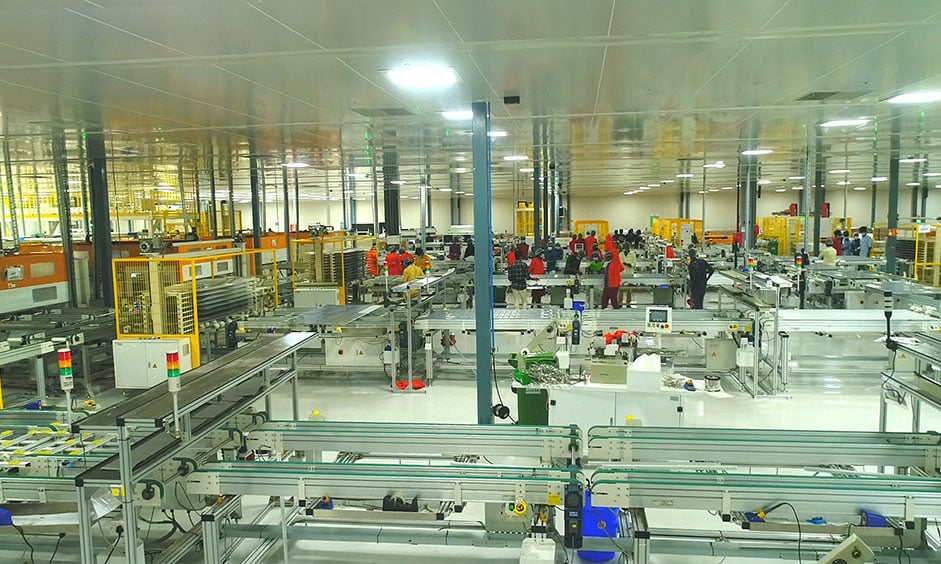
Indian solar PV manufacturer Vikram Solar is on track to begin production of the first cells at its n-type TOPCon solar cell manufacturing facility in Gangaikondan, Tamil Nadu.
Vikram Solar plans to ramp up production in phases to reach the plant’s nameplate 9GW capacity, beginning in December 2026. The company has plans to expand the plant’s output to 12GW.
Try Premium for just $1
- Full premium access for the first month at only $1
- Converts to an annual rate after 30 days unless cancelled
- Cancel anytime during the trial period
Premium Benefits
- Expert industry analysis and interviews
- Digital access to PV Tech Power journal
- Exclusive event discounts
Or get the full Premium subscription right away
Or continue reading this article for free
The facility will supply TOPCon cells for the majority of Vikram Solar’s downstream PV module production and Vikram Solar intends to seek ALMM (Approved List of Models and Manufacturers) List-II enlistment for the cells produced at Gangaikondan in due course.
List-I contains the manufacturers approved by the Ministry of New and Renewable Energy (MNRE) that produce solar modules, while List-II covers the manufacture of the cells used within modules, and listing on the ALMM is beneficial for domestic Indian manufacturers to supply to their home market. For example, under the government’s PM Surya Ghar: Muft Bijli Yojana (PMSGY) programme, which aims to install rooftop solar PV on ten million homes, homeowners can apply for a government subsidy to cover the costs of new installations, but must source modules and components from ALMM-listed suppliers.
Listing on the ALMM is also required to be eligible for government tenders and PM Kisan Urja Suraksha evam Utthan Mahabhiyan (PM-KUSUM), India’s scheme to replace use of diesel in the agricultural sector with electricity from decentralised solar projects.
Vikram Solar says most cells in solar modules in India are currently imported, but the Gangaikondan plant will allow it to offer PV hardware where both upstream and downstream components are domestically produced.
Vikram Solar moves towards vertical integration
Expanding manufacturing across the supply chain has become a priority for Vikram Solar. In September this year, the company began a supply agreement with Avaada Electro to receive ALMM-compliant half-cut cells, in a deal worth INR12.5 billion (US$150 million).
The December schedule for TOPCon cell manufacturing at the Gangaikondan plant is the second of three phases in the company’s roadmap. The first was a 6GW module manufacturing plant that opened in August 2026. The third and final phase is a 9GW ingot and wafer production facility that is planned for completion in FY2029. The company says that on full completion, Gangaikondan will be one of the few sites in India where ingots, wafers, cells and modules are made at the same facility.
Gyanesh Chaudhary, chairman and managing director of Vikram Solar, said: “Indian module makers, including us, have built their businesses around imported cells. Gangaikondan ends that for Vikram Solar. Cells are where the value, the technology and the risk in a module sit, and in December we start making them here. It is the most important step in our integration journey, and not the last: our roadmap runs from wafer to module, on Indian soil.”
Cell production in India rose from around 1GW in 2022 to more than 29GW in 2026 as other manufacturers have also sought to expand their operations. According to figures from PV Tech Research, the leading technology in Indian cell production this year is PERT/TOPCon at 13GW, followed by PERC at 11GW.