The unfolding conflict in the Middle East brings to mind the fallout from Russia’s invasion of Ukraine four years ago. Then, a huge spike in oil and gas prices followed Russia’s hostilities towards its next-door neighbour, driven by fears of supply shortages.
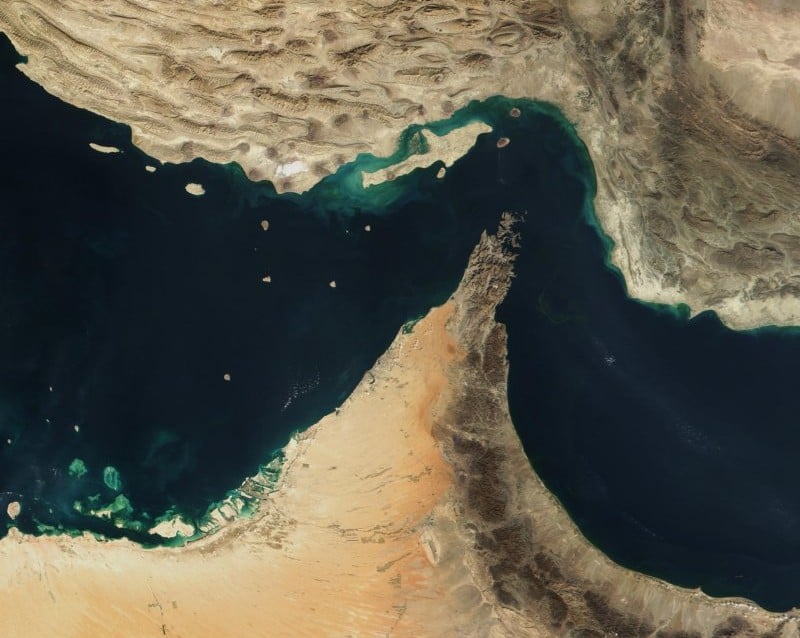
Iran’s closure of the Strait of Hormuz in response to the joint US-Israeli airstrikes this week has largely halted the flow of oil and gas through this critical supply route, sharply pushing up global prices of both. Only a few days into the military campaign against Iran, Brent crude prices were up by 6-9%, while European gas prices had surged by 50%, with no obvious end in sight to the hostilities.
Try Premium for just $1
- Full premium access for the first month at only $1
- Converts to an annual rate after 30 days unless cancelled
- Cancel anytime during the trial period
Premium Benefits
- Expert industry analysis and interviews
- Digital access to PV Tech Power journal
- Exclusive event discounts
Or get the full Premium subscription right away
Or continue reading this article for free
Another parallel to consider is whether this latest energy crisis will have similar long-term consequences to the Ukraine invasion in prompting a pivot towards renewable energy.
The 2022 energy crisis exposed critical vulnerabilities in Europe’s energy supplies, owing to its over-reliance on Russian gas. Russia weaponised this and reduced supplies to the EU, sending gas prices in Europe soaring by as much as 400% at their highest. EU leaders responded with a multifaceted package of new energy policies intended to break the bloc’s overreliance on Russian gas and shore up energy security.
Solar was a big beneficiary of these measures. In 2022, PV installations surged to around 40GW, a 47% year-on-year increase, according to industry body SolarPower Europe. In 2023, that trend continued, with annual installations increasing another 40% to 55.9GW. As a result, energy thinktank Ember reported that in 2025, for the first time, solar and wind together generated more power in the EU than fossil fuels.
Impacts on Asia
With the world now confronting a new energy crisis, the logic suggesting that a similar swing to renewables may follow is clear. Indeed, the fact that Asian heavyweights such as China, Japan and India are among the largest importers of oil and gas passing through the Strait of Hormuz points to the prospects for a much broader global shift to renewables than in 2022, which was largely a European affair.
“One thing that is really fundamentally different to this is that the largest majority of the oil and gas that comes out of the Strait goes through to Asia,” said Dave Jones, chief analyst and co-founder of Ember. “So, where 2022 was a moment that Europe doubled down on clean energy as a result of the Ukraine crisis, this could be the moment that Asian countries start doubling down.”
In the same way that the EU was quick to respond to the Ukraine energy crisis with a package of new energy security policies, Jones said this could be a similar moment for Asian countries, which have become “complacent” over access to relatively cheap oil and gas in the past two to three years, to follow suit.
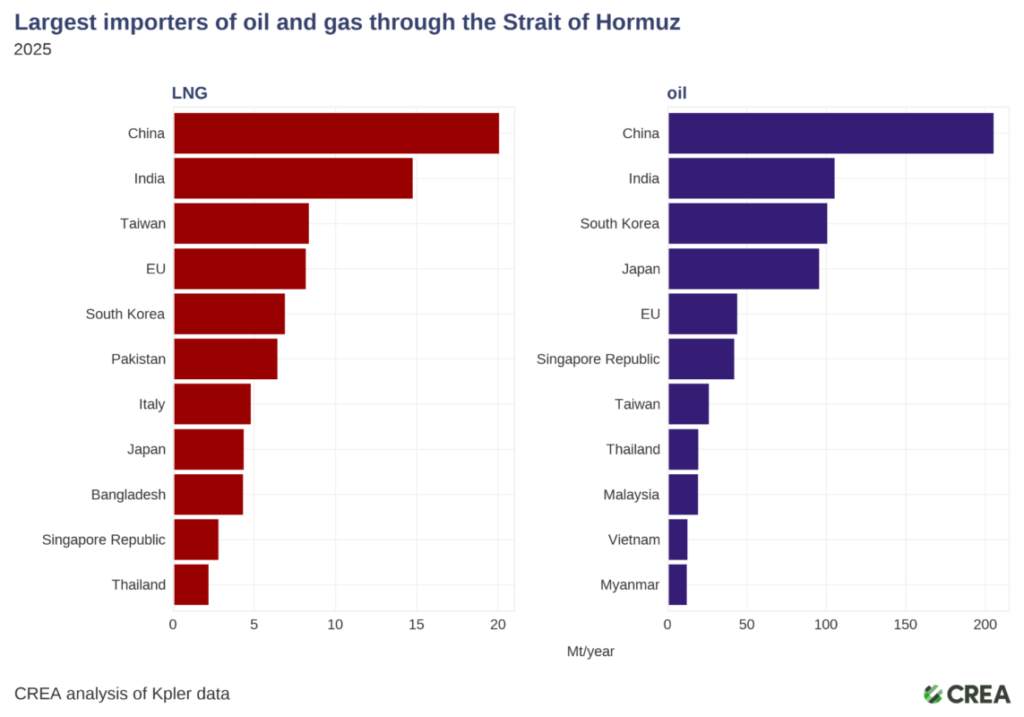
“It would be interesting to track any direct messages from those [Asian] countries, because in 2022-23 in Europe [after the Ukraine invasion] there was very clear messaging, very clear policy coming through. I wonder if we’ll now start to see the same coming from some of the Asian countries,” said Jones.
Certainly, they have the capacity to make such a move; just as the EU’s build-up in clean energy commitment and capability prior to 2022 meant it could respond quickly when crisis struck, so the recent advances in clean energy in many Asian countries put them in a strong position to act similarly now.
“Now Asian countries—much more so than in 2022—have begun with clean energy, maybe now they have the confidence and ability to double down,” Jones said.
In Europe, as the latest spike in oil and gas prices feeds through to wholesale power markets, merchant PV generators and storage assets stand to gain.
“If you’re a solar PV merchant, a utility-scale generator, you could benefit, because the prices overall would be higher generally in the wholesale market because of this event,” said Gaurav Purohit, vice president of European asset finance at global credit rating agency, Morningstar DBRS.
Beyond the immediate upside for PV, storage and other renewables assets, Purohit said it would “make sense” that, in the longer term, the latest energy crisis would create renewed momentum towards clean energy deployment.
“Whether the war lasts for a week or it lasts for a month, I expect there would be some rethinking going on in terms of how strong the volition is for making the move to renewables,” he said.
Inflationary pressures
One counterpoint to that, though, could be the long-term inflationary effects of a sustained increase in energy prices. As witnessed in the aftermath of the Ukraine invasion, high energy prices sparked a steep rise in interest rates as central banks struggled to contain rising inflation.
Given that solar and other renewables are especially capital-intensive and sensitive to borrowing costs, a repeat of this scenario and a possible increase in the costs associated with deploying renewables would offer a country, perhaps one sitting on cheap coal reserves, an excuse not to embrace clean energy.
“Sustained energy supply disruptions could raise construction and financing costs for greenfield power projects under construction,” said Purohit.
However, on the prospects for inflation derailing any fresh momentum behind clean energy resulting from the new energy crisis, Ember’s Dave Jones said: “I don’t really see how that figures through because governments know that [inflation] is coming from oil and gas reliance. And if you want to reduce oil and gas reliance, you want to be building renewables. So countries are suffering through higher interest rates and higher inflation because of fossil fuels, which is only going to benefit the case for renewables.
“Higher capex is only part of the picture, and I don’t see that as stalling [the rollout of clean energy]. For me, this is really going to lead to an overpowering desire for governments to find ways to reduce oil and gas imports as quickly as possible. Renewables are an essential part of that toolkit.”
Indeed, Purohit highlighted that during and after the last energy crisis, solar maintained its momentum, whereas offshore wind, for example, slowed and saw its levelised cost of electricity (LCOE) increase. “That part of the renewables story [offshore wind] slowed down, but solar kept on. So those technological advances in solar are quite remarkable, and I see a lot more resistance there to increases in financing costs. It’s much more resilient,” said Purohit.
The extent to which the Middle East crisis leads to a step change in clean energy deployment, as the Ukraine invasion did in Europe, will depend heavily on how long it continues and for how long energy prices remain inflated. And on that question, no one has any clarity.
But to illustrate the extent to which solar has become a serious actor in helping break global dependence on volatile fossil fuels, Jones highlighted how the 2025 increase in global solar power generation—roughly 600TWh—was equivalent to the amount of electricity that could be generated from the 82 million tons of liquid natural gas that passed through the Strait of Hormuz last year.
“So the amount of energy that was exported through that strait last year was basically equal to just one year’s growth in global solar generation,” Jones said. “That shows how replaceable LNG is in this context; this isn’t beyond human ingenuity. To me, that’s a powerful demonstration that this is really quite achievable.”