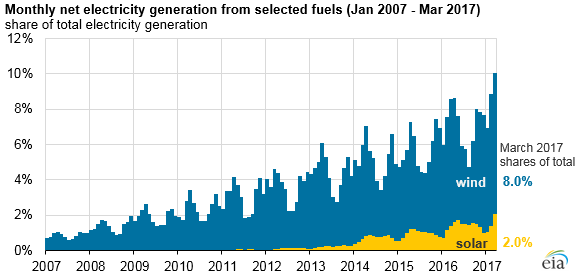
Wind and solar power produced more than 10% of the electricity generated in the US for the time in March, according to new analysis by the Energy Information Administration (EIA).
Wind and solar power capacity has been growing in the US, accounting for an average of up to 7% of electricity in 2016.
Try Premium for just $1
- Full premium access for the first month at only $1
- Converts to an annual rate after 30 days unless cancelled
- Cancel anytime during the trial period
Premium Benefits
- Expert industry analysis and interviews
- Digital access to PV Tech Power journal
- Exclusive event discounts
Or get the full Premium subscription right away
Or continue reading this article for free
Wind accounted for 8% of the electricity produced, with solar producing the remaining 2% that month. In almost all states, wind makes up a larger share of total electricity generation than solar, according to the EIA. Among the top dozen states, only California and Arizona had more solar generation than wind in 2016. Three states in the top 12 – Iowa, Kansas, and North Dakota – had no generation from utility-scale solar plants in 2016 and relatively little output from small-scale solar.
The solar generation for the analysis was sourced from both distributed residential solar panels and utility-scale installations, reflecting an ongoing effort to install more renewable capacity and work towards a more low-carbon economy. The US market added 2,044MW of new solar PV capacity in Q1 2017 alone, according to GTM Research’s latest figures.
Spring and early autumn months are often anticipated to break renewable energy records due to high winds and increased sunlight in the northern hemisphere. Further, milder weather generally means air conditioning and heating units are not used as much, resulting in a lower overall electricity use. California broke a record for its renewable energy production in May, according to the state’s system operator (CAISO); with solar, wind and hydro producing a record of 80.7% of the grid’s electricity.
The Administration expects the two sources to top 10% again in April but forecasts that their generation will fall below that mark during the summer months. However, monthly solar output is highest in the summer months because of the higher number of daylight hours.