The US Department of Energy’s National Renewable Energy Laboratory (NREL) has confirmed a 15.5% aperture area efficiency on commercial size flexible PV module (total area 1.68m2) from thin-film manufacturer MiaSolé. MiaSolé’s record represents over 2 points of improvement compared to the previous world record for flexible PV of 13.4% set earlier this year by SoloPower.
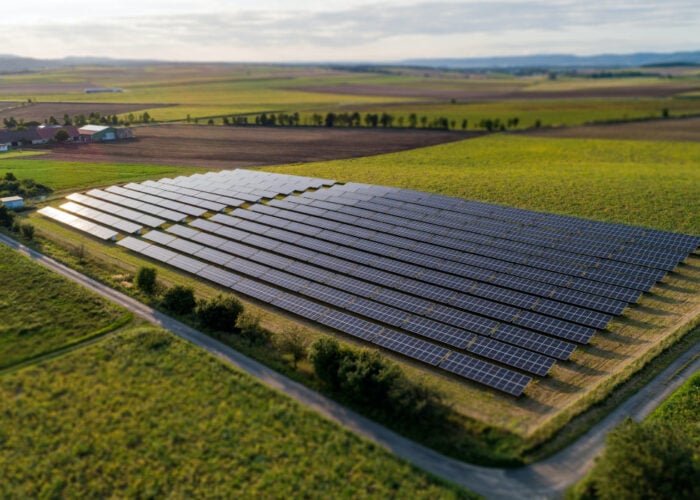
Having formed a joint venture firm in March, PV CIStems, Solar Frontier and BELECTRIC have connected what they claim to be the world’s largest CIS thin-film solar power plant in Bochow, Brandenburg, Germany. The project’s investor is CommerzReal and the financing is provided by HypoVereinsbank (HBV) /UniCredit.
A report from Digitimes has provided musings on how thin-film face an uphill battle in the current market. According to the report, solar firms will need to segue from being thin-film solar module providers to solar PV system project designers and suppliers in order to stay competitive. According to the report, as silicon-based solar product prices drop, thin-film solar products have been sidelined, especially during the past year.
Axuntek Solar Energy is using DuPont PV5400 series ionomer encapsulant in its IEC-certified CIGS thin-film modules, the company has announced.
The solar modules are frameless and the first to adopt DuPont PV5400 into CIGS technology. The modules aid to reduce shipping costs because they permit a higher density in shipping, therefore lower costs. Further, the modules are stronger due to DuPont’s encapsulant. The combination of ionomer and glass allows for the utilization of the frameless modules in building-integrated applications.
Having made a few leaps in the last six months alone with a TÜV safety certification in September, announced the production of its first 100MW thin-film modules and partnering with altPOWER for future US-based BIPV projects, executive management of Soltecture have applied to open insolvency proceedings. Having extensively explored new financing options, including rebranding and restructuring initiatives towards the end of last year, the company has stated it saw no other viable option for averting the company’s impending insolvency at the present time.
The German Technical Control Board, TÜV Süd Germany, has awarded Nanosolar’s Luckenwalde panel assembly plant the ISO 9001:2008 certificate.
Six years after the US Department of Energy (DOE) awarded Nanosolar a US$42 million Solar American Initiative (SAI) Technology Pathway Partnership (TPP) grant, the company has advised that all 10 major tasks have been achieved or surpassed. The grant was originally awarded in 2006 for the development of large-scale PV systems for commercial buildings that would offer the best price per watt performance in the industry.
German-based companies involved in the supply of manufacturing equipment for the global solar industry had a record sales year in 2011, according to the latest report from trade association, VDMA. German equipment suppliers benefited from a focus on advanced cell technology that supported a global market share of 46% in 2011. However, overcapacity is impacting sales to major markets in Asia, particularly China, in 2012.
Global Solar Energy has announced that it is to sell its portable solar business, including the Sunlinq and P3 product lines. The company assures that it does not anticipate any disruption in production or service to its portable solar business customers during the sale process. Global Solar insists the purchase will allow it to better position its focus on and grow other key business units serving the BIPV market.
This February, Konarka made the announcement that its OPV modules were the first OPV technology to pass individual critical tests for IEC 61646, an accelerated lifetime testing protocol, by TÜV Rheinland. The company has now stated that its organic solar modules have passed IEC stress tests under IEC 61646. The testing was conducted by TÜV Rheinland at its Solar Energy Assessment Centre (SEAC) in Cologne, Germany.