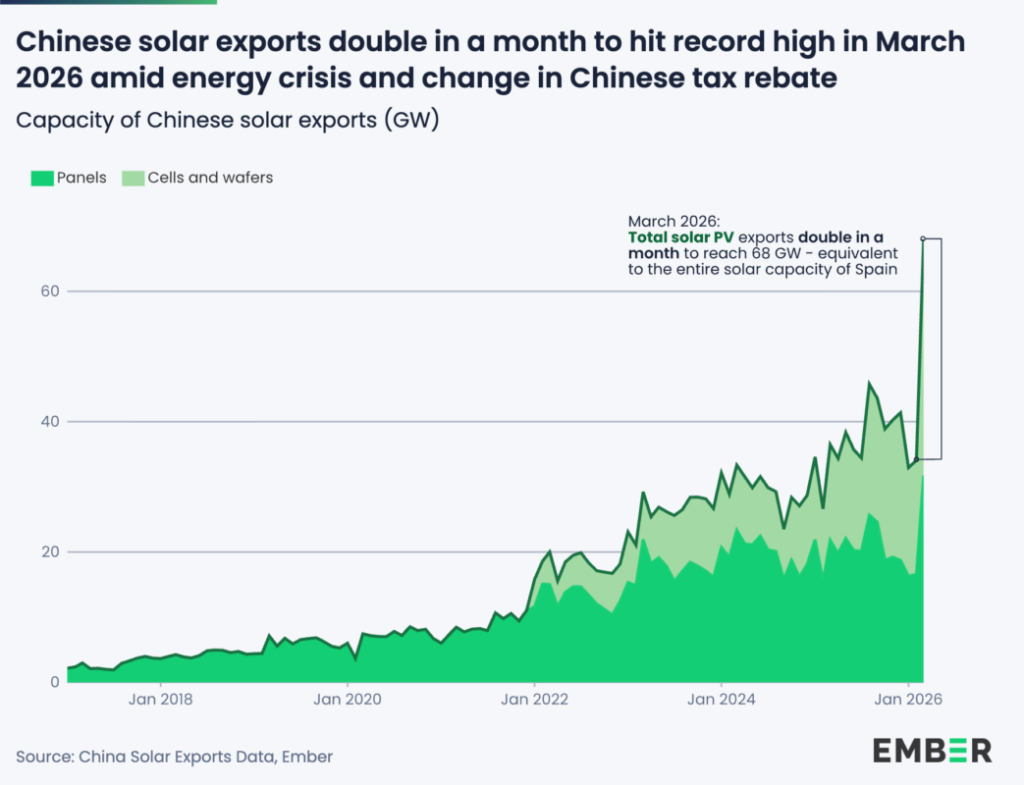
Exports of Chinese solar products – including modules, cells and wafers – hit a record 68GW in March 2026, a figure that is equivalent to Spain’s entire operational solar PV capacity.
This is according to the latest figures from Ember, published today, which includes monthly export data for Chinese solar products, now up to and including March 2026, since the start of the conflict in them Middle East. As shown in the graph below, total solar PV exports doubled in the month between February and March 2026, exceeding 60GW in a month for the first time, and Ember notes that regions “most affected” by the energy crisis have seen “some of the sharpest increases in demand” for Chinese solar products.
Try Premium for just $1
- Full premium access for the first month at only $1
- Converts to an annual rate after 30 days unless cancelled
- Cancel anytime during the trial period
Premium Benefits
- Expert industry analysis and interviews
- Digital access to PV Tech Power journal
- Exclusive event discounts
Or get the full Premium subscription right away
Or continue reading this article for free
For instance, exports to India grew by 6.6GW between February and March 2026, the most to any single country, and reflecting a 141% month-on-month growth rate. Over the same month, the consumer price index in India rose to 3.4%, up from 3.21% the previous month, according to Bloomberg, as the conflict has raised crude oil prices and limited gas supplies, putting pressure on India’s energy supply.
Africa, meanwhile, was the continent to see the largest month-on-month increase in solar exports from China, with exports rising 176% in March. This was led by Nigeria, which saw a 519% month-on-month increase, followed by Ethiopia with a 391% increase and Kenya with a 207% increase. The three countries each imported over 1GW of solar PV products in a month for the first time, and Ember noted that this trade “predominantly” consists of solar cells.
Shifting manufacturing capacity
These trends follow a number of announcements of new manufacturing projects in Africa, as several East Asian companies have sought to circumvent US legislation that makes it expensive to export products to the US by building manufacturing bases in Africa. For instance, in Egypt alone, EliTe Solar started work at a 5GW cell and module manufacturing facility, while GCL has announced plans to build its own manufacturing plant in the country.
More broadly, upstream components, such as cells and wafers, are now accounting for a larger proportion of China’s total solar exports. According to Ember, cell and wafer exports first exceeded module exports in October 2025, and between February and March this year, cell and wafer exports rose 108% to 36GW.
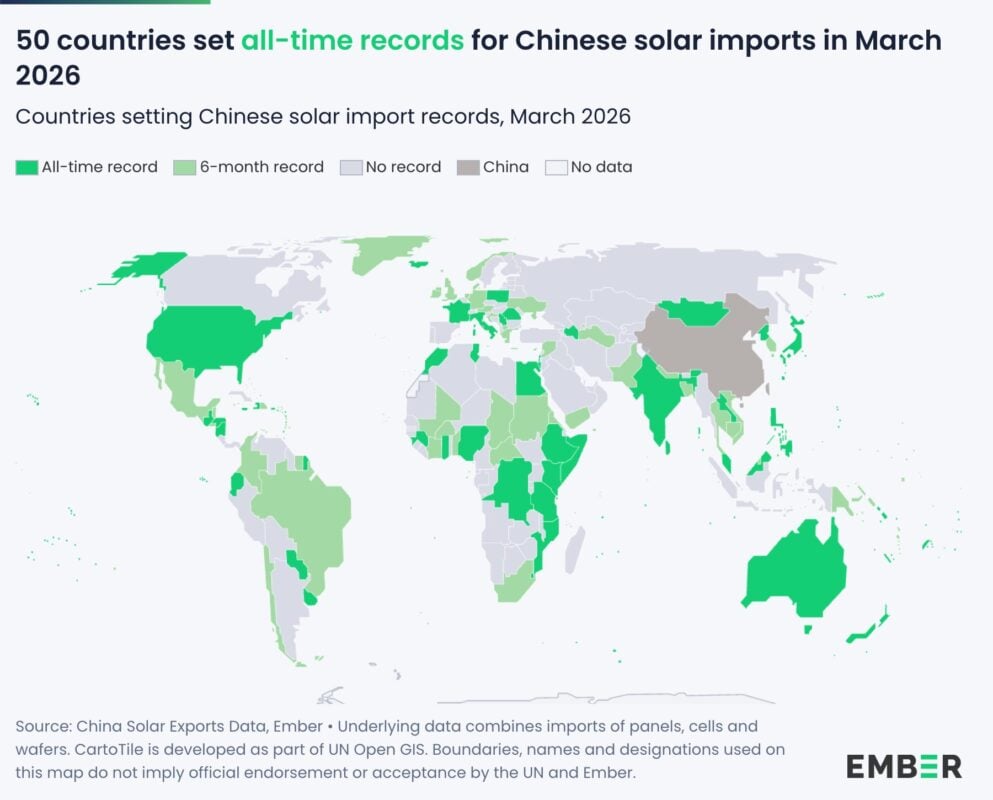
However, this legislation did not dissuade US buyers from acquiring solar products made in China in March. The US was one of several larger economies to set an all-time record for volume of solar products acquired from China last month, alongside Australia, France, India, Italy and Japan, and the map above shows which countries set records for imports of Chinese solar products in March.
“Solar has already become the engine of the global economy, and now the current fossil fuel price shocks are taking it up a gear,” said Ember senior analyst Euan Graham. “Countries are importing solar modules at record levels, and building up their own domestic assembly and manufacturing capabilities to address surging global demand.”
Ember did note, however, that factors beyond the current energy crisis could have affected Chinese export figures. On 1 April, the Chinese Ministry of Finance and State Taxation Administration will end export tax rebates for the VAT of solar PV products exported overseas; in effect this means Chinese PV manufacturers will not be able to claim back as much as 13% of their VAT for products sold to other countries, as they once did.
This is likely to cause manufacturers to increase the prices of their products, with this cost passed on to buyers. It’s possible that the ending of these rebates at the start of April triggered a rush of activity, as international buyers sought to acquire Chinese products quickly, before an anticipated price increase from 1 April.