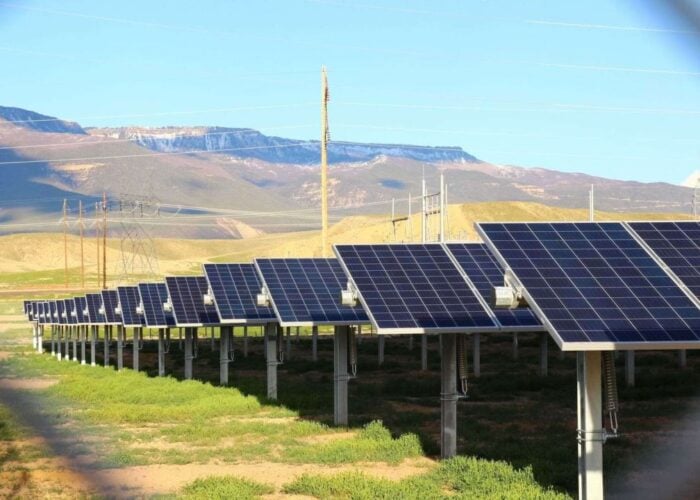
Advanced Energy Industries (AE) has said it has begun shipping its new flagship ‘AE 1000NX’ 1MW-sized according to its backlog pipeline to PV projects.
The modular transformerless 1MW central inverter is a key next-generation product for AE following over two years of restructuring, which has included outsourcing production in China to lower manufacturing costs while providing higher product margins.
Try Premium for just $1
- Full premium access for the first month at only $1
- Converts to an annual rate after 30 days unless cancelled
- Cancel anytime during the trial period
Premium Benefits
- Expert industry analysis and interviews
- Digital access to PV Tech Power journal
- Exclusive event discounts
Or get the full Premium subscription right away
Or continue reading this article for free
PV inverter manufacturers have come under intense pressure in the last two years to reduce inverter prices as PV module costs have fallen drastically, resulting in inverters becoming a higher percentage of the BOS cost and have greater impact on the overall levelised cost of energy (LCOE).
The bottom-up designed AE 1000NX includes a bipolar 1000V system topology to reduce BOS costs, while claimed to improve energy harvesting for better LCOE metrics that are intended to offer the lowest in the industry.
“This quarter [4Q 2013] we generated US$55 million in solar revenues and maintained a strong backlog of orders for our 1MW Inverter. With the transition behind us we are ramping volumes of the 1MW and developing a number of country-specific three-phase string products, and positioning us for growth in 2014 across a number of geographies,” noted Gordon Tredger, president of AE Solar Energy in a conference call last week discussing AE’s fourth quarter financial results.
Tredger said in the call that “multiple” customers had installed the new central inverter during the quarter, including utility-scale and ground-mount commercial installations.
“The inverters are producing power at very strong rates, reflecting the key advantages of this product including one, the wider voltage range that enables the production of power earlier each day and also allows peak efficiencies to be reached sooner; two, higher DC loading ratios that allow power to ramp quickly; and three, the 98% efficiency rating enables peak production to be sustained longer,” added Tredger.
However, management were reluctant to provide specific figures on the number of units in its backlog as well as the number of units actually shipped in the quarter, despite repeated questions from financial analysts on the call.
Management did note that that production was ramping and would reach a ‘steady state’ in the second quarter of 2014.
The company has traditionally remained heavily dependent on the utility and commercial markets in the US for revenue generation in its Solar Energy segment.
However, management noted that it was seeing increasing interest and activity in Mexico and Canada for central inverters.
The acquisition of REFUsol in April, 2013 enabled the company to broaden its product and market opportunities. REFUsol focused on three-phase string inverters for commercial applications and had a wider geographical footprint.
Management noted in the call that after revamping the three-phase string inverter portfolio it was increasing sales in established markets but was also targeting India as well as Eastern Europe, Thailand, Turkey, Mexico and Latin America via indirect distribution channels.
The company noted that it was also developing three-phase string inverters for the booming Japanese market, which were expected to be launched in the first half of 2014.
Financial results
The company reported that solar energy sales increased 16% to US$250 million in 2013, compared to US$217 million in 2012, helped by the acquisition of REFUsol.
However, solar sales were US$64.9 million in the fourth quarter of 2013, down 4% from the previous quarter.
The company overall made a net loss in the quarter of US$1.5 million and US$14.6 million for the year.
AE expects solar energy sales in the first quarter of 2014 to be impacted by seasonality, partially offset by demand for new products.