As global PV and energy storage installation skyrockets, energy storage has transitioned from a mere auxiliary support of solar power to the undisputed central backbone of modern energy systems, serving as a core pillar of the renewable energy ecosystem.
The global PV and energy storage market has hit a critical turning point. Integrated PV-storage solutions are now a mainstream feature across major markets, including China, Europe and Australia. However, rapid industrial expansion has stretched traditional manual operations and basic intelligent systems to their limits. Amid surging installed capacity and increasingly complex application domains, conventional manual approaches and basic intelligent systems can no longer keep pace with industry requirements.
Try Premium for just $1
- Full premium access for the first month at only $1
- Converts to an annual rate after 30 days unless cancelled
- Cancel anytime during the trial period
Premium Benefits
- Expert industry analysis and interviews
- Digital access to PV Tech Power journal
- Exclusive event discounts
Or get the full Premium subscription right away
Or continue reading this article for free
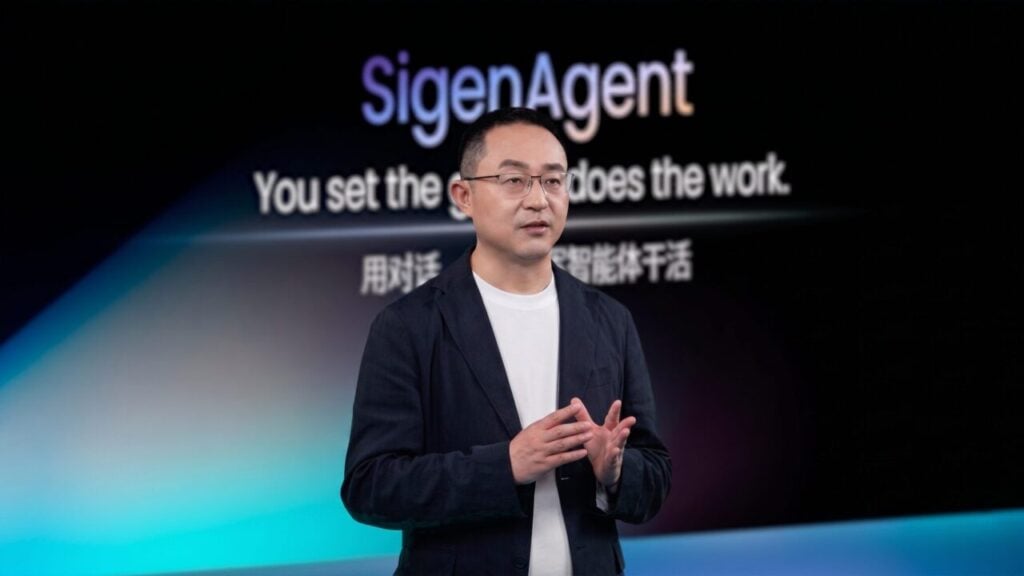
To tackle these industry-wide challenges, Sigenergy unveiled its all-domain intelligent energy agent, SigenAgent, on 29 May. The launch marks the energy industry’s official entry into the agentic AI era, where energy AI moves beyond simple Q&A functions to proactively interpret needs, autonomously operate and be deployed at scale.
“This is far more than a regular product upgrade. It’s a fundamental shift in how we use and manage energy,” said Tony Xu, founder and CEO of Sigenergy, at the launch event.
The end of hardware-centric competition: intelligent, cognitive energy hubs are now an industry must-have
Over the past decade, PV technology has reshaped global power generation. For years, the industry revolved around power output, with competition focused on the efficiency and cost of core hardware such as PV modules and inverters. Today, the global energy landscape is undergoing a profound shift from power generation to power consumption, putting smart energy usage front and centre. Precise dispatching, revenue maximisation and adaptive grid response have emerged as the industry’s top priorities.
Against this backdrop, energy storage derives value no longer merely from power storage, but from intelligent energy regulation. This encompasses electricity price forecasting, dynamic load adaptation and grid coordination, maximising the economic value of every kilowatt-hour. According to third-party industry data, the global storage market will sustain a compound annual growth rate of over 25% over the next five years, marking a decisive shift in industry competition from hardware manufacturing strength to intelligent system capabilities.
As PV and storage capacity continue to surge and application domains grow increasingly complex, renewable energy operators worldwide are confronted with growing operational and management challenges. Various regions and market segments are enforcing stricter system response performance standards.
European users must continuously capture fleeting negative-price windows to optimise energy costs. In Australia, where electricity prices fluctuate dozens of times a day, manual monitoring simply cannot keep pace with the volatility of the market.
China’s commercial and industrial (C&I) sector faces mounting challenges in energy cost management. Enterprises seek to cut daily power expenses through precise peak-valley arbitrage while remaining vigilant to avoid substantial demand charges. This dual objective greatly complicates cost control, requiring higher internal dispatching capabilities.
Meanwhile, downstream installers and O&M providers are under immense operational pressure. Terminal equipment from diverse brands is highly fragmented, and project sites are widely distributed, leaving routine fault diagnosis and parameter adjustment heavily dependent on manual work. This results in excessive communication costs, low O&M efficiency, and persistently high long-term O&M expenses.
As energy systems grow far too complex for manual dispatching and real-time response, companies can no longer build sustainable competitive advantages relying solely on hardware such as inverters and batteries. The industry is in urgent need of an energy hub that features autonomous perception, intelligent decision-making, collaborative execution, and continuous optimisation. This enables a fundamental shift from humans adapting to equipment, to equipment proactively catering to user needs. This transition has become the core pathway for the industry to overcome its development bottlenecks.
SigenAgent: all-domain intelligent energy agent redefines the future of energy living
“SigenAgent, our newly launched all-domain intelligent energy agent, is far more than a new product or a routine technical upgrade. What we are bringing to the industry is an entirely new paradigm of energy utilisation,” said Xu, at the official launch.
He noted that the market often confuses conventional energy AI with intelligent energy agents. The core distinctions between the two create a fundamental gap in user experience and product value.
“Traditional energy AI is essentially a tool-based auxiliary solution built on passive response logic. It operates on rigid, step-by-step workflows, where every device action relies on manual task breakdown, parameter configuration and command issuance. SigenAgent, by contrast, represents a transformative leap toward proactive, user-centric services. As a genuine intelligent energy partner, it only requires users to set ultimate operational goals. The system can independently handle the full workflow of reasoning, decision-making and equipment execution, eliminating cumbersome manual operations entirely,” Xu further explained.
Put simply, SigenAgent acts as a 24/7 all-round intelligent energy manager. Its core competitiveness stems from a closed intelligent loop covering perception, reasoning, execution and iterative optimisation. At the perception level, the system leverages over 200,000 high-precision sensory data points to capture real-time updates on weather changes, electricity price fluctuation, grid signals, equipment operating status and user consumption patterns, guaranteeing authentic and reliable underlying data.
At the reasoning level, SigenAgent deeply integrates hands-on industrial expertise with state-of-the-art large language models such as DeepSeek and GPT, enabling it to autonomously break down complex objectives and formulate optimal energy management strategies. At the execution level, it delivers millisecond-level command dispatch and efficiently coordinates the operation of PV systems, energy storage units, charging piles and diverse load devices.
Moreover, the system boasts robust self-upgrade capabilities. By continuously evaluating operational results and dynamically optimising control strategies, the system develops a self-evolving mechanism that grows smarter and more effective the more it is used.
Four integrated roles, one all-domain solution: SigenAgent addresses industry-wide operational pain points
During the launch event, Xu showcased SigenAgent’s robust capabilities to attendees. He defined the product as a vertical energy-specific intelligent agent that integrates four core roles into one: an Energy Manager, a System Doctor, a Power Trader and a Business Assistant. It fully covers critical domains spanning residential energy management, PV plant O&M, power trading, and enterprise operational management, with each capability precisely targeting and resolving key industry pain points.
First, the Energy Manager addresses common long-standing issues such as confusing parameters and poorly performing strategy settings. Users simply set their energy management goals. The system then leverages real-time load, PV output, battery status and fluctuating electricity prices to generate and run optimal operation strategies, greatly streamlining complex home energy management.
Second, the System Doctor eliminates inefficient traditional workflows such as manual data verification, reactive fault troubleshooting and repetitive communications. One click launches full-site intelligent diagnostics: the system automatically checks equipment conditions, pinpoints faults and generates standard reports, transforming labour-intensive manual work into efficient data-driven operations.
Third, the Power Trader tackles a key industry pain point: manual monitoring fails to keep up with fluctuating electricity prices and virtual power plant (VPP) operational needs. It continuously analyses multi-dimensional market and equipment data, intelligently identifies optimal charging and discharging schedules, and helps users maximise gains amid volatile power markets.
Fourth, the Business Assistant caters to corporate management teams, unifying disjointed data from production, warehousing, logistics and full-lifecycle asset management. It consolidates data across multiple systems to deliver data-driven insights and operational guidance. The platform will also be available to downstream distribution partners, acting as an intelligent efficiency tool for the entire industry chain.
SigenAgent’s powerful all-domain capability is built on Sigenergy’s mature digital infrastructure. On the hardware front, more than 200,000 power stations worldwide run on Sigenergy hardware, which helps collect real-time operational data, including voltage and current, sustaining an ultra-low failure rate of 0.24%. For communications, the system uses standard 100 Mbps high-speed networks alongside the industry-leading WLAN-Mesh and Sub-1G solutions. The Sub-1G coverage is ten times that of conventional Wi-Fi, enabling stable millisecond-level data transmission.
Sigenergy combines deep industry expertise with state-of-the-art large language models such as DeepSeek and GPT at the cloud service level. The updates of the mySigen App embody its user-first R&D philosophy. Version 1.0 delivers readable and traceable energy data visualisation; Version 2.0 introduces AI-powered smart assistance and operational optimisation; Version 3.0 enables full visibility into granular parameters. Across all updates, the company has always prioritised user feedback from around the world.
Fully powered by SigenAgent, the brand-new mySigen App 4.0 is slated for official global launch in June 2026.
Safety first by design: building a trustworthy, controllable AI-powered energy ecosystem
Safety and reliability are fundamental prerequisites for AI adoption in energy systems. They support the stability of critical power supplies and the security of energy assets. From the initial design phase of SigenAgent, Sigenergy has embedded four core principles — user authorisation, secure infrastructure, offline resilience guaranteed and transparent AI decision— laying a robust foundation for secure, traceable, and accountable AI-driven energy operations.
“Users’ biggest concern with AI autonomous dispatching is that it might act arbitrarily or exceed its operational boundaries — this is the core challenge we set out to solve from the start,” said Xu. He emphasised that user authorisation is the paramount foundational principle of SigenAgent. In short, the system operates on strict, clear logic: the AI only offers optimised operational recommendations, while end users retain ultimate decision-making authority at all times.
Given its extensive global business footprint, Sigenergy adopts a localised development strategy of “local deployment, local compliance” to meet stringent international data compliance and cross-border governance requirements.
The company has set up six global cloud nodes in Frankfurt, Tokyo, Singapore, Sydney, Oregon and Ningxia, enabling localised, proximity-based data storage for users. This architecture fully complies with regional privacy regulations and cross-border data governance standards, delivering end-to-end data compliance for global PV and energy storage projects.
To address industry-wide pain points, including network instability and unexpected outages, SigenAgent is equipped with a robust offline operation mechanism. It supports continuous, normal operation even during network outages, eliminating the need for a stable internet connection.
As for the prevalent “black box decision-making” flaw inherent in conventional industrial AI systems, Xu commented: “Energy dispatching leaves no room for uncertainty. Every charging and discharging action for every kilowatt of power must be fully traceable and justifiable.”
He further stressed that SigenAgent eliminates the “AI black box” entirely by enabling full traceability and interpretability for all dispatching behaviours. Users can access a complete, real-time 24-hour dispatching ledger to clearly review the core logic behind every charging, discharging and energy storage decision. This delivers fully transparent, controllable and verifiable end-to-end energy dispatching operations.