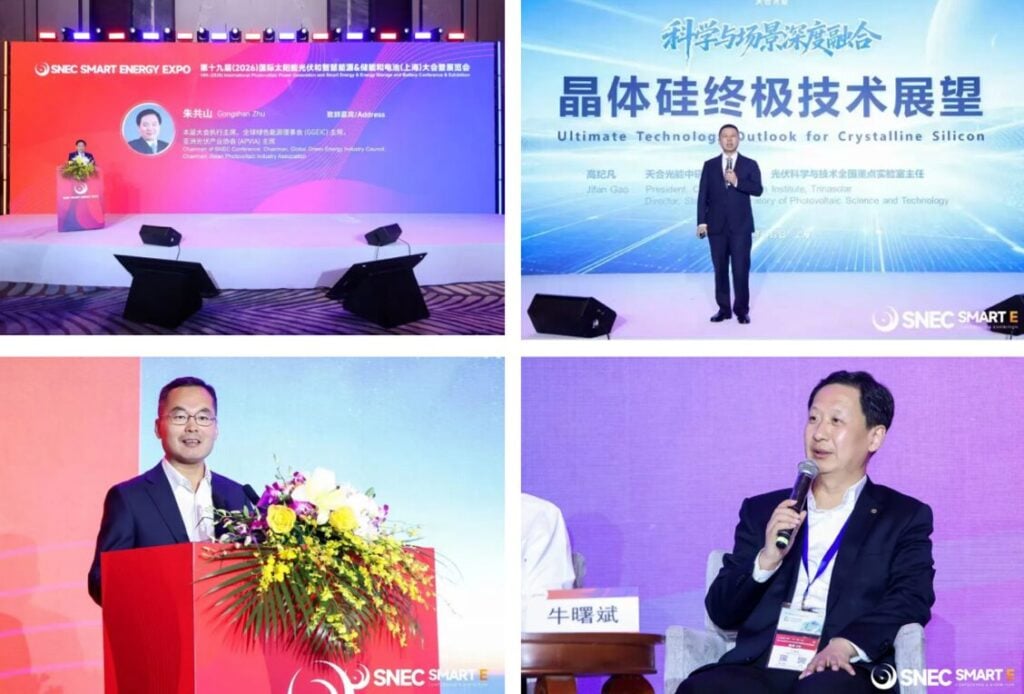
The 19th SNEC International PV & Smart Energy Expo in Shanghai this week coincided with a critical turning point for China’s PV industry as it seeks to move beyond unchecked capacity expansion and fierce price wars toward value restructuring.
Leaders from top PV and energy storage companies, including GCL, Trina Solar and Envision, gathered at the SNEC opening event on 2 June and shared key insights on ending cyclical downturns, accelerating technology upgrades, integrating AI into power systems, and building new energy infrastructure. Focusing on four core areas—industrial model transformation, breakthrough technologies, evolving business models and end-to-end system solutions—they outlined a fresh roadmap for high-quality growth in China’s PV industry.
Try Premium for just $1
- Full premium access for the first month at only $1
- Converts to an annual rate after 30 days unless cancelled
- Cancel anytime during the trial period
Premium Benefits
- Expert industry analysis and interviews
- Digital access to PV Tech Power journal
- Exclusive event discounts
Or get the full Premium subscription right away
Or continue reading this article for free
Years of unchecked capacity expansion in China’s PV industry have led to oversupply and brutal price wars. The result is a deep-seated paradox: the larger a company’s installed capacity, the slimmer its margins—proof that blind scale-driven growth is no longer viable. Founders of leading tier-one manufacturers agree that 2026 marks a landmark year for the sector’s ecosystem restructuring, value restoration and efficiency gains. The industry is now shifting away from scale-centric growth toward value-led development, moving beyond standalone manufacturing to become an integrated provider of comprehensive energy services.
In his keynote address, Zhu Gongshan—chairman of both the Global Green Energy Council and GCL —argued that the PV industry is undergoing a fundamental paradigm shift. The old zero-sum game of grabbing market share through blind capacity expansion and price undercutting is now entirely obsolete.
He noted that the coupling of materials across silicon, lithium and carbon, combined with PV-storage integration, is laying a new industrial foundation. Along with two other pivotal shifts, namely all-domain application convergence and power market liberalisation, these forces are pushing traditional manufacturers to evolve into digital energy service providers. Zhu also proposed an innovative two-phase framework for the industry’s transformation.
Phase one focuses on reciprocal synergies between computing power and green energy. AI-enabled power-compute coordination removes bottlenecks that constrain renewable energy absorption.
Phase two pursues space-based energy development, using orbital PV technology to bypass terrestrial resource constraints and open new frontiers for global energy advancement.
Niu Shubin, vice president of GCL Energy Technology, outlined a four-pronged solution to address the sector’s persistent challenges. The framework spans scenario customisation, large-scale asset deployment, market-driven operations and financial structuring – delivered via four core measures: expanding diversified PV applications, scaling up source-grid-load-storage assets, facilitating cross-border green power trading and deploying green finance instruments to ease industry bottlenecks.
According to company figures, GCL Energy Technology closed 786 million kWh in green power deals in 2025, backed by 2.003 billion kWh of tradable green certificate volumes. Its standardised West-to-East power transmission model has effectively addressed the imbalance between renewable energy supply in western China and power demand in the country’s eastern hubs.
Full-lifecycle PV technology roadmap
From a technological perspective, Gao Jifan, chairman of Trina Solar, laid out a roadmap to help the industry navigate cyclical downturns. At the event, Trina Solar unveiled its full-lifecycle PV technology roadmap—moving away from unfocused technical infighting and adopting full-cycle project power generation returns as the core yardstick for all technology selection.
As previously reported by PV Tech, Trina Solar has locked in a medium-term development blueprint around two parallel technical pathways – TOPCon 3.0 and THBC (TOPCon-compatible hybrid back-contact) – both optimised for distinct use cases: utility ground-mount plants and overseas rooftop distributed PV, respectively.
Lab testing puts THBC’s conversion efficiency at 28.00%, delivering an extra $0.02–0.03 per watt in revenue over conventional products. Over the long term, the company will push forward the commercialisation of perovskite-silicon tandem cells alongside its two established mainstream routes, creating a three-technology lineup. Trina Solar has also achieved a milestone in mass production with its 907W ultra-high output PV modules.
Trina Solar is leading the drafting of new PV performance metrics, spearheading an industry-wide shift from rated nominal power to real-world, full-lifecycle output as the core statistical benchmark. It is also leading the effort to establish an industry-wide patent pool, using intellectual property collaboration to foster orderly, sustainable innovation across the sector.
End-to-end delivery
Tian Qingjun, senior vice president of Envision Group and president of Envision Energy Storage, mapped out the industry’s evolutionary trajectory by segmenting China’s renewable energy rollout into three phases: Equipment 1.0, Development 2.0 and Operations 3.0. The sector has now fully entered the ‘Operations 3.0’ era, centred on system services and full-lifecycle asset management. Amid persistent overcapacity and destructive price wars, corporate competitiveness has shifted from standalone hardware manufacturing toward end-to-end, full-lifecycle solution delivery.
Tian described Envision’s operational framework, built on full-stack in-house R&D, full-industry-chain deployment and end-to-end lifecycle services. He also flagged five defining long-term industry trends: AI integration, system-centric operation, financial structuring, global expansion and full market liberalisation, with AI-enabled energy as the top growth driver. Envision has already rolled out its Tianji large-scale meteorology foundation model and Tianshu large energy model for extensive commercial use.