PV deployment in Africa is booming, but not showing up in official statistics, new analysis by Ember and African Tech Futures Lab has revealed.
According to a report from the two research bodies last week, Africa is on track to install a record 17GW of solar in 2026, marking a 45% increase over last year’s figure.
Try Premium for just $1
- Full premium access for the first month at only $1
- Converts to an annual rate after 30 days unless cancelled
- Cancel anytime during the trial period
Premium Benefits
- Expert industry analysis and interviews
- Digital access to PV Tech Power journal
- Exclusive event discounts
Or get the full Premium subscription right away
Or continue reading this article for free
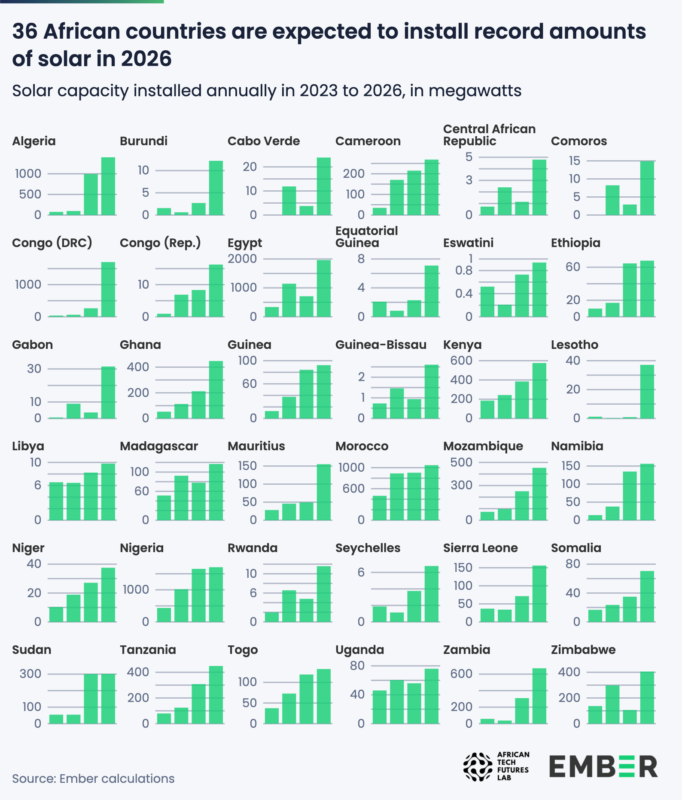
The analysis reveals Africa’s solar expansion is spreading across the continent, with 36 of 54 countries expected to install record levels of PV this year.
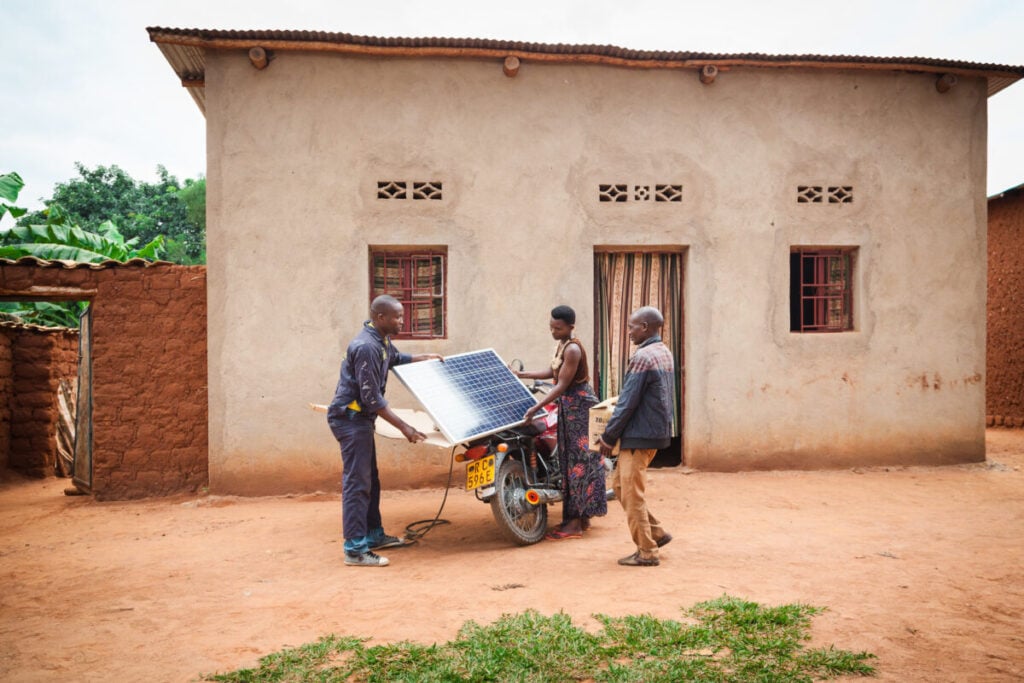
But the report highlights the extent to which much of Africa’s solar boom is hidden from view, with three-quarters of the continent’s deployment between 2023 and 2025 in distributed solar, which is often not counted in official statistics.
Ember and African Tech Futures Lab’s analysis uses a methodology that traces Chinese customs export data to specific countries. It then applies a calibrated installation rate based on deployment patterns across the EU and five other markets, where around 73% of exported panels are typically installed within six months. Chinese export data is already available up to June 2026, meaning the methodology can be used to estimate Africa’s full-year installations.
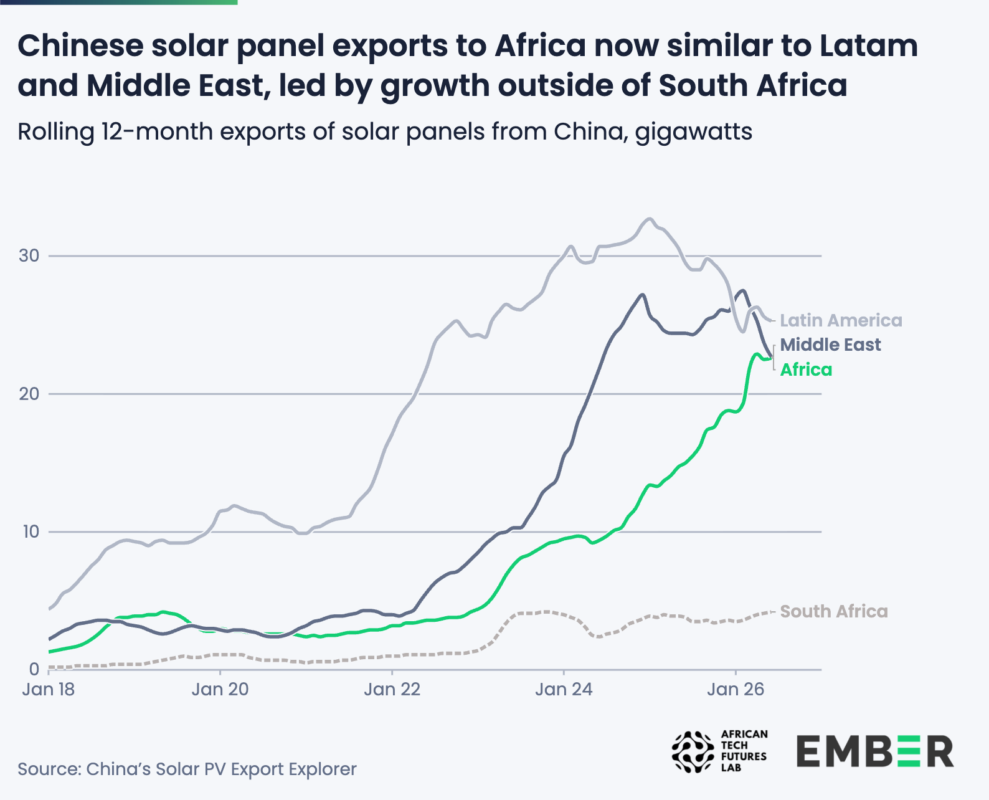
According to the figures, 19 countries have seen year-on-year growth of over 100%, including 544% in the Democratic Republic of the Congo (DRC), 282% in Zimbabwe and 176% in Egypt. South Africa, the continent’s perennial top performer and once responsible for half its solar imports, will account for less than a fifth of installations in 2026 as growth spreads to new markets, the analysis reveals.
Dave Jones, chief analyst at Ember, said: “It’s incredible seeing so many businesses and individuals, across so many African countries, choosing to install solar. Solar panels have become so cheap, the economics are compelling. But so much of this growth is hidden from view—national governments need to get better at gathering solar data. Countries are already leapfrogging into faster, more secure, cleaner energy growth, and the governments that get ahead of it stand to gain all the benefits.”
The researchers said the new solar installed in Africa this year is expected to generate around 23TWh a year, enough to meet Africa’s average annual electricity demand growth over the past decade. In more than half of Africa’s 54 countries, the rise in solar generation is expected to exceed the historic pace of demand growth.
The new solar installed this year will also add more than 10% to the annual electricity generation of ten countries, home to a combined 190 million people: Sierra Leone (97%), Togo (24%), Somalia (21%), Djibouti (21%), DRC (14%), Comoros (14%), Namibia (12%), Liberia (12%), Chad (11%) and Lesotho (10%).
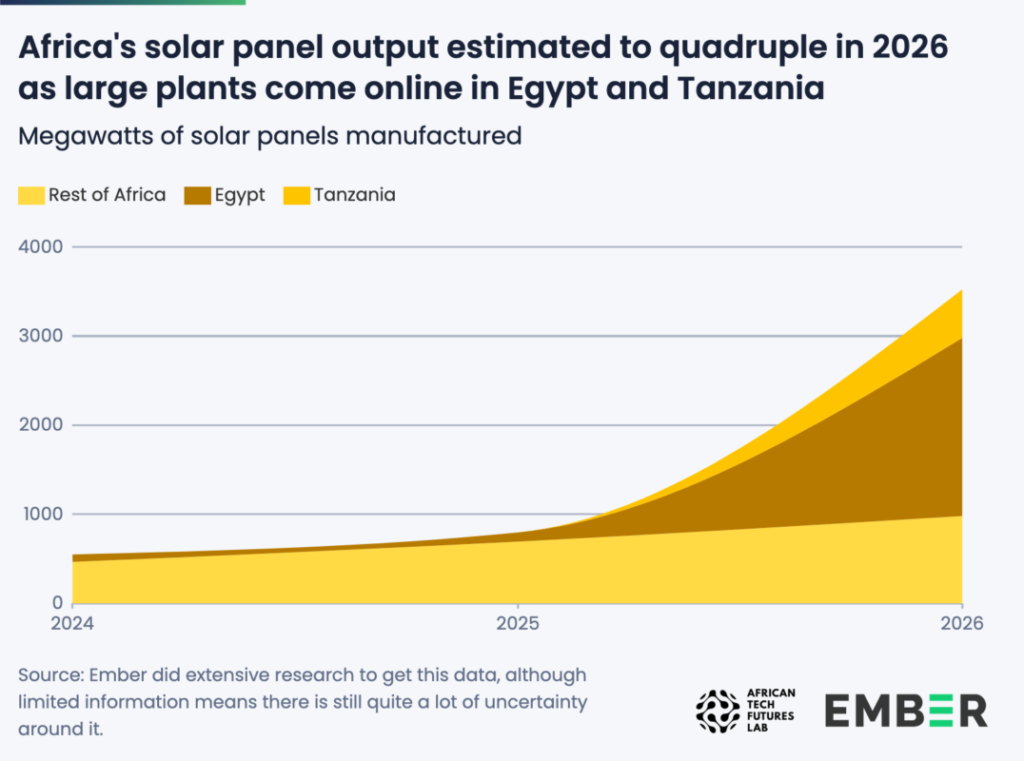
And the good-news story is not restricted to solar deployment: according to the research, Africa’s PV manufacturing capacity is also set to quadruple in 2026, reaching around 3.5GW as new plants come online in Egypt and Tanzania. However, most of this output is destined for export to the US, and 94% of the panels installed across Africa are still imported from China. Manufacturing data is also limited, with little documentation either by governments or publicly elsewhere.
Joel Nana, research director at African Tech Futures Lab and project manager at Sustainable Energy Africa, said: “Across Africa, distributed energy resources are rapidly expanding, and in many cases, overtaking grid capacity. This transition is chaotic and disruptive, and far from the orderly model planned in national strategies. Policymakers need to start responding to this shift.”