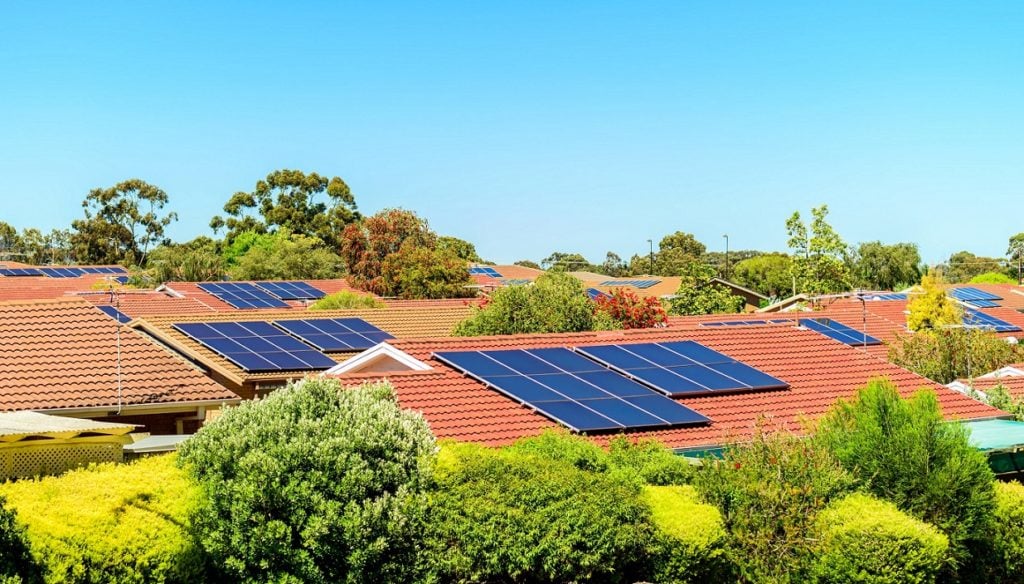
The installed capacity of rooftop solar has surpassed 20GW in Australia as of 2023, becoming the second largest source of renewable electricity generation in the country, according to Clean Energy Council.
The Rooftop solar and storage report shows that Australia added a total of 2.9GW of rooftop solar last year, up from 2.8GW in 2022. However, the addition was still behind the record set in 2021, as 3.2GW of rooftop solar was added in that year. Last year was also the first year in which the sector contributed over 10% of Australia’s total electricity generation, reaching an 11.2% share.
Try Premium for just $1
- Full premium access for the first month at only $1
- Converts to an annual rate after 30 days unless cancelled
- Cancel anytime during the trial period
Premium Benefits
- Expert industry analysis and interviews
- Digital access to PV Tech Power journal
- Exclusive event discounts
Or get the full Premium subscription right away
Or continue reading this article for free
Although the installed capacity increased year-on-year, fewer rooftop solar units were installed in 2023 than in 2022, down from 315,753 to 314,507. Clean Energy Council said this could be attributed to the growth in the average system size in 2023, reaching a new annual record of 9.4kW.
The average system size increased significantly in previous years, up from 4.2kW a decade ago and 7.1kW five years ago.
Geographically, New South Wales (NSW) broke the record for the highest annual installed capacity of any state, reaching 970MW in 2023. NSW was followed by Queensland and Victoria, with their annual installed capacities of 751MW and 571MW, respectively. Moreover, Queensland was the first state to install more than one million rooftop solar systems.
Con Hristodoulidis, Clean Energy Council’s policy director of distributed energy, said: “Rooftop solar is experiencing rapid growth in Australia’s clean energy mix, with an estimated one in three households and businesses.”
Hristodoulidis added that the abundance of sunshine and the inherent benefits of installing rooftop solar, including lower energy bills and feed-in tariffs, contributed to the growth of rooftop solar in Australia.
Clean Energy Council published another report in March this year, saying that continued growth in rooftop solar and “record-breaking” investment into utility-scale energy storage led renewable energy to fulfil almost 40% of Australia’s electricity supply in 2023.
The Clean Energy Australia 2024 report shows that renewables accounted for 39.4% of the country’s electricity supply last year, representing a 9.7% increase. This rise was facilitated by 5.9GW of new clean energy capacity which came online, spearheaded by rooftop solar.
Meanwhile, Australia’s Prime Minister Anthony Albanese announced an Inflation Reduction Act-style investment package this month to stimulate a domestic clean energy manufacturing industry. The act will likely feature in the Australian government’s May budget and will see the federal authority “act and invest at scale” to support energy transition infrastructure, manufacturing and technologies.