The Australian federal government has announced AU$24.7 million (US$16.56 million) in funding over three years to establish a National Solar Panel Recycling Pilot programme.
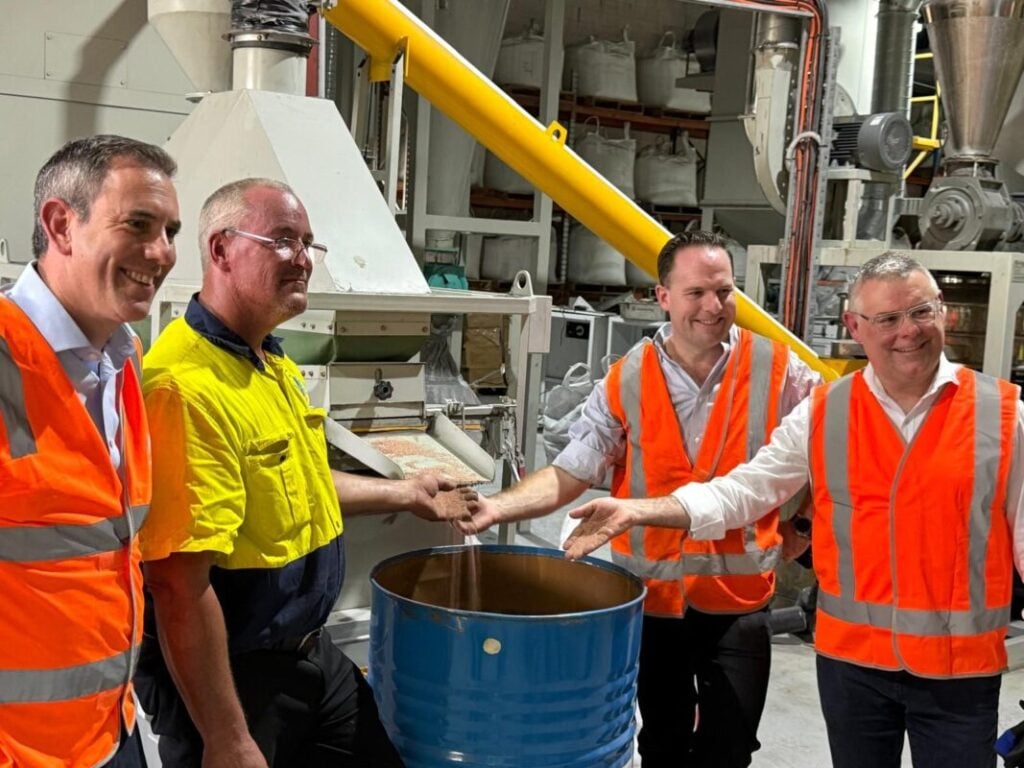
The programme, announced jointly by treasurer Jim Chalmers, climate change and energy minister Chris Bowen, and the environment and water minister, Murray Watt, will establish up to 100 pilot collection sites nationwide to address the growing challenge of end-of-life solar PV module management in Australia.
Try Premium for just $1
- Full premium access for the first month at only $1
- Converts to an annual rate after 30 days unless cancelled
- Cancel anytime during the trial period
Premium Benefits
- Expert industry analysis and interviews
- Digital access to PV Tech Power journal
- Exclusive event discounts
Or get the full Premium subscription right away
Or continue reading this article for free
According to the government announcement, only 17% of solar modules are currently recycled in Australia, despite the potential to unlock up to AU$7.3 billion in benefits through reduced waste and material reuse.
The pilot programme aims to develop a sustainable national solution to manage the growing volume of retired solar modules as Australia’s solar fleet ages.
Plans to establish a national solar PV module reuse and recycling scheme first emerged in August last year, when the federal, state and territory governments affirmed their intention to build a nationally mandated scheme.
The announcement represents a direct response to sustained industry advocacy, particularly a joint statement from over 60 organisations calling for mandatory product stewardship for solar PV modules.
Nigel Morris, chief strategy officer at the Smart Energy Council and an interviewee of our PV Talks series (Premium access), described the funding decision as “huge and exciting news” on LinkedIn and highlighted the role of collective advocacy in securing government recognition of the urgent need for circular solutions.
“This landmark decision is a direct response to our collective advocacy and the unprecedented collaboration across industry and civil society,” Morris stated.
He emphasised that the outcome reflects daily advocacy work on behalf of Smart Energy Council members, including installers, recyclers, manufacturers and the broader renewable energy supply chain.
The federal initiative builds on existing state-level programmes, particularly in Queensland, which has emerged as a leader in solar recycling policy development.
The timing of the federal announcement aligns with growing recognition of PV module recycling’s central role in Australia’s clean energy transition plans.
Solar modules contain valuable materials, including copper, silver, and aluminium, that can be recovered and reused to support continued renewable energy deployment while reducing dependence on virgin material extraction.
Minister Bowen emphasised the programme’s dual benefits, stating that recycling initiatives will ensure solar modules become “renewable energy themselves” while creating local employment opportunities and supporting domestic manufacturing capabilities.
The three-year pilot timeline allows for data collection and programme refinement before potential expansion to a permanent national scheme. The programme will work with state and territory governments to improve sustainable solutions and consider findings from the Productivity Commission inquiry into Australia’s circular economy opportunities.
Morris noted that a national approach to solar module stewardship will provide long-term business certainty, protect responsible operators, and deliver environmental and economic benefits across the smart energy industry.
Indeed, the announcement represents what he characterised as “a big win for our smart energy industry” following sustained advocacy efforts.
Solar module recycling in Australia
Given Australia’s strong solar credentials and anticipated growth over the coming years and decades, it is crucial to establish module-recycling facilities across the country.
This will help maintain a circular economy and safeguard against rare material shortages, such as copper and silver.
Australian module manufacturer Tindo Solar’s CEO, Richard Petterson, exclusively told PV Tech Premium that if Australia installed around 1TW of solar modules over 25 years to keep the assets running, the nation would need to recycle around 40GW of modules each year.
Should the country be less ambitious and install 500GW, Petterson added that 20GW of modules will still need recycling each year.