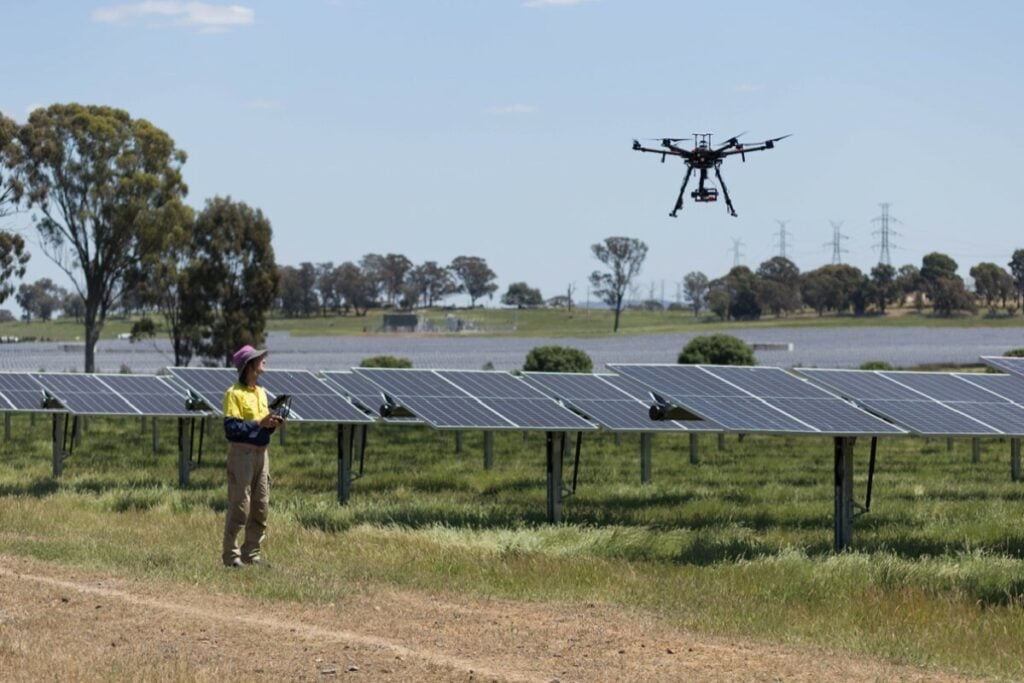
Australian start-up Lab360 Solar has been awarded AU$3.96 million (US$2.64 million) of public funding to commercialise a new drone-based solar inspection that it says could transform the monitoring of PV power plants.
The funding from the Australian Renewable Energy Agency (ARENA) will enable the University of New South Wales spin-out company to advance its daylight photoluminescence (DPL) technology, which can be used to carry out field inspections of PV systems in daylight hours.
Try Premium for just $1
- Full premium access for the first month at only $1
- Converts to an annual rate after 30 days unless cancelled
- Cancel anytime during the trial period
Premium Benefits
- Expert industry analysis and interviews
- Digital access to PV Tech Power journal
- Exclusive event discounts
Or get the full Premium subscription right away
Or continue reading this article for free
It is claimed the technology can identify faults that other inspection methods miss, right down to the individual cell level, and is more accurate, cheaper and easier to use than traditional approaches, which are more labour- and equipment-intensive
Lab 360 Solar said the DPL approach differed from other monitoring methods by using the sun itself as the excitation source for inspections.
“High-quality DPL image acquisition is enabled by switching the operating point of modules optically. The single module optical switching technique enables DPL image acquisition on individual modules. The string switching technique can be used in utility-scale solar farms, enabling DPL image acquisition of entire strings or of individual modules,” the company said.
CEO of Lab360 Solar, Thorsten Trupke, added: “Our drone-based Daylight Photoluminescence technology is a result of more than two decades of systematic research and development into luminescence imaging at UNSW. Once rolled out commercially, first in Australia and then globally, it will be central to ensuring that photovoltaic panels are a reliable and sustainable cornerstone of the future energy mix, by enabling better monitoring, early fault detection and long-term performance of solar assets.”
ARENA CEO Darren Miller said the technology had the potential to significantly reduce the cost and complexity of solar farm diagnostics. “By spotting issues early and reducing the need for heavy equipment and associated labour, this innovation helps operators get the most out of their solar panels and supports Australia’s clean energy future,” he said.