The US House of Representatives has passed Joe Biden’s Build Back Better act, which now moves to the Senate, where negotiations will continue over the legislation that includes clean energy and climate investments totalling US$555 billion.
Friday’s vote largely fell along party lines, 220 to 213, with only one Democrat voting against. The US$1.75 billion spending bill will face significant hurdles in the Senate, where it will require unanimous support from all 50 Democrats.
Try Premium for just $1
- Full premium access for the first month at only $1
- Converts to an annual rate after 30 days unless cancelled
- Cancel anytime during the trial period
Premium Benefits
- Expert industry analysis and interviews
- Digital access to PV Tech Power journal
- Exclusive event discounts
Or get the full Premium subscription right away
Or continue reading this article for free
Among the renewables support included in the act – details of which were revealed last month – are a ten-year extension of the solar investment tax credit as well as tax credits to support the domestic manufacture of PV equipment.
Biden said the passing of the bill represents “another giant step forward in carrying out my economic plan to create jobs, reduce costs, make our country more competitive, and give working people and the middle class a fighting chance”.
The positive result for the president came after he signed the US$1 trillion infrastructure deal into law earlier in the week. Including investments that will modernise power infrastructure to support new renewables, that bill was passed by the House earlier this month.
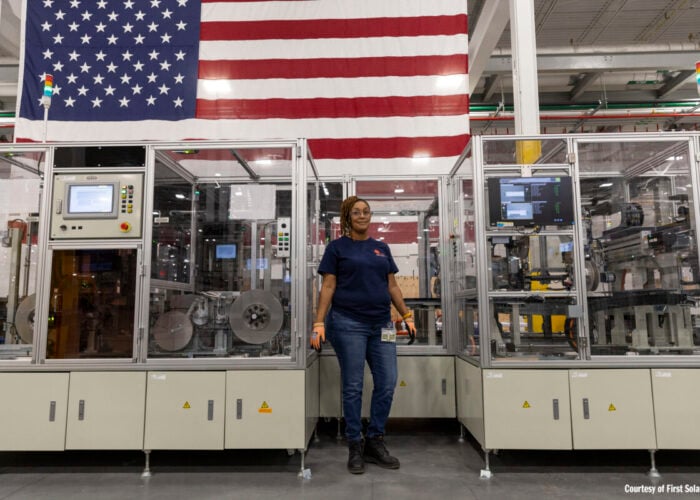
It was also revealed that the House passed legislation on Friday that would provide credits for US manufacturers at each stage of the PV manufacturing supply chain, from polysilicon production to solar cells and fully assembled modules.
That legislation, dubbed the Solar Energy Manufacturing for America (SEMA) Act, was introduced by Georgia Senator Jon Ossoff earlier this year and was warmly welcomed by US-based manufacturers such as First Solar and Q CELLS America when it was unveiled.
A statement from Ossoff on Friday said the legislation “will supercharge domestic solar manufacturing” and help the US reach a goal of having solar account for 40% of US energy by 2035. “Demand for solar energy is skyrocketing, and we need to be building and manufacturing this technology here in the United States, reduce our reliance on imports from China, and meet the moment,” Ossoff said.
At US$320 billion, the majority of clean energy and climate support in the Build Back Better bill is for expanded tax credits for utility-scale and residential clean energy, transmission and storage, and clean energy manufacturing. Some US$110 billion would also be allocated for targeted incentives to spur new domestic supply chains and technologies, such as solar and batteries.
House approval of the act is a “critical milestone” in America’s efforts to take on the climate challenge, said Gregory Wetstone, CEO of the American Council on Renewable Energy. “The legislation finally moves the country beyond years of on-again, off-again renewable tax credits and establishes a stable, predictable and long-term clean energy tax platform that will spur critically important investment in renewable power, energy storage and advanced grid technologies,” he said.
Groups such as the Solar Energy Industries Association are now urging the Senate to complete its negotiations and send the bill to Biden for his signature. The trade body’s CEO, Abigail Ross Hopper, said: “Decarbonising the electric grid will add close to one million Americans to the solar workforce by 2035, and after months of negotiation, we are on the verge of approving policy that will take a meaningful step toward tackling the climate crisis.”