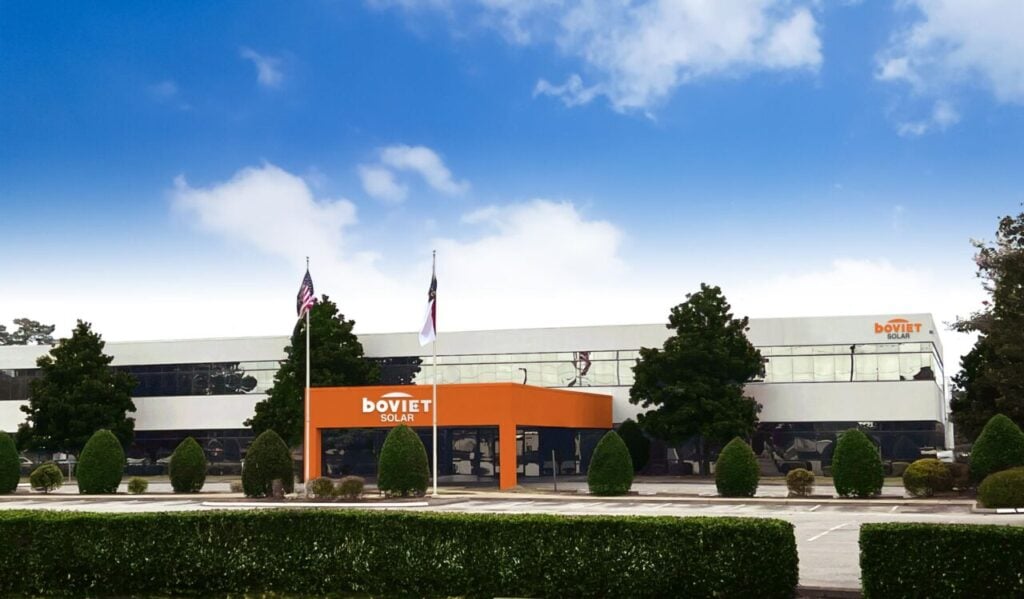
Vietnamese solar manufacturer Boviet Solar has said it will continue its commitment to US solar PV manufacturing despite plans by its parent company to divest its ownership.
Ningbo Boway Alloy Material Co., a Chinese technology and manufacturing firm, has said it is “evaluating strategic alternatives” to its ownership of Boviet Solar, having bought the company in 2016.
Try Premium for just $1
- Full premium access for the first month at only $1
- Converts to an annual rate after 30 days unless cancelled
- Cancel anytime during the trial period
Premium Benefits
- Expert industry analysis and interviews
- Digital access to PV Tech Power journal
- Exclusive event discounts
Or get the full Premium subscription right away
Or continue reading this article for free
Despite this uncertainty, Boviet Solar has said it will continue plans for US solar manufacturing. The company issued the following statement: “Our US manufacturing activities reflect a deliberate, long-term commitment to the American solar market. We are investing in real capacity, real jobs and real infrastructure because we believe in the future of US solar manufacturing and in supporting our customers with dependable, domestic supply.”
The company said that the shareholder situation does not change its day-to-day operations and that it remains “fully operational”. It did not mention any potential new buyers.
FEOC restrictions start to bite
The divestment is related to “ongoing trade and policy challenges” for US solar products and the “changes to US subsidy eligibility, which have influenced parent-level capital allocation considerations,” Boviet Solar said in a statement.
The US introduced new “Foreign Entity of Concern” (FEOC) restrictions in last summer’s “Big, Beautiful” budget reconciliation bill. While the industry is still waiting for guidance on these, the bill already limits the ownership of US solar and energy storage companies by Chinese companies.
Companies that infringe on FEOC restrictions are not eligible for tax credits for manufacturing or deployment that were introduced under the Inflation Reduction Act (IRA). Modules produced at Boviet Solar’s 3GW module assembly factory in North Carolina would not be eligible for 45X advanced manufacturing tax credits while the company is owned by Ningbo Boway Alloy.
As well as FEOC, US companies are faced with challenges over supply and procurement, with specific tariffs on solar cell and module imports from Southeast Asian countries and looming restrictions on imports of polysilicon products under the ongoing Section 232 investigation.
Ownership models in the US solar manufacturing industry have shifted as a result of these trade and policy changes. Back in 2024, ahead of Donald Trump’s inauguration, the first mover was Chinese sector giant Trina Solar, which sold its PV module production facility to T1 Energy (then Freyr Battery). More recently, fellow Chinese manufacturer JA Solar sold its US module facility to US chemical giant Corning.
In late 2025, Canadian Solar announced plans to restructure the ownership of its North American solar and storage manufacturing operations. The company is listed on the NASDAQ stock exchange and headquartered in Ontario, Canada but has a large operational presence in China, with its manufacturing subsidiary CSI Solar listed on the Shanghai stock exchange.
The company established a new joint venture between CSI Solar and Canadian Solar to take ownership of its US manufacturing operations. The news followed the replacement of founder and long-time president Shawn Qu with Colin Parkin.
After five editions of Large Scale Solar USA, the event becomes SolarPLUS USA to mirror where the market is heading. The 2026 edition, held in Dallas, Texas, on 24-25 March, will bring together developers, investors and utilities to discuss managing hybrid assets, multi-state pipelines, power demand increase from data centres and AI as well as the co-location of solar PV with energy storage in a complex grid. For more details and how to attend the event, visit the website here.