More businesses expected their respective country to fully transition to renewables later than 2050 than did policymakers, while the majority of them believed that the war in Ukraine would delay the journey to net zero by at least two years, according to BayWa r.e.’s The Decade That Matters 2.0 study.
Globally, 32% of business leaders estimated that their country will fully transition to renewables after 2050, while 8% said it would never happen. In contrast, only 11% of policymakers trusted that their country would fully transition to renewables after 2050. A mere 1% did not believe this vision would ever come true.
Try Premium for just $1
- Full premium access for the first month at only $1
- Converts to an annual rate after 30 days unless cancelled
- Cancel anytime during the trial period
Premium Benefits
- Expert industry analysis and interviews
- Digital access to PV Tech Power journal
- Exclusive event discounts
Or get the full Premium subscription right away
Or continue reading this article for free
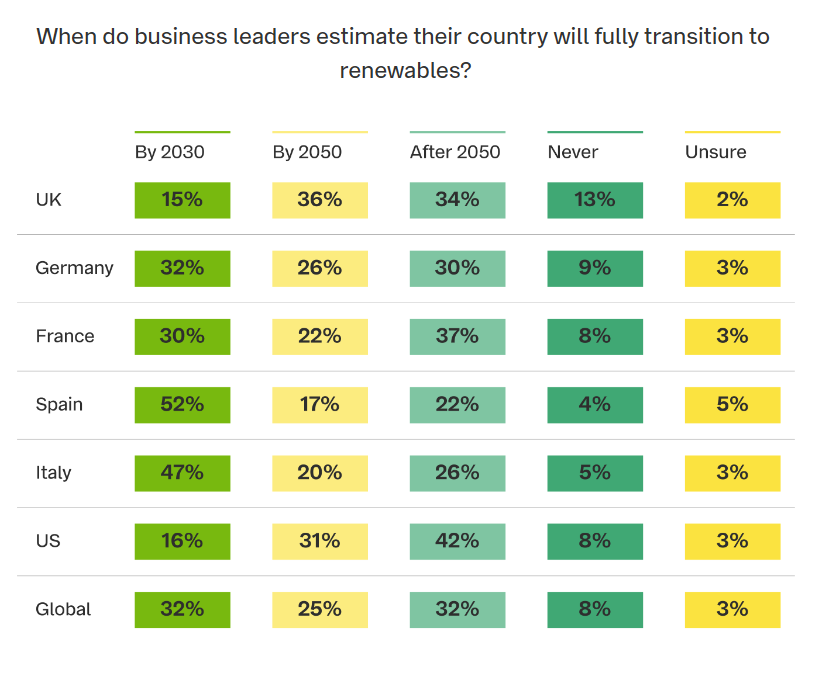
Policymakers worldwide were more optimistic about reaching the goal of full transition to renewables in their respective countries; 25% of them said it would be achieved by 2030, while 58% said the goal would be reached by 2050. On the other hand, only 32% of business leaders believed that their country would fully transition to renewables by 2030, and 25% said this would take place by 2050.
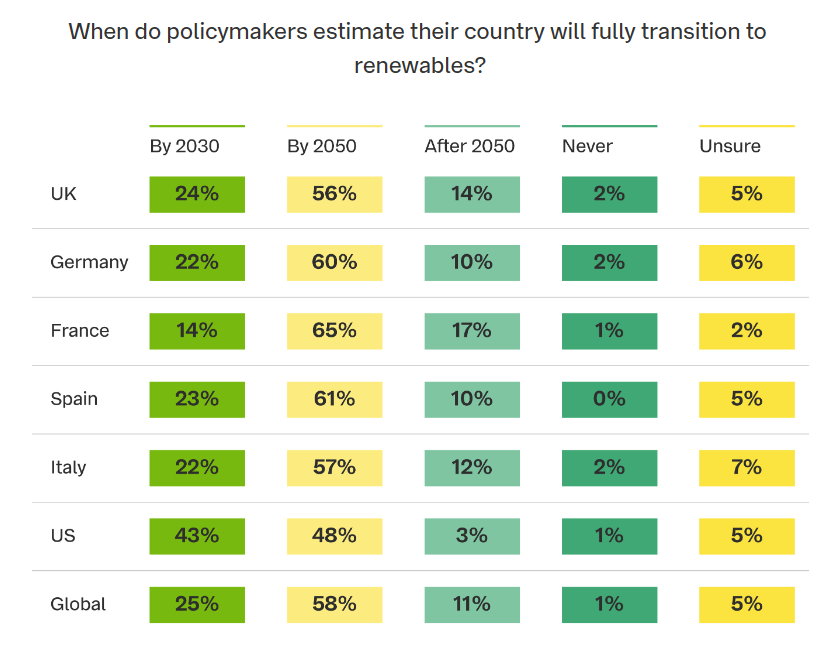
A notable national discrepancy between policymakers and business leaders was evident in the US. Only 16% of US executives believed the transition would be achieved before 2030, compared to 43% of US policymakers. Such difference was the result of the passing of the Inflation Reduction Act (IRA) in the summer of 2022, according to BayWa r.e.
EU businesses as a whole were more optimistic about the 2030 deadline, at 40% versus the 32% survey average. Spanish and Italian business leaders were the most confident, at 52% and 47% respectively. However, UK business leaders were the most pessimistic, with 13% saying the complete transition to renewables will never be achieved.
The study also examined the biggest barriers to speeding up the net zero goal. For example, 35% of policymakers said the public and businesses did not fully appreciate the impacts that climate change would have on them, or the speed at which the public and businesses could change or adapt. Moreover, 34% said the technical challenge of transitioning to net zero was the biggest barrier.
However, business leaders had different views, as 42% said the cost of transitioning was the biggest barrier, followed by inadequate support from the government (34%) and a lack of control over supply chain emissions (32%).
The Russo-Ukrainian war resulted in an energy crisis in Europe as countries struggled to rapidly reduce their reliance on Russian fossil fuels and prices skyrocketed due to the supply reduction from Russia at the same time.
As a result, 47% of business leaders said the war would delay their respective countries’ journey to net zero by two to three years, while 22% believed that it would delay by four years or more. Policymakers were slightly more optimistic, as 42% said it would delay by two to three years. A total of 21% said it would delay by four years or more.
But businesses have been finding ways to survive amid the energy crisis. 96% of business leaders had started sourcing or were planning to source renewable energy after the energy crisis emerged, with 44% of respondents saying that they used only renewable energy already (17%) or in part (27%). A further 23% said they had planned to source all their energy from renewables, and 29% had planned a partial transition.
As the majority of businesses had plans to use renewable energy, it was not surprising that 53% of them said the rising energy prices had affected their sustainability strategies positively.
Lastly, the report also examined the obstacles faced by the European renewables industry in transitioning and phasing out reliance on Russian fossil fuels, although businesses and policymakers had different views.
European businesses said a fragmented response in policy from different EU countries (41%) was the main obstacle, followed by a lack of agreement from EU nations on gas price cap in case of an emergency (37%), and supply chain and trade policy constraints (36%).
However, 32% of European policymakers said supply chain and trade policy constraints were the major obstacles, while 31% said community acceptance challenges resulting from increased clean energy deployment was the main barrier, followed by resource constraints at a national and local level preventing institutions from keeping up with projects’ deployment needs (29%).